Axolotl
Historical document, translated for reference. It reflects medical knowledge of the 1920s–30s and is not medical advice.
Summary
The axolotl is a larval form of the American tailed amphibian Amblystoma tigrinum, capable of reproduction in its larval state (neoteny). It can be transformed into the adult form through thyroid hormone exposure or gradual water deprivation.
Encyclopedia article (1928–1936)
AXOLOTL, larval form of the American tailed amphibian (Amblystoma tigrinum). Having characteristic larval features (gills, tail fin, typical larval structure), the axolotl is capable of reproduction (neoteny, see). In 1883, Marie Chauvain achieved transformation of the axolotl into the adult form, amblystoma, by gradual deprivation of water. Later it was established that feeding the axolotl with mammalian thyroid gland substances leads to rapid transformation of the axolotl into amblystoma. The thyroid glands of the axolotl itself are significantly less developed than those of amblystoma. The neotenic state of the axolotl is connected with insufficient function of its thyroid glands. Experiments with removal of thyroid glands in tadpoles led to cessation of development and permanent larval state. There are two races of axolotl—"black" and "white," differing in the content of pigment cells in their skin. The characteristics of the "black" race dominate in crossing over the characteristics of the "white" race. The difference between one race and another apparently depends on one gene, similar to the color-enhancing genes studied, for example, in rodents. The viability of the "white" race compared to the "black" race is significantly reduced; this is especially noticeable in the early stages of post-embryonic development. In general, the axolotl lives well in captivity, reproduces quickly and abundantly. A good pair can produce offspring of several thousand. The young are first fed with small crustaceans (cyclops, daphnia), and then with mosquito larvae (larvae of Chironomus plumosus); adult axolotls readily eat meat. Due to high resistance to infection, the axolotl is an indispensable object of experimental research. It is sufficient to say that removal of the pituitary gland, representing such a complex and dangerous operation in mammals, can be performed on the axolotl within two minutes without bleeding and postoperative complications. The axolotl has served as an excellent object for a series of works related to problems of developmental mechanics. The sensitivity of the axolotl to the thyroid hormone and a number of characteristic changes that the axolotl undergoes under the influence of this hormone make it an excellent biological indicator for the presence of the active principle of the thyroid gland. If a large dose of dried mammalian thyroid gland is injected into a chicken and then its various tissues (blood, muscles, liver, brain, endocrine glands) are tested for thyroid hormone content by implanting pieces of them into the axolotl, one can be convinced that the thyroid hormone is fixed in various tissues differently. The ability of the axolotl to undergo transformation only in the presence of external thyroid hormone exposure allows one to solve with the help of this object a number of significant general questions. One of them can be considered the question of the reversibility of metamorphosis processes. In case of short-term exposure of the axolotl to thyroid hormone, the first signs of metamorphosis occur. Cessation of exposure leads to reverse development processes. The beginning to resorb gills and fin return to their former size. The axolotl also served as convenient material for studying the effects of internal secretions on the pigment system. The melanin-containing pigment cells of the axolotl's skin are normally in a state of expansion, causing the dark coloration of the animal. Complete removal of the pituitary gland in the axolotl first leads to intensive contraction (contraction) of melanophores, and then to partial excretion of pigment granules from the body. The pigment system of the axolotl's skin also reacts to pituitary hormone in vitro. However, experiments with isolated pieces of skin and experiments with introduction into the abdominal cavity of hypophysectomized axolotls of various substances (extracts from different organs, various organic and inorganic substances) indicate the non-specificity of the irritant in the skin pigment function of the axolotl. In addition to the topics mentioned above, the axolotl has served as a successful object for studying various problems of embryogenesis both with the help of elementary methods of morphology and with the help of the experimental method (transplantation of parts of the embryo, etc.).
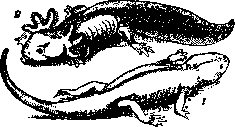
1-amblystoma; 2-axolotl.
In addition to the topics mentioned above, the axolotl has served as a successful object for studying various problems of embryogenesis both with the help of elementary methods of morphology and with the help of the experimental method (transplantation of parts of the embryo, etc.).
Related articles
Mentioned in
Cite this page
“Axolotl.” Soviet Medical Encyclopedia. English translation of Bolshaya Meditsinskaya Entsiklopediya, 1st ed. (Moscow, 1928–1936), ed. N. A. Semashko. https://sovietmedicalencyclopedia.pages.dev/article/axolotl/