Axon
Historical document, translated for reference. It reflects medical knowledge of the 1920s–30s and is not medical advice.
Summary
This 1930s encyclopedia article defines the axon as the process of a nerve cell that gives rise to a nerve fiber, also known as a neurite or axial-cylinder process. It describes the anatomical origin of the axon from the nerve cell body or dendrite and notes the characteristic absence of Nissl granulation at its point of origin.
Encyclopedia entry (1928–1936)
AXON (from Greek axon - axis), the process of a nerve cell giving rise to a nerve fiber (syn.: neurite, axial-cylinder process). The axon departs from the body of the nerve cell
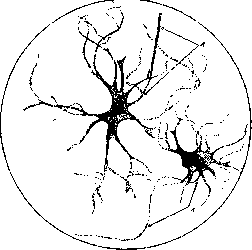
Nerve cells, A-axons (after N. F. Ognev).
or from a thick protoplasmic process (dendrite) in the form of a cone, which first narrows, forming the neck of the axon, and then, expanding, passes into a cylindrical fiber that acquires certain sheaths (see Nerves). The site of origin of the axon in the nerve cell is marked by the absence of Nissl granulation.
Related articles
Mentioned in
- Abducens Nerve
- Ambiguous Nucleus
- Aplasia Axialis Extracorticalis Congenita
- Axonometer
- Axostyle
- Baillarger's Striae
- Darkshevich's Nucleus
- Glosso-Pharyngeal Nerve
- Golgi
- Goll's Tract
- Hanko and Nerve Ganglia
- Hemiplegia
- Hypoglossus Nerve
- Motor Nerves
- NERVE FIBERS
- Nerve Plexuses
- Neurotization
- Oculomotorius Nervus
- Organotropy
- Santiago Ramón y Cajal
Cite this page
“Axon.” Soviet Medical Encyclopedia. English translation of Bolshaya Meditsinskaya Entsiklopediya, 1st ed. (Moscow, 1928–1936), ed. N. A. Semashko. https://sovietmedicalencyclopedia.pages.dev/article/axon/