Hypoglossus Nerve
Historical document, translated for reference. It reflects medical knowledge of the 1920s–30s and is not medical advice.
Summary
The hypoglossus nerve, the twelfth cranial nerve, originates in the medulla oblongata and innervates the muscles of the tongue. It can be affected by various pathological conditions leading to paralysis, atrophy, or spasms of the tongue.
Encyclopedia article (1928–1936)
HYPOGLOSSUS NERVE (подъязычный нерв), belongs to the XII pair of cranial nerves. It originates in a nucleus located in the medulla oblongata; the nucleus begins in the lower parts of the medulla oblongata, at the level of decussationis lemniscorum (crossing of sensory fibers), where it lies in the anterior parts of the gray matter surrounding the central canal. In the upper parts of the medulla oblongata, when the central canal opens into the fourth ventricle, the nucleus is located along the midline at the bottom of the fourth ventricle, forming an elevation - trigonum hypoglossi (see Figure 1); the nucleus disappears below the upper border of the medulla oblongata. The cells of the nucleus are very large; around them ends a large number of fibers, a significant part of which belong to fibrae propriae nucl. hypoglossi, i.e., fibers connecting different parts of the nucleus not only of its own but also of the opposite side; in addition to them, in the nucleus of the XII nerve end after crossing the descending cortical pathways - fibr. cortico-nucleares, fibers connecting the nucleus of the XII nerve with other
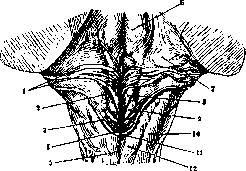
Figure 1. Rhomboid fossa: 1-striae medullares; 2-fovea inferior; 3-taenia ventriculi quarti; 4-calamus scriptorius; 5-fissura mediana posterior; 6-colliculus facialis; 7-area acustica; 8-trigonum n. hypoglossi; 9-alae cinereae; 10-tuber culum cuneatum; 11-obex; 12-claustra.
nuclei of the medulla oblongata (nuclei of the vagus, glossopharyngeus, facialis), and terminal fibers of some sensory nerves (nerves V, IX, X). The nucleus of the hypoglossus nerve, according to some authors, is divided into 3 parts - anterior, posterior-internal, and posterior-external; each of them innervates the corresponding group of muscles. The axon cylinders, forming root fibers, gather into bundles, pierce the medulla oblongata and exit from its anterior surface in the fissura lateralis anterior, between the olive inferior and the pyramidal tract. The XII nerve leaves the cranial cavity through foramen condyloideum anter., or canalis hypoglossi, surrounded by a venous ring - rete canalis hypoglossi. When exiting the skull, it is located behind and medial to the vagus nerve, carotid artery, internal jugular vein, then, bending in the form of an arc (arcus s. ansa hypoglossi), it goes forward and ends in the muscles of the tongue (mm. genioglossus, hypoglossus, styloglossus, transversus linguae, lingualis dorsalis) (see Figure 2). On its way it anastomoses with ganglion cervicale superius, gangl. nodosum, rami linguales nn. vagi et trigemini, ansa cervicalis prima et secunda; gives branches: ramus meningeus, thyreoideus, geniohyoideus. The nucleus of the hypoglossus nerve through fibrae cortico-nucleares is connected with the cortex of the lower third of the anterior central gyrus of the opposite hemisphere (see Motor centers, Brain). The XII nerve is exclusively a motor nerve, innervating the muscles of the tongue. The tongue can move in all directions. Although all muscles of the tongue participate in all movements, it can still be noted that when protruding forward, the m. genioglossus works predominantly; backward movements are achieved by m. styloglossus; in other movements, especially with the tip of the tongue, m. lingualis and transversus linguae participate; in normal condition, muscles cannot contract in isolation; this great synergy that the muscles of the tongue exhibit is explained by the richness of connections between the cells of the nucleus of the XII nerve not only of its own but also of the opposite side. Pathology of the XII nerve. Disease of the XII nerve or its nucleus can cause paralysis, atrophy and spasms of the tongue. One third of all cases of tongue paralysis depend on disease of the peripheral part of the XII nerve (according to Ascoli); isolated neuritis of the XII nerve is very rare, usually other cranial nerves are also affected. The etiological factors of the disease can be: 1) various processes in the posterior cranial fossa - new formations, meningitis, hemorrhages, carious processes in the bones of the skull; 2) various pathological processes in the neck area; 3) various infections and intoxications (influenza, tbc, rheumatism, angina, pharyngitis, chronic alcoholism). Mostly the processes are unilateral, but they can also be bilateral. Clinically, the disease of the XII nerve manifests as paralysis of the tongue - glossoplegia or - in unilateral lesion - hemiglossoplegia; the paralyzed side is always atrophied, the atrophy is of a degenerative nature, in the atrophied muscles fibrillar contractions are observed. In the oral cavity, the tongue is displaced to the midline to the healthy side; all movements on the affected side are difficult: for example, it is impossible to touch with the tip of the tongue the teeth or cheek, when protruding the tongue deviates to the affected side with the tip of the tongue bent to the healthy side, the raphe of the tongue forms an arc, concave to the affected side (see Figure 3); when retracting the tongue back into the oral cavity, it again deviates to the healthy side. On speech, the act of chewing, swallowing, unilateral paralysis and atrophy of the tongue have little effect or are not reflected at all. - In addition to disease of the peripheral part of the XII nerve, unilateral paralysis can also be observed with damage to the central connections of the nuclei of the XII nerve with the cerebral cortex (pyramidal tract); then in addition to the tongue, paralysis of the limbs and the VII nerve of the same side are simultaneously observed (see Hemiplegia, Brain and in the article Apoplexy - cerebral apoplexy). Disease of the nuclei of the XII nerve usually gives bilateral paralysis of the tongue, in the presence of other bulbar phenomena (see Bulbar paralysis, Amyotrophic lateral sclerosis, Medulla oblongata). In addition to paralysis and atrophy, disease of the XII nerve can also cause spasms, depending
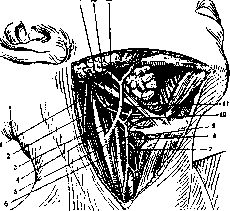
Figure 2. 1-n. accessorius; 2-v. jugul. ext.; 3-ram. descendens n. XII; 4-n. vagus; 5-a. carotis int.; 6-v. jugul. int.; 7-a. thyreoidea sup.; 8-n. laryngeus sup.; 9-a. carotis ext.; 10-a. lingualis; 11-n. hypoglossus; 12-a. maxillaris ext.; 13-a. carotis ext.; 14-a. occipitalis. (According to Tandler.)
on its irritation by various processes in the oral cavity (inflammatory processes in the mouth, caries of the teeth, neuralgia of the tongue), as well as in general diseases accompanied by spasms (hysteria, epilepsy, chorea); spasms can be tonic or clonic or mixed. Usually both halves of the tongue participate equally (glossospasmus), but in hysteria there can also be a half-spasm of the tongue (hemiglossospasmus). Spasms occur in attacks, with various periods - from several times a day to once a month and less frequently; attacks can last seconds or minutes and even hours. Speech, swallowing, and sometimes even breathing during spasms are difficult, words are uttered in separate syllables. - Treatment in all diseases of the XII nerve - symptomatic.
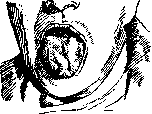
Figure 3.
on its irritation by various processes in the oral cavity (inflammatory processes in the mouth, caries of the teeth, neuralgia of the tongue), as well as in general diseases accompanied by spasms (hysteria, epilepsy, chorea); spasms can be tonic or clonic or mixed. Usually both halves of the tongue participate equally (glossospasmus), but in hysteria there can also be a half-spasm of the tongue (hemiglossospasmus). Spasms occur in attacks, with various periods - from several times a day to once a month and less frequently; attacks can last seconds or minutes and even hours. Speech, swallowing, and sometimes even breathing during spasms are difficult, words are uttered in separate syllables. - Treatment in all diseases of the XII nerve - symptomatic.
Related articles
Mentioned in
Cite this page
“Hypoglossus Nerve.” Soviet Medical Encyclopedia. English translation of Bolshaya Meditsinskaya Entsiklopediya, 1st ed. (Moscow, 1928–1936), ed. N. A. Semashko. https://sovietmedicalencyclopedia.pages.dev/article/hypoglossus-nerve/