Glosso-Pharyngeal Nerve
Historical document, translated for reference. It reflects medical knowledge of the 1920s–30s and is not medical advice.
Summary
This article from the 1st edition of the Great Medical Encyclopedia details the anatomy, function, and pathology of the glossopharyngeal nerve (IX cranial nerve), including its sensory, motor, and secretory components, as well as associated clinical conditions such as glossopharyngeal paralysis and bulbar paralysis.
Encyclopedia article (1928–1936)
GLOSSO-PHARYNGEUS NERVUS (glossopharyngeal nerve), belongs to the IX pair of cranial nerves, is mixed: it contains both sensory and motor fibers, with the former predominating. The sensory fibers of the ninth nerve originate in two ganglia: the inferior ganglion (petrous ganglion) and the superior ganglion (jugular ganglion). The peripheral processes of the cells
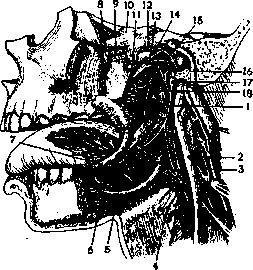
Figure 1. 1 - glossopharyngeal nerve; 2 - vagus nerve; 3 - accessory nerve; 4 - superior laryngeal nerve; 5 - hypoglossal nerve; 6 - submandibular ganglion; 7 - lingual nerve; 8 - sphenopalatine ganglion; 9 - Vidian nerve; 10 - Gasserian ganglion; 11 - otic ganglion; 12 - greater superficial petrosal nerve; 13 - lesser superficial petrosal nerve; 14 - anastomosis between them; 15 - Jacobson's nerve; 16 - facial nerve; 17 - inferior ganglion; 18 - internal carotid plexus.
of these ganglia ramify in the posterior third of the tongue, in the fauces, on the anterior surface of the epiglottis, the pharynx, the Eustachian tube, and the tympanic cavity. The axial-cylinder processes of the ganglion cells, as part of the root of the ninth nerve, penetrate the medulla oblongata through
the retroolivary fissure and there enter the solitary fasciculi (for further course, see Taste, conducting pathways). The motor nucleus is the anterior part of the nucleus ambiguus; fibers from this nucleus enter the ninth nerve, which, together with the vagus nerve, leaves the skull, exiting through the jugular foramen, then expands into the petrous ganglion; below this ganglion, the nerve runs first between the internal jugular vein and the internal carotid artery, then crosses the lateral surface of the stylopharyngeus muscle, describing an arc with its convexity downward, and reaches the root of the tongue. - The motor fibers of the ninth nerve participate in the innervation of the muscles of the pharynx, without it being possible
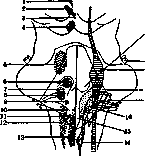
to determine its innervation area precisely, give branches to the stylopharyngeus muscle; for the esophagus, fibers from the ninth nerve are part of the tenth nerve. In addition to sensory and motor fibers, the ninth nerve also contains secretory fibers for the parotid gland; the nucleus of these fibers—the inferior salivatory nucleus—lies in the medulla oblongata near the nucleus of the ninth nerve (see Figure 2), fibers from the nucleus enter the root of the ninth nerve and reach the petrous ganglion with it, from here via the tympanic nerve and the superficial petrosal nerve they go to the otic ganglion, where they terminate, and already from this ganglion fibers go to innervate the gland. The glossopharyngeal nerve has its main functional significance as a taste nerve, innervating the posterior third of the tongue; in addition, it participates in the motor and sensory innervation of the pharynx (see Figure 1). Diseases of the glossopharyngeal nerve usually occur simultaneously with other cranial nerves, while its isolated lesion is very rare. The etiological factors of the disease can be 1) various processes in the posterior cranial fossa—neoplasms, meningitides, hemorrhages, 2) various infections and intoxications. Clinically, the lesion of the ninth nerve is manifested by taste disorders in the posterior third of the tongue, anesthesia of the upper half of the larynx, some difficulty in swallowing due to partial paralysis of the pharyngeal muscles, and extinction of reflexes from the mucous membrane of the pharynx; pharyngeal spasms have also been noted, which occur in local diseases of the pharynx, esophagus, or surrounding formations, and also develop on the basis of general diseases accompanied by spasms (hysteria, neurasthenia, chorea, etc.). Figure 2. Scheme of the arrangement of the nuclei of the cranial nerves: 1 - Edinger-Westphal nucleus; 2 - lateral oculomotor nucleus; 3 - medial oculomotor nucleus; 4 - trochlear nucleus; 5 - motor trigeminal nucleus; 6 - abducens nucleus; 7 - motor facial nucleus; 8 - superior salivatory nucleus; 9 - inferior salivatory nucleus; 10 - vagal trigone; 11 - dorsal nucleus of vagus; 12 - nucleus ambiguus; 13 - hypoglossal nucleus; 14 - commissural nucleus of Cajal; 15 - hypoglossal trigone; 16 - nucleus of solitary tract; 17 - cochlear nuclei; 18 - vestibular nuclei; 19 - sensory trigeminal nucleus; 20 - trigeminal nerve; 21 - facial colliculus. (After Herrick.)
E. Kononova.
GLOSSOPHARYNGOLABIAL PARALYSIS (bulbar paralysis), a symptom complex characterized by atrophic paralysis of the muscles of the lips, tongue, soft palate, and larynx. Speech disturbance caused by paralysis of the lips, tongue, and soft palate has a typical dysarthric character: words are pronounced indistinctly, blurred, the mouth seems stuffed with porridge, and speech has a nasal tint. This is joined by phonation disturbance—from a slight impurity of the voice to complete aphonia—and swallowing disturbance, which poses a huge danger to the patient's life and is often the cause of a fatal outcome in such cases. Glossopharyngolabial paralysis can develop acutely, in a stroke-like manner—during hemorrhage or, more frequently, during thrombosis of the basilar artery, vertebral artery, or their branches. But paralysis can also develop slowly and progressively. In this case, we are dealing mainly with a special rare variety of amyotrophic lateral sclerosis, in which the process begins precisely first of all in the nuclei of the medulla oblongata.
Related articles
Cite this page
“Glosso-Pharyngeal Nerve.” Soviet Medical Encyclopedia. English translation of Bolshaya Meditsinskaya Entsiklopediya, 1st ed. (Moscow, 1928–1936), ed. N. A. Semashko. https://sovietmedicalencyclopedia.pages.dev/article/glossopharyngeus-nervus/