Laryngeus Superior Nerve
Historical document, translated for reference. It reflects medical knowledge of the 1920s–30s and is not medical advice.
Summary
The superior laryngeal nerve is a branch of the vagus nerve that provides sensory innervation to the larynx and pharynx, motor innervation to certain laryngeal muscles, and vasomotor and secretory fibers to the laryngeal mucosa and thyroid gland.
Encyclopedia article (1928–1936)
LARYNGEUS SUPERIOR NERVUS (superior laryngeal nerve), one of the branches of the cervical part of the vagus nerve, from which it departs at the level of the nodose ganglion; then it descends and forward along the inner side of the internal carotid artery; after anastomosis with the fibers of the pharyngeal plexus, external carotid plexus and superior cervical sympathetic ganglion, the L. s. n. divides into two terminal branches - the external branch and the internal branch (see the figure).-- The external branch innervates the inferior pharyngeal constrictor muscle and the cricothyroid muscle and possibly gives off small branches
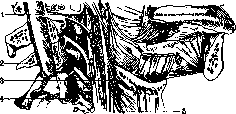
1- anterior branch of cervical nerve; 2- vagus nerve; 3- internal branch
superior laryngeal nerve; 4- cervical nerve; 5- external branch of the superior laryngeal nerve to the thyroepiglottic and aryepiglottic muscles, which are mainly innervated by the inferior laryngeal nerve; part of the fibers ends in the mucous membrane of the larynx and in the thyroid gland; often from the external branch, the superior cardiac branch departs.-- The internal branch, together with the thyroid artery, goes to the hyothyroid membrane and pierces it, then divides into epiglottic, pharyngeal, and inferior branches; the epiglottic branches innervate the mucous membrane of the epiglottis; the pharyngeal branches and inferior branches innervate the mucous membrane of the posterior wall of the larynx down to the vocal fissure; from the internal branch, an anastomotic branch to the inferior laryngeal nerve departs. From the L. s. n. and from the trunk of the vagus nerve, the depressor nerve arises.-- In function, the L. s. n. is mainly a sensory nerve of the larynx, since the greater part of its fibers ends in the mucous membrane of the larynx and epiglottis; the innervation by sensory fibers is not strictly unilateral; when the L. s. n. is cut on one side, a change in sensitivity is observed on both sides. The L. s. n. contains vasomotor and secretory fibers for the mucous membrane of the larynx and secretory fibers for the thyroid gland. Of the muscles innervated by the L. s. n., the inferior pharyngeal constrictor muscle constricts the pharynx, and the cricothyroid muscle tenses the vocal cords, thanks to which the L. s. n. has an influence on voice formation.-- Pathology. Isolated disease of the L. s. n. occurs in isolated cases during operations on the neck or with various cervical processes. It manifests as paralysis of the cricothyroid muscle (which is innervated exclusively only by this nerve), which is expressed
Related articles
Mentioned in
Cite this page
“Laryngeus Superior Nerve.” Soviet Medical Encyclopedia. English translation of Bolshaya Meditsinskaya Entsiklopediya, 1st ed. (Moscow, 1928–1936), ed. N. A. Semashko. https://sovietmedicalencyclopedia.pages.dev/article/laryngeus-superior-nerve/