Ansa
Historical document, translated for reference. It reflects medical knowledge of the 1920s–30s and is not medical advice.
Summary
Ansa, in anatomy, refers to various anatomical structures shaped like a vessel handle or loop. The article details specific ansae including the cervical ansa (ansa hypoglossi), lenticular ansa, peduncular ansa, and subclavian ansa (Vieussenii), describing their formation, connections, and functions in the nervous system.
Encyclopedia article (1928–1936)
ANSA (Latin - handle of a vessel, loop), in anatomy denotes various anatomical structures that have the form of a vessel handle or loop. As a specific term, the word "Ansa" is used in the following expressions: A. cervicis (A. hypoglossi), A. lenticularis, A. peduncularis, A. subclavia (Vieussenii).
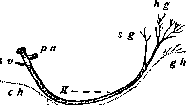
A. cervicis (A. hypoglossi) is formed as follows (see diagram): from the connecting trunk between the first and second cervical nerves, a branch (ramus communicans hypoglossi) arises, which, upon joining the hypoglossal nerve where it curves around the occipital artery shortly after emerging from the skull, immediately divides into two unequal parts; the first, smaller part continues its course with the hypoglossal nerve and gives branches to the m. thyreo-hyoideus and to the m. genio-hyoideus; the second, larger part (ramus descendens cervicis) deviates from the course of the hypoglossal nerve and descends downward, lying in the thickness or on the surface of the common carotid artery sheath; at the level of the thyroid cartilage, this branch connects with a nerve composed of cervical connecting branches (rami communicantes cervicis) of the second and third cervical nerves and forms with this nerve a loop, which is called A. cervicis or A. hypoglossi, although it does not contain fibers originating from the hypoglossal nerve. From the convexity of this loop, directed downward, the following branches arise: to the m. sterno-hyoideus, to the m. sterno-thyreoideus, and to the posterior belly of the m. omo-hyoideus. The nerve to the anterior belly of the m. omo-hyoideus arises from the ramus descendens cervicis, just before the formation of the loop. A. lenticularis (lenticular nucleus loop), one of the bundles that make up the radiation of the corpus striatum. By means of these radiations, the corpus striatum establishes connections with the intermediate and midbrain. According to Tilney, the fibers forming A. lenticularis begin in the globus pallidus and end partly in the ventrocephalic part of the thalamus, partly pass to the habenular ganglion, and partly backward to the mesocephalic portion of the capsule surrounding the red nucleus, giving collaterals to the central gray matter of the third ventricle. A. peduncularis refers to the fibers of the thalamic (thalamic) radiation that connect the thalamus with the cortex of the hemispheres. The thalamic radiation contains both centrifugal and centripetal fibers. All fibers of the thalamic radiation are divided into four bundles or peduncles: 1) frontal peduncle, 2) parietal peduncle, 3) occipital peduncle, and 4) ventral or inferior peduncle. The ventral peduncle, from the anteroventral part of the thalamus, passes transversely under the lenticular nucleus, directing toward the cortex of the temporal lobe and the Reil island. Some authors call this peduncle A. peduncularis, while others include in the concept of A. peduncularis also those fibers of A. lenticularis that go in close proximity to the ventral peduncle. A. subclavia s. A. Vieussennii, subclavian loop, or loop of Vieussens (R. de Vieussens, 1641-1716), so-called connecting branch between the 2nd and 3rd cervical sympathetic ganglia (sometimes between the 2nd cervical and 1st thoracic), passing in front of the subclavian artery and then curving around it from front to back. The subclavian loop gives branches to the subclavian artery to form the subclavian plexus (plexus subclavius), branches to the art. mammaria interna, and sometimes a branch to the n. phrenicus.
a. Deshin.
Related articles
Mentioned in
Cite this page
“Ansa.” Soviet Medical Encyclopedia. English translation of Bolshaya Meditsinskaya Entsiklopediya, 1st ed. (Moscow, 1928–1936), ed. N. A. Semashko. https://sovietmedicalencyclopedia.pages.dev/article/ansa/