Animal Migration
Historical document, translated for reference. It reflects medical knowledge of the 1920s–30s and is not medical advice.
Summary
This article from the 1928-1936 Soviet Medical Encyclopedia examines the phenomenon of animal migration, distinguishing it from other types of animal movement and classifying migrations into three main types: seasonal migrations, mass emigrations, and gradual dispersal. It discusses methods for studying migration, particularly bird banding, and provides examples of seasonal migrations in various animal groups including crustaceans, fish, and reptiles.
Encyclopedia article (1928–1936)
ANIMAL MIGRATION. Basic principles. A. m. (migration) is a widely distributed biological phenomenon. However, the concept of migration cannot be applied to any movement of animals within their habitat. Minor movements of animals during the day or, for example, the passive displacement of animals by ocean currents cannot be considered migration. Activity in migration is an essential feature. Additionally, a change of habitat due to drastic changes in the structure of the animals themselves during individual development cannot be called true migration—for example, in forms that have free-living larvae, sometimes leading a completely different lifestyle in a different biological environment than adult animals (e.g., in insects with aquatic larvae, in amphibians, in some parasitic worms, etc.). The most characteristic example of A. m. (migrations) can be seasonal bird migrations. This seasonal phenomenon, annually repeating in spring and autumn, is expressed in many birds by enormous (several thousand km) displacements from one area of the globe to another. The autumn departure to warm wintering grounds is as regular as the spring return to nesting or breeding sites. Another general example of migration (of a different kind) can be the unexpected (seemingly sudden) emigrations of animals from their old habitat, sometimes moving over great distances and invading areas previously not occupied by this species. Such are the sudden migrations of the lemming vole (Microtus lemmus)—small rodents inhabiting the Scandinavian Peninsula, striking in their grandeur, as often thousands and tens of thousands of animals move in streams in one direction, not even being stopped by rivers and other obstacles. The Pallas's sandgrouse (Syrrhaptes paradoxus)—a bird inhabiting the sandy and saline steppes of Turkestan, Kazakhstan, and Mongolia—also undergoes periodic emigrations westward, sometimes flying in flocks even to England (in 1888). But in both the lemming vole and the Pallas's sandgrouse, and in some other animals that have mass "outbreaks" of migration, these migrations end with the death of all individuals that cannot adapt to the new conditions. This is an exodus from the main habitat, an emigration of excess individuals, almost always doomed to death.—Finally, a third general example of A. m., also characteristic of a whole group of similar phenomena, can be dispersal, i.e., the slow, stretching from generation to generation expansion of the habitat of a particular animal species. Historical data, fossil finds, and observations of old zoologists allow us to trace with certainty the history of dispersal of many animals. In some animals, such dispersal occurs almost before our eyes (in the wood warbler, the ortolan bunting; see below) and animals gradually and successfully colonize new areas for them. Thus, three main groups of phenomena can be outlined, united under one concept of migration: 1. True migrations—seasonally repeating movements of animals from one area to another with a regular return. Such migrations are mostly closely connected (at least chronologically) with climatic changes and with the breeding season of animals. 2. Emigrations, not occurring annually (but sometimes repeating with some periodicity)—mass emigrations of animals from the main habitat, without reverse movement (ending in death). The connection with climatic changes is less clear. 3. Dispersal—a slow (over several generations) change in habitat (species range) in a certain direction. Dispersing individuals successfully occupy new places. Methods for studying migrations. The basic and most accessible method of study is simple but attentive observation of the animal being studied. Various expeditions and local observations have provided and continue to provide material on A. m. Special observations on seasonal migrations (e.g., on bird migration) are conducted in specific places and at specific times, even in special stations, by many zoologists. But not very long ago, another method was first applied to birds, which can be called "experiment in nature." This is the so-called banding or marking method. Captured animals (in birds—young chicks still in the nest) are fitted with an aluminum ring on the leg or a special "band" with a number, date, and name of the institution doing the marking. The animal is released and, if it is found again in human hands alive or dead, then from the place of its find, one can sometimes judge the distance, and sometimes the path, traveled since marking. The banding method is best developed and widely applied in birds (by many ornithological stations specially studying migration). (In the USSR—at the Sokolniki Biological Station, the Bureau for Local Studies, etc.). To the present time, in 30 years of work, several hundred thousand birds of various migratory species have been banded, a large number of ring returns have been obtained, and thanks to banding, the factual side of migration of many species has been studied extremely thoroughly (migration routes). Banding of mammals—game animals and pests (e.g., ground squirrels)—is also beginning to give interesting results (see below) and is developing in the USSR. The marking method is even applied to fish, whose movements are most difficult to study. Seasonal regular migrations. Seasonal migrations are almost always connected with reproduction. Among invertebrate animals, such seasonal movements are known, for example, in the edible crab (Cancer pagurus), which in autumn, in September, moves from the intertidal zone to deeper waters. The reverse movement to shallow water begins in February in connection with reproduction, and the young are hatched from eggs already in the coastal zone. Here there is a close connection with temperature changes (shallow water is warmer in summer) and with autumn storms. Remarkable seasonal migrations are observed in the Indian land crab (Gecarcinus ruricola). Migration from land to sea occurs annually in May. The crabs descend from the hills, climb over all obstacles on the way, and sometimes move in whole flocks. In the sea, the young hatch from eggs, and after this the adult crabs return back to land, sometimes very far from the shore. The young, after passing the larval stage in water, climb ashore and go deep into the land until the beginning of reproduction (the following year). In insects, regular seasonal migrations are not encountered, but emigrations and nomadic movements have been repeatedly observed (see below). In vertebrates, seasonal migrations are much more widespread. Even in fish, many remarkable examples are found. The question of fish movement also has practical importance, so its study is quite intensive. Fish with seasonal migrations are grouped under the term so-called "anadromous." These include in the first place the salmon family (Salmonidae), the sturgeon family (Acipenseridae), then some species of the perch family (Percidae) and the carp family (Cyprinidae; semi-anadromous). Anadromous fish, before the breeding season, move up rivers against the current, sometimes for hundreds of km, to the upper reaches, where spawning occurs. After the end of reproduction, the reverse movement ("downstream") to the sea or lower rivers begins. In some species, the seasonal movement ends with almost complete death of the exhausted animals, and only a few return to the sea. Such fish runs (the so-called "fishery") are used for commercial purposes, as the concentration of a large number of fish facilitates their catching. Salmon fish (which include, in addition to many species of salmon, also trout, the Siberian chum salmon, the pink salmon, and some others) are of greatest importance in the fishery of the Union. The common salmon, or sea trout (Salmo salar):—a large fish inhabiting in the USSR the Baltic and White Seas and the rivers flowing into them. In summer, the salmon enters rivers, overcoming strong currents and other obstacles, gradually ascends them to the upper reaches, in autumn it spawns there, and then returns to the estuary. The salmon fry gradually descends to the sea, where it reaches adult status. Characteristic movements exist in various kinds of herring. Even the names of some of them are connected with anadromous instincts. Thus, the Caspian shelyanka (Clupea caspia)—in early spring enters the Volga estuary and in large dense schools moves up the current. Spawning occurs in May (and later), and before it, the herring has a definite tendency to move against the current. During the herring run, millions of individuals are caught. Less connected with the breeding season are the movements of the pike-perch (Lucioperca sandra), found in almost all our large European rivers and lakes. Spawning occurs in May-June. In lakes and other closed basins, the animals are sedentary, but in the lower Volga, for example, in spring there is a run of pike-perch inhabiting the freshened areas of the Caspian Sea. After spawning, these pike-perch quickly return to the sea, but in autumn a second run of pike-perch begins, not directly connected with reproduction. These pike-perch remain in the river for the winter, and in spring the run that began in autumn turns into the spring run, ending with spawning. Clear seasonal migrations are also observed among reptiles.
Some sea turtles undertake periodic movements from open waters to land to lay eggs (in coastal sand). After laying eggs, the old turtles return to the sea. The hatched young, after some time, also make their way to the sea, finding the route on their own (e.g. Caretta caretta). In mammals, seasonal migrations are widespread. Regular movements are made by reindeer (American and North Asian). The American reindeer (Rangifer terranovae)- caribou--in autumn descends from the highlands to milder areas in the southern regions and returns back in spring. Autumn migrations begin after mating, mostly in late October. The beginning of migration follows the sudden onset of cold weather, which causes a depletion of lichen flora--the main food of reindeer. The reasons for the return migration (in spring) are less clear. In some localities (for example in Siberia on the Kolyma, Anadyr rivers) there are certain well-trodden paths of the reindeer, crossing even large rivers at certain points, and the native population organizes mass hunts on these paths, stocking up provisions for winter. Seals, for example the Greenland hooded seal (Hystriophoca groenlandica), in summer time stay at the edge of the ice between Spitsbergen and Novaya Zemlya, and by the end of summer migrate south to the White Sea, where they 'whelp', mate, and molt. In March the return to the north begins. Seasonal migrations are also observed in the Caspian seal, which migrates in summer from the northern parts of the Caspian Sea to the southern, deeper waters, where the water is less warmed. Among movements not directly related to reproduction but having a seasonal character due to climatic changes, we can point to the seasonal movements of hoofed mammals (antelopes, onagers) on the plateaus of Central Asia and in S. Africa. These movements are undoubtedly connected with periodic droughts. Exceptional droughts cause migrations even in animals not generally prone to them. Seasonal migrations are most widespread in birds. According to the latest data, among the fauna of the central part of the USSR there are about 300 species of birds and of them only a little over 50 are sedentary. The rest make regular seasonal movements--migrations, in many cases for thousands of km. The study of bird migrations has already been conducted quite deeply. It has been established that each species has its own slightly fluctuating times of autumn departure and spring arrival. It has also been clarified that each species from a certain area of its summer habitat flies in autumn to a fairly clearly defined wintering zone, where it remains until spring. For many species, the routes along which birds fly from summer nesting grounds to wintering grounds and back have been traced (mainly by the method of ringing). It turned out that these flyways are not straight lines from north to south connecting the areas of summer and winter habitat. Such almost straight meridional migrations are known relatively few (e.g. in the nightjar, the barn swallow). The flyways of most birds are winding lines, mostly following the geographical relief of the terrain, and are determined by the biological peculiarities of the birds that follow them. For example, most waterfowl and generally water-associated birds fly to wintering grounds, adhering to the outlines of sea coasts, where they have food and convenient stopping places. [The accompanying maps of flyways in Europe, Asia, and N. America are compiled on the basis of materials collected to the present time (by ringing and observation)]. Some sandpipers have remarkably long flyways, migrating twice a year even from one hemisphere to another (e.g. some sandpipers), as well as gulls and terns. Thus, the long-tailed tern (Sterna macrura) annually makes two flights almost from pole to pole. Its nesting grounds in the New World are in the extreme north of America and along the southeastern coast of Greenland, and its wintering grounds are south of Tierra del Fuego near the Orkney Islands. Due to such a migration, this tern uses sunlight to the maximum extent, since during its nesting period in the north-there is constant daylight, and on the Antarctic wintering grounds the birds also stay during the light season. Bird migration does not occur as quickly as was previously believed on the basis of simple observations. According to the latest precise data and calculations, small passerine birds move no more than 50 km per day during migration, with larger ones only slightly faster. The spring migration is faster than the autumn one. The altitude of migration is also not great, normally not more than 500 m. A tailwind appears to be favorable, and with it migration occurs more intensely. Migrations without regular return, emigrations and their possible causes. The migrations of this second group differ significantly from the first in that for each individual they do not repeat several times in life. There is no regular return of migrating individuals to old places. However, these two groups are not isolated, and a number of transitions connect them together. Thus, in some anadromous fish, after spawning, the return downstream does not occur, and most individuals perish. A particularly vivid example of such a migration for reproduction without return is the migration of the river eel, undertaken by each individual only once in its life. The eel (Anguilla vulgaris) inhabits the basin of the Baltic Sea (and partly the Black Sea) and its rivers. Not so long ago, the reproduction of the eel seemed mysterious and it was unknown how and where it occurs. But the Danish researcher Schmidt established that the spawning grounds of the eel, found in European rivers, are in the deep parts of the Atlantic Ocean. There, flat transparent larvae of the eel-Leptocephali-were caught, which were previously considered completely different animals. The larvae feed and grow in the depths of the ocean and approach the shores of the continent and the mouths of rivers only at about three years of age, when they become already round, like adult individuals. In spring, schools of such young eels ascend the rivers, going quite far. In rivers with weak currents, in flowing lakes and ponds, they remain for a long time, growing and fattening up. In fresh water, reproduction does not occur, and only after several years, when the eel becomes fully adult, the return to the sea begins, mostly in autumn. This return to the homeland for reproduction occurs much faster and ends in the deep parts of the ocean, from where the movement of larvae began several years ago. Reproduction apparently ends with death, since no backward movement of old eels into rivers is observed. Thus, the life cycle of the eel begins and ends with migration. It is its characteristic biological feature, similar to migratory habits in some birds or sedentary habits in others. In many animals, there are much less regular migrations. One of the first places in such emigrations is occupied by the insect locust (Pachytylus migratorius), whose mass flights to cultural fields in the southern regions of the USSR sometimes cause enormous damage to agriculture. Large swarms of locusts easily move over considerable distances, and eggs laid in the ground are very difficult to destroy. Despite all the attention paid by various scientific and practical institutions to the study of the causes of mass locust flights, they are still far from being clarified. Increased reproduction and lack of food in the main areas, temperature changes and the nature of winter-these are the main factors that can be assumed, but they do not explain all the peculiarities of locust flights. Among other insects, mass emigrations have also been repeatedly observed. For example, the American butterfly Danaida (Danaida plexippus) cannot live in winter in the temperate parts of N. America, but every summer it makes a significant migration north, ending in general death. In Europe, some other species behave similarly (Pyramis cardui, P. atalanta). Mass flights are also observed in our pest-the cabbage white butterfly, as well as in dragonflies. The emigration of the lemming (Myodes lemmus) was mentioned above. These emigrations are directly connected with the reproduction of animals that lack food.
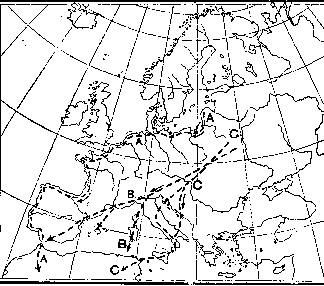
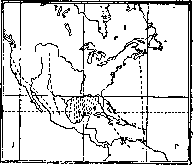
Figure 2.
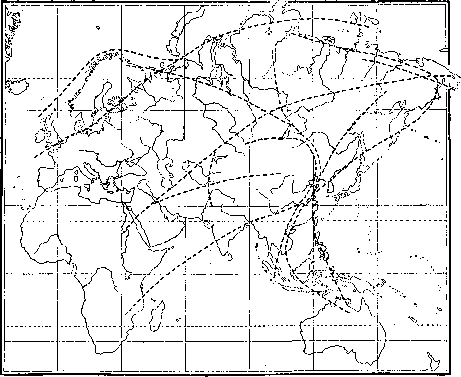
Fig. 3.
Figure 1. Main flight paths in Europe: A - western coastal route; B - Italian-Spanish route; C - Adriatic-Tunisian route (according to Lucanus). Figure 2. Main flight paths in North America (according to Cook). Figure 3. General scheme of bird migration paths from North Asia (according to Tugarinov). in the main area of habitat. Existing observations indeed seem to show that a series of lean years is not accompanied by the emigration of these rodents, while an abundant harvest year is often followed by emigration. This is confirmed by the fact that in years when the zokor migrates, an increase in the number of other small rodents was observed. Probably in normal years only a small number of young survive, while in times of abundance of food almost all survive and create overpopulation. Explanations of movement only by lack of food are less likely, since in some years enormous numbers of emigrating animals are observed. The movement of some steppe rodents (mainly ground squirrels) is of particular interest in connection with the fact that these rodents, through the fleas living on them, are carriers of plague. Autumn outbreaks of plague, for example in the little ground squirrel (Citellus pygmaeus) in the North Caucasus, depend on the dispersal of young individuals (offspring of this year) that occupy vacant burrows, the inhabitants of which died from plague, but the fleas have survived. Banding data establish that ground squirrels can move over quite large distances (150-200 km) and even cross large rivers. The dispersal of rats (for example the Alexandrian rat on ships), whose parasites also carry plague, is also of interest from this point of view. Migrations clearly related to food resources are observed in the squirrel (Sciurus vulgaris). They depend on the failure of the cedar nut crop in the large forest areas of North-West Siberia. The Siberian cedar (Pinus sibirica) has a fruiting periodicity of 3-4 years, and in years of complete crop failure, squirrels migrate in a certain direction. Probably of the same nature are the periodic invasions of nutcrackers (Nucifraga caryocatactes) and other birds biologically associated with the coniferous forests of the north. Causes of seasonal M. In seasonal migrations, the core of which is bird migration and the migration of anadromous fish (the so-called "putina"), there is a fairly clear connection with the breeding season. What this connection is, causal or merely a coincidence in time, is not yet resolved and represents one of the main problems in the study of seasonal migrations. How did seasonal animal movements arise? What causes migration at this time? Why do some species have seasonal migrations while others do not? All these are extremely complex questions requiring careful study and knowledge of animal biology. The movements of anadromous fish have been studied fairly well from a geographical point of view, but very little is known about the nature of this phenomenon. That "putina" has enormous significance in modern biology of anadromous fish is undoubtedly true. As a result of the "migration" fish reach the breeding grounds in a completely different biological environment, very favorable for the development of the young. After breeding, mass mortality of the parent generation often occurs, having lost all strength in overcoming obstacles when striving upstream. This striving against the current, a special rheotaxis observed before breeding, underlies the movements of anadromous fish, but its physiological essence has not been studied at all. The remarkable life history of the river eel, which twice in its life makes a huge migration in distance from the ocean to fresh water and back after several years for breeding, suggests a connection between migration and the dispersal and evolution of this species, undoubtedly of marine origin. This is indicated by the fact that it still breeds in oceanic depths. Young eels return to their birthplace for breeding, similar to anadromous fish, and also to migratory birds that return to nest in their birthplaces every year. Bird migration is more accessible to observation. The main, striking moment is, of course, the seasonal meteorological changes occurring in nature (changes in temperature, appearance of snow cover, etc.). The winter regime, cold, blizzards to one degree or another can affect the existence of the animal, causing either hibernation (in mammals) or extinction (in insects) or temporary migration to more suitable conditions. The connection is undeniable, since in the vast majority of cases migratory species really cannot survive the winter in their summer habitats. But it would be an undeniable and crude schematization to assume that temperature, winter regime and other purely external conditions in general directly determine migration, are its permissive causes. This is by no means proven. Some migratory birds arrive at our place very late (for example, the chaffinch, oriole - in May), and according to their biology they could have arrived earlier. Similarly, the departure for winter of some birds occurs very early, long before the first signs of autumn appear. In general, all migratory birds can be divided into two biological groups. 1. Birds that arrive early and depart late. Their wintering grounds are mostly not far away or even merge with the area of summer habitat. These birds in their spring movement follow the wave of warming, and their arrival is indeed in fairly clear connection with the general course of spring. An example of birds of this kind can be the rook, the chaffinch. 2. Birds that arrive late and depart early. These birds in most cases have a long migration route, their wintering grounds are located far from summer nesting sites. The connection of their migrations with temperature and other seasonal climatic changes occurring in the northern hemisphere is less clear. The spring migration begins for them on distant wintering grounds hardly in any direct causal connection with the climatic changes occurring in their homeland. An example of this group of birds can be some birds that winter in southern Africa or Asia ( some warblers, swallows / storks and others). How could bird migration have appeared? Undoubtedly this happened a very long time ago, in those times when the usefulness of seasonal migration became real. In the tertiary period of the earth's history, when the climate, conditions in the northern hemisphere were milder, without clear seasons of the year, and migrations probably did not exist yet. They appeared later in the quaternary period, with the beginning of glaciations, when cold began to push the bird south. At present ornithologists argue whether to consider our flying birds as natives, merely periodically pushed back in winter to warmer areas (the view of Deichler), or as colonists from the south, occupying in summer free nesting sites (the opinion of Brown). Some conclusions about the development of migrations can be made on the basis of the study of flight paths. In many cases, the migration paths that birds travel annually coincide with the path of their dispersal. For example, the green warbler (Acanthopneuste viridana), the golden oriole (Hypocentor aureolus) and some other birds that recently migrated to Eastern Europe from Asia, in autumn fly from us in an eastern direction to their ancient wintering grounds in southern Asia. Birds are very attached to their habitats and for a long series of generations repeat in seasonal migrations the dispersal path of their ancestors. The physiological nature of the "instinct" of migration is still very dark. The chronological connection with the period of reproduction, so distinct in birds, forces one to seek some relationship between migrations and the physiology of the sex glands, which become extremely active during the breeding period. Their increase, intensification of activity occurs just at the time of spring migration, which precedes reproduction. The autumn departure coincides with the phase of the reverse process - the reduction of the sex glands. Supporters of the predominance of purely internal factors in the phenomenon of migration point to the annual rhythm observed in the life of a bird. The change of extremely different states in a bird is indeed very sharp (wintering, migration, reproduction, molting, autumn departure) and affects the entire physiology of the organism. Supporters of external factors point to the great importance of light in the life of a bird (Allard) and connect the causes of migration with seasonal changes in illumination in the northern hemisphere (the desire of birds to places with the longest day). All these assumptions are based on a certain number of facts and show that there is no single cause of migrations and that this is an extremely complex phenomenon in its present state, representing the result of the relationship of a whole series of factors. One should not forget that birds are highly organized animals and undoubtedly that conditioned reflexes (see), established during the life of an individual (some "experience"), have great importance in migration, facilitating on the basis of biological conditions of migration and innate reflexes the orientation in flight paths ("tradition" of each species) and ensuring the existence of the species. The complex phenomenon of seasonal M; animal cannot be understood by one analysis of its constituent elements, since, considering only individual aspects of migration, its components, we cannot understand the qualitative uniqueness of the remarkable phenomenon that occurs annually.
Only as a result of the combination of all factors, of which the main ones are the ecology (see) of the animal, its physiological (reflexological) characteristics, and the seasonal changes in its habitat, does Animal migration occur.
Related articles
Mentioned in
Cite this page
“Animal Migration.” Soviet Medical Encyclopedia. English translation of Bolshaya Meditsinskaya Entsiklopediya, 1st ed. (Moscow, 1928–1936), ed. N. A. Semashko. https://sovietmedicalencyclopedia.pages.dev/article/animal-migration/