Crustacea
Historical document, translated for reference. It reflects medical knowledge of the 1920s–30s and is not medical advice.
Summary
Crustacea are a class of arthropods characterized by an external chitinous skeleton and a segmented body, often forming a carapace. They are aquatic organisms with diverse forms including free-living, sessile, and parasitic species, and include important food sources for humans.
Encyclopedia article (1928–1936)
Crustacea, Crustacea, a class of the type Arthropoda, characterized by the presence of an external chitinous skeleton and a segmented body; in many Crustaceans, the skeleton forms a carapace (crusta) covering the front part of the body from above and from the sides (hence the name Crustacea). The body, consisting of segments, forms the head and trunk. Some segments of the trunk may fuse with the head, in such cases forming the cephalothorax; the remaining part of the body is called the abdomen. In typical representatives, the head bears 5 pairs of appendages: 2 pairs of antennules, a pair of anterior or upper jaws, and 2 pairs of lower (posterior) jaws. Depending on the fusion of trunk segments with the head, the corresponding number of pairs of legs is transformed into gnathopods of the cephalothorax. The segments of the body typically bear a pair of biramous appendages called legs. The main axis of the leg splits into two branches - the outer (exopod) and inner (endopod). The exopod may be underdeveloped. The appendages often bear various outgrowths (e.g., gills) and can vary greatly in form (e.g., flattened legs, claws, etc.).
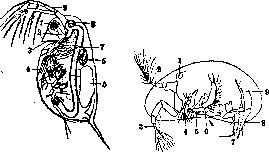
Figure 1.
Figure 2.
Figure 1. Representative of Cladocera-Daphnia: 1- eye; 2- nerve node; 3-antennula; 4-swimming legs; 5- brood chamber; 6- heart; 7- shell gland; 8- digestive gland; 9-antenna. (After Claus.) Figure 2. Representative of Ostracoda-Cypris: 1- median eye; 2-antennula; 3-antenna; 4- upper jaw; 5 and 6- lower jaws; 7 and 9- thoracic legs; 8- abdomen. (After Gerstaecker.)
The growth of Crustaceans is connected with molting, when the old chitinous carapace is shed and replaced by a new one. The hardness of the chitinous skeleton depends on the deposition of lime salts in it. Crustaceans are aquatic inhabitants (marine and fresh water). They breathe with gills, which are appendages of the legs or adjacent parts of the body. The circulatory system of Crustaceans is open, with a heart lying on the dorsal side of the body. The nervous system is chain-like, consisting of the supraesophageal ganglion and the abdominal chain. Sense organs are well developed in different segments. They are either dioecious or hermaphroditic. They lay eggs, from which a typical six-legged larva - the nauplius - emerges, often undergoing complex metamorphosis. In most cases, Crustaceans lead a mobile life; there are sessile and parasitic forms.
They feed predatorily, devour corpses, parasitize at the expense of other Crustaceans or fish. Some serve as an important source of food for humans. Small forms and metamorphosis stages constitute part of the plankton and characterize the degree of pollution or purity of water in a body of water.
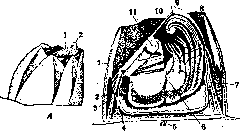
Crustaceans are divided into orders: Phyllopoda-leaf-footed Crustaceans [e.g., inhabitants of salt water bodies-Artemia; water fleas or daphnids (fig. 1) and others]; Ostracoda-ostracod Crustaceans with a carapace-covered body (Cypris, fig. 2); Copepoda-copepods [Cyclops strenuus (fig. 3)- first intermediate host of the broad tapeworm; C. coronatus, C. quadricornis, C. viridis and others- intermediate host of the lung fluke; Diaptomus gracilis- first intermediate host of the broad tapeworm; a number of copepod forms parasitize fish]; Cirripedia-cirripeds [sessile-sea acorn-Balanus (fig. 4) and parasitic forms-Sacculina and others]; Decapoda-ten-footed Crustaceans (Potamobius fluviatilis-river crayfish, Homarus vulgaris-lobster, Crangon-crayfish, various crabs-all are used for food; Astacus japonicus and crabs-Sesarma dehaani, Eriocheir japonicus, Paratelphusa sinensis, Potamon obtusipes and others-are the second intermediate hosts of the lung fluke) and other orders.
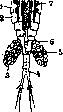
Figure 4. Balanus. A-externally: 1-scutum; 2-tergum; B-dissected: 1- shell; 2- oviduct; 3 and 7- muscles of scuta and terga; 4- ovary; 5- antennulae; 6- female genital opening; 8- edge of shell; 9-tergum; 10-scutum; 11- adductor muscle-
cephalothorax-Г2Л°й из надглоточного узла и брюш-6 - thoracic ной цепочки. Органы чувства разные сегменты; виты хорошо. Раздельнополые ш"o"к- ? -post- или гермафродиты. Откладыва-abdomen; б- ЮТ яйца, из к-рых выходит ти-i-й сегмент пичная шестиногая личинка- яичншг' /- науплиус, проделывающая часто antennula; 9- сложный метаморфоз. P. B боль-срединный шинстве случаев ведут подвиж-глаз.
HHg 05pаз жизни; есть сидячие и паразитические формы. Питаются хищнически, пожирают трупы, паразитируют за счет других ракообразных или рыб. Некоторые служат важным источником питания человека. Мелкие формы и стадии метаморфоза входят в состав планктона и характеризуют степень загрязненности или чистоты воды в водоеме.
Related articles
Cite this page
“Crustacea.” Soviet Medical Encyclopedia. English translation of Bolshaya Meditsinskaya Entsiklopediya, 1st ed. (Moscow, 1928–1936), ed. N. A. Semashko. https://sovietmedicalencyclopedia.pages.dev/article/crustacea/