Rotifers
Historical document, translated for reference. It reflects medical knowledge of the 1920s–30s and is not medical advice.
Summary
Rotifers are microscopic aquatic animals, mostly free-swimming but some attached. They resemble the trochophore larva of annelid worms and are considered by some to be neotenic larvae of annelids. Rotifers are an important component of freshwater plankton.
Encyclopedia article (1928–1936)
Rotifers (Rotatoria or Rotifera), a class from the type of worms and subtype of trochophore worms (Trochophorida). Microscopic aquatic animals, mostly free-swimming, some attached. In general structure, Rotifers resemble the larva of annelids, the trochophore, for which reason many consider them to be neotenic larvae of annelid worms. Rotifers, histologically, according to the data of Martini (Mart), represent animals whose bodies consist of a definite number of cells. The elongated body is divided into head, trunk sections and a movable muscular leg, ending in two finger-like processes. The head is equipped with two corona of cilia, forming the so-called wheel apparatus, which serves for movement and capturing food (figs. 1 and 2). The intestine is complete, with a pharynx equipped with a chitinous chewing apparatus consisting of an incus and two hammers. The nervous system consists of a supraesophageal ganglion, a pair of eyespots, and small tentacles; the excretory system is formed by two protonephridia; circulatory and respiratory systems are absent. The body cavity is primary. Rotifers are dioecious, with pronounced sexual dimorphism: males are significantly smaller than females; some internal organs are reduced in them. Reproduction consists of alternating multiple virgin generations with rare typical sexual ones. Rotifers constitute one of the important parts of freshwater plankton. Some Rotifers have the ability to withstand complete drying out, returning to life upon moistening.
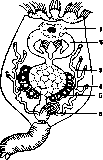

Figure 1.
Figure 2.
Figure 1. Rotifer Brachionus urceolaris (female): 1-supraesophageal ganglion with eyespot; 2-pharynx with chewing apparatus; 3-protonephridia; 4-stomach; 5-ovary; 6-urinary bladder. Figure 2. Rotifer Brach. urceolaris (male): 1-supraesophageal ganglion with eyespot; 2-protonephridia; 3-testis.
Related articles
Mentioned in
Cite this page
“Rotifers.” Soviet Medical Encyclopedia. English translation of Bolshaya Meditsinskaya Entsiklopediya, 1st ed. (Moscow, 1928–1936), ed. N. A. Semashko. https://sovietmedicalencyclopedia.pages.dev/article/rotifers/