Crystals
Historical document, translated for reference. It reflects medical knowledge of the 1920s–30s and is not medical advice.
Summary
This article defines crystals as homogeneous solids with a regular internal structure, characterized by a spatial lattice of atoms. It details the laws of crystallography, methods of formation, and the classification of crystals based on symmetry and systems.
Encyclopedia article (1928–1936)
CRYSTALS (from the Greek crystallos—ice), homogeneous solid bodies that have a regular internal structure. The scheme of such a structure is the so-called spatial lattice (see figure), which must be understood as a geometric image of infinite extent, consisting of an infinite multitude of identical parallelepipeds, which, when folded into a spatial lattice, fill space without gaps. A single such parallelepiped is determined by 6 values: the lengths of 3 edges a, b, c and 3 angles between the edges α, β, and γ. If one does not define the absolute size of the parallelepipeds, then to characterize the lattice it is sufficient to have 5 values: 2 ratios a : b : c and 3 angles α, β, γ. In a spatial lattice, the following elements are distinguished: nodes, rows, and flat nets; they correspond to the vertices, edges, and faces of crystals. All parallel rows have identical intervals between nodes, and all parallel flat nets have the same mesh size. Atoms or groups of atoms of a substance are located at the nodes of the spatial lattice. Each substance has its own lattice; from it, all properties of the crystalline medium can be derived, such as: 1. Steno's Law of the constancy of angles. If the angle between two faces corresponds to the angle between two flat nets of the spatial lattice, then it is obvious that for one and the same lattice, and consequently for one and the same substance, this angle always retains its value. Faces can move parallel to themselves, i.e., a crystal can take on a different external appearance while always retaining its angles. 2. Haüy's Law of rational relations. If three rows of a spatial lattice not lying in one plane—corresponding to 3 edges of a crystal—are taken as coordinate axes, then the position of any flat net (crystal face) can be determined with the help of three integers. This is possible because any flat net will cut off segments on the taken coordinate axes, the ratio of which will always be equal to the ratio of three integers corresponding to the number of row intervals. A face cutting off segments of 1 : 1 : 1 on the axes is called a unit face. By dividing these segments by the indicated ratio of three integers, we obtain three fractions, which can be converted into integers. These latter are called indices. Faces serve for its designation. Enclosed in parentheses, they constitute the symbol of the face. For example, a face cuts off 2, 3, and 6 intervals on the coordinate axes, then we obtain: 1/2 : 1/3 : 1/6 = 3 : 2 : 1; (321) will be the symbol of the taken face. The coordinate axes are denoted by the letters x, y, z; x—from the origin of coordinates to the observer, y—from left to right, z—from bottom to top. The direction from the origin of coordinates can be positive or negative. 3. Any flat net of a given spatial lattice can participate in the limitation of a crystal. The frequency of appearance of a face is proportional to its density, i.e., the number of nodes per unit area (Bravais' Law).
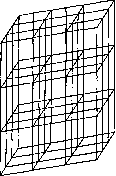
In contrast to crystals, those substances that do not possess a regular internal structure of the spatial lattice type are called amorphous (formless), e.g., glass. Three main cases of crystal formation are distinguished: 1) from a molten state, 2) from solutions, 3) by sublimation. All these cases are observed both in nature and under laboratory conditions. The first includes the formation of massive crystalline rocks, the industrial production of metals, etc. The second includes the formation of many secondary minerals (e.g., salts) and the precipitation of sediments during chemical reactions. In the third case, we have a direct transition from the gaseous phase to the solid, e.g., the formation of frost, the sublimation of iodine. If one compares the cooling curves of crystalline and amorphous bodies, then in the second case the curve shows an even decrease in temperature; in the first, at a certain transition point (melting point), there is a discontinuity in the curve, and it has a stepped appearance. Some crystalline bodies, after melting and solidifying, pass into an amorphous state (sugar, salicin), which, however, slowly changes into a crystalline one over time (the sugaring of jam). Crystallization from solutions can take place only in the case of a supersaturated solution. In this case, the solution deposits the excess solid substance in the form of crystals. Crystallization can be conducted in various ways: 1) by removing the liquid through slow evaporation, 2) by preparing a saturated solution at a high temperature and allowing it to cool, 3) by adding to the solution a substance that is miscible with the solvent and reduces the solubility of the crystallizing body in it (see Crystallization). The choice of one or the other method depends on the shape of the solubility curve. With slow crystallization, larger and well-formed crystals are obtained; with fast, small and less regular ones. The main factor influencing the shape of a slowly growing crystal is the so-called concentration currents. These are the currents that form around a growing crystal due to the difference in concentration between the areas of the solution immediately adjacent to the crystal and those more distant. Having deposited the excess of the substance contained in them onto the crystal, the nearest layers become lighter and rise upward. Layers of greater specific gravity flow into their place, etc. Thus, a kind of barometric minimum is created above the growing crystal, under the influence of which the solution is constantly mixed. The consequence of this is faster growth to the sides for a crystal lying on the bottom of a vessel, and the opposite picture for a suspended crystal. Using concentration currents, one can grow crystals of a specific type—plate-like or, conversely, elongated. Temperature changes play an outstanding role in the process of crystallization. Therefore, temperature stabilization is a necessary condition for growing pure, transparent crystals. It is achieved with the help of thermostats. To obtain crystals close to the ideal theoretical form, rotating crystallizers are used, which exclude the action of concentration currents.

These ideal forms possess a peculiar symmetry, which is nowhere in nature manifested in such diversity and perfection as in crystals. According to symmetry, crystals are divided into 32 classes, possessing a different number of symmetry elements. The latter include 1) a plane of symmetry (P), 2) an axis of symmetry (Ln), 3) a center of symmetry (C), and 4) a mirror-rotation axis of symmetry (Lin). Axes of symmetry can have different names depending on the elementary angle of rotation of 360°: n = 360/α, where n is the name of the axis, and α is the smallest angle of rotation. For crystals, n can take the values: 2, 3, 4, and 6. Axes of other names cannot exist in a spatial lattice. Each class is characterized by a certain number of symmetry elements, e.g., 3L23PC. The classes are combined into 7 systems, which bear the names: triclinic (2 classes), monoclinic (3 classes), orthorhombic (3 classes), tetragonal (7 classes), trigonal (5 classes), hexagonal (7 classes), and cubic (5 classes). Each system is characterized by the form of the basic parallelepiped of the spatial lattice. Thus, for the cubic system, this parallelepiped has the form of a cube, for the tetragonal—the form of a prism with a square base, etc. The constants of the parallelepipeds of the lattices of various systems are given in the following table. Triclinic system a≠b≠c; α≠β≠γ. Monoclinic system a≠b≠c; α=γ=90°; β≠90°. Orthorhombic system a≠b≠c; α=β=γ=90°. Tetragonal system a=b≠c; α=β=γ=90°. Trigonal system a=b=c; α=β=γ≠90°. Hexagonal system a=b≠c; α=β=90°; γ=120°. Cubic system a=b=c; α=β=γ=90°. The given names of the systems are not the only ones: many synonyms are encountered in the literature; e.g., the cubic system is also called regular and hexahedral, etc. There are especially many synonyms for the names of simple forms. The most rational is the nomenclature developed by the Fedorov Institute (Leningrad) in 1923. A simple form is called a figure that is derived from one face by all symmetry elements present in a given class. Simple forms are divided into general, characteristic for each class, and particular, which can be encountered in different classes of one and the same system. Very rarely are crystals encountered that have the appearance of one simple form; usually, these are combinations of several simple forms, as if superimposed one upon another. The most complex combinations are observed on the mineral calcite (Iceland spar), the crystals of which sometimes reveal the presence of 30–40 or more simple forms. Symmetry is manifested not only in the external appearance of crystals; internal properties, such as thermal, electrical, and optical, are also subject to it. When studying these properties of crystals, it becomes clear that the medium manifests
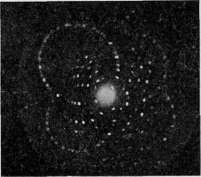
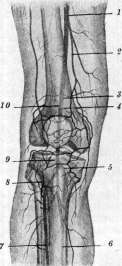
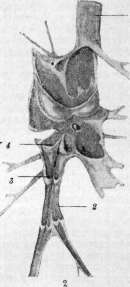
Figure 1. Arterial network of the knee joint: 1-a. femor.; 2-a. genu suprema; 3-a. poplitea; 4-a. artic. genu sup. med.; 5-a. artic. genu sup. lat.; 6-a. artic. genu inf. lat.; 7-a. genu inf. med.; 8-a. tibial. post.; 9-a. tibial. ant.; 10-a. recurrens tibialis. Figure 2. Valves of the veins: 1-v. femor.; 2-v. saphena magna; 3-valves along the vein; 4-valves at the site of the entry of the v. saphena into the v. femoralis. Figure 3. Preparation of vessels in the region of the knee joint, prepared by the clearing method of W. Spalteholz (from the Museum of Normal Anatomy of the 1st Moscow State University). Figure 4. Kulchitsky cells. Figure 5. Radiography of crystals. Figure 6. Living cell under dark-field illumination. Figure 7. The same cell after its fixation
vectoriality, i.e., a change in properties with a change in direction. For example, the thermal conductivity of many crystals is different in different directions. If a layer of paraffin is applied to a plate of gypsum and a heated round rod is applied to it, the paraffin, upon melting, forms not a circle, but an ellipse around the rod. Its shape depends on the direction in which the plate is cut from the gypsum crystal. The dissolution of crystals also proceeds at different speeds in different directions, which is why depressions of a regular shape, so-called etch figures, are formed on the faces. These figures are an important factor for determining the symmetry of crystals. The optical properties of crystals are especially remarkable. All crystals, with the exception of those belonging to the cubic system, possess the property of splitting a light ray entering them into two, and these two rays are polarized in two mutually perpendicular planes. One of them obeys the usual laws of refraction and is called the ordinary ray (denoted by o), the other deviates from these laws and is called the extraordinary ray (denoted by e). The ordinary and extraordinary rays have different propagation speeds, with this speed being constant for the first for a given substance, while for the second it changes with a change in direction. If we take a point inside a crystal and lay off segments proportional to the speeds of both rays in all directions from it, we obtain two surfaces, one enclosed within the other. For the ordinary ray, this will be a spherical surface, and for the extraordinary ray, an ellipsoid of revolution. Both surfaces touch each other at two points. In the direction connecting these points, both rays propagate at the same speed, and double refraction does not occur. This direction is called the optical axis of the crystal. Crystals having one optical axis are called uniaxial, and those having two optical axes are called biaxial. In the latter, the surface of the rays has a more complex form than just described. Depending on which of the two rays has a higher propagation speed, crystals are divided into positive (v0 > ve) and negative (ve > v0). The reverse is true for refractive indices, since the refractive index is inversely proportional to the speed of ray propagation. Some crystals (e.g., quartz) also possess the ability to rotate the plane of polarization. Since the force of rotation is in direct dependence on the thickness of the crystal, this is used for practical purposes, e.g., for determining the concentration of solutions. The optical properties of crystals form the basis of the methodology for determining the constituent parts of rocks. Special microscopes, so-called polarizing microscopes, are used for this purpose. They differ from ordinary microscopes in that they have two polarizing prisms and a rotating stage with graduations and a vernier. Preparations are made in the form of very thin plates (thin sections), glued between a microscope slide and a coverslip using Canada balsam. The study of crystals aims to solve the following tasks: 1) finding the symmetry (system and class); 2) determining the optical and other most important physical properties; 3) determining the structure of a given substance. 1. Finding the symmetry is performed by measuring crystals on special instruments called goniometers (see). They are of various types—from crude instruments giving an accuracy of up to 0.5°, to extremely complex ones allowing for the consideration of 3-4 seconds of arc. At the present time, mainly reflection goniometers are used, which are built on the following principle. The crystal is attached to a rotating stage equipped with a limb and verniers. A beam of parallel rays from some light source is sent onto it. This beam, after reflection from the crystal face, is captured by a telescope. By rotating the stage, the second face is brought into the place of the first—the difference in the readings will give the value of the angle between the perpendiculars to the faces. The most convenient are goniometers with two mutually perpendicular circles, so-called theodolite goniometers. They make it possible to quickly measure even very small crystals, with a size of fractions of a millimeter. The measurement results are plotted on a projection. Projections are of various types; the most common are: stereographic, gnomonic, and orthogonal. A projection is necessary for generalizing the measurement results and, in addition, serves for very simple graphical calculations. These calculations make it possible to find the symbols of simple forms observed on crystals and to approximately determine the constants of its lattice. Special templates called nets are used for graphical calculations. The net proposed by Wulff is considered the most convenient. 2. Optical investigation consists in determining the refractive indices: two for uniaxial and three for biaxial crystals. This determination is done with the help of a refractometer or the same goniometer that serves for measuring angles (prism method). Then the optical sign is determined, and for biaxial crystals—the angle of the optical axes. The latter determination is performed on a special instrument. 3. Determination of the structure became possible since X-rays were applied to solve this task (1912). Before this, one had to limit oneself to theoretical considerations, which could not be verified experimentally. The initiative of applying X-rays to the study of crystal structure belongs to the German physicist Max von Laue. For a long time, the nature of these rays remained mysterious, and all attempts to induce their refraction or diffraction were fruitless. In setting up his famous experiment, Laue proceeded from two theoretical assumptions: 1) that X-rays possess an extremely short wavelength and artificial diffraction gratings are too coarse for them, and 2) that a crystal, if the theory of a space lattice is correct, represents a natural three-dimensional diffraction grating. The gaps between its planes are values of the same order as the wavelength of X-rays. Laue's theoretical assumption was brilliantly confirmed by experiment. From this time, the study of crystal structure entered a new era. The works of Bragg, Debye, Scherrer, and Hull made it possible not only to determine the absolute values of the parallelepipeds of the space lattice but also to provide accurate structural models of a whole series of substances. The methodology of investigating crystals with the help of X-rays is now exhaustively developed. One can point to 4 main methods: 1) Laue, 2) Bragg, 3) Debye and Scherrer, 4) the rotating crystal method. In the Laue method, a beam of X-rays, having passed through an opening in a lead diaphragm, falls on a crystal. The individual atoms of this crystal, under the influence of primary rays coming from the tube, themselves become sources of X-rays (secondary). These latter, interfering with each other, cause a series of spots on a photographic plate, arranged around a central spot (see separate table, fig. 5). The position of these spots is connected by a simple relationship to the distance from the crystal to the plate. For the analysis of Laue-type X-ray diffraction patterns, the Wulff net and the graphical methods associated with it are very conveniently used. To determine the distance between atomic planes, the methods of Bragg and Debye and Scherrer are used. In the first of these, a beam of rays from a tube is sent onto a crystal at different angles. After "reflection" from the atomic planes (here, of course, there is no ordinary reflection, but the same interference of secondary rays takes place), the rays cause ionization of the gas in a special chamber. The strength of ionization is judged by the deflection of an electrometer. This phenomenon can be expressed by the equation nλ = 2d sinφ, where n is an integer, λ is the wavelength, d is the distance between atomic planes, and φ is the angle of incidence, counting from the crystal face. For these first two methods, sufficiently large crystals are needed, which cannot always be obtained. The 3rd method (Debye and Scherrer) bypasses this difficulty. Here, small columns pressed from fine crystalline powders are used. Rays of a certain wavelength, falling on such a column and encountering a huge number of small, randomly oriented crystals, give reflection only in the case when the angle of incidence on some atomic plane corresponds to the above equation. The effect is reproduced on a photographic film bent in the form of a cylinder, in which the column occupies a central position. On the film, a series of curves of different intensity and at different distances from the central spot is visible. This method serves not only for determining interatomic distances but is also a very convenient means to reveal the hidden crystallinity of substances. Finally, the rotating crystal method makes it possible to determine the structure with all possible completeness, and in this case, photographs are also taken according to the Laue method to clarify the geometric features of the lattice under study. From all that has been presented, the practical significance of the science of crystals—crystallography—is clear. As an independent science, it is of great importance for the investigation of the internal structure of solid matter, and this structure is the basis upon which all its properties depend.
Therefore, in recent times, crystallography has begun to connect with such fields of knowledge and technology to which it would seem to have little relation, for example, metallography, metallurgy, and chemistry. In the latter field, one cannot pass over in silence the extremely important achievement of E. S. Fedorov and his students—crystallochemical analysis. This method makes it possible to identify a substance solely on the basis of the external form and optical properties of its crystals, without resorting to chemical analysis. In its original form, Fedorov's method is unfortunately quite difficult and requires special skills. In recent years, Fedorov's student Boldyrev has significantly simplified the identification methodology, making it accessible to the average chemist. In practice, crystallochemical analysis has yielded excellent results. Fedorov himself correctly solved about 90% of the problems sent to him. According to Boldyrev's system, an even higher percentage of correct identifications is obtained, and the entire operation takes very little time. Crystallography as an auxiliary discipline is further necessary for mineralogy, petrography, and physics. Historically, it is connected with mineralogy, since the first objects of study were beautiful, large natural crystals. Subsequently, when the number of artificial compounds exceeded the number of natural ones many times over, crystallography separated from mineralogy and occupied an independent position. The USSR can be proud of many outstanding scientists who have worked in the field of crystallography: Gadolin derived the aforementioned 32 classes; Fedorov is one of the scientists whose name has long achieved worldwide fame; Wulff was a pioneer of X-ray crystallography in the USSR and is known as the author of his stereographic net and for his work in the field of liquid crystals. These peculiar formations, discovered by O. Lehmann, are quite incorrectly called crystals. True, they exhibit certain optical properties similar to the properties of crystals. This phenomenon is explained by the ability of the molecules of these substances to form long chains with a specific orientation. It is much more correct to call these formations crystalline liquids, since they are essentially liquids, the structure of which has nothing in common with the stable spatial lattice of crystals.
Related articles
Cite this page
“Crystals.” Soviet Medical Encyclopedia. English translation of Bolshaya Meditsinskaya Entsiklopediya, 1st ed. (Moscow, 1928–1936), ed. N. A. Semashko. https://sovietmedicalencyclopedia.pages.dev/article/crystals/