Gastroduodenostomy
Historical document, translated for reference. It reflects medical knowledge of the 1920s–30s and is not medical advice.
Summary
This article describes the surgical procedure of gastroduodenostomy, which creates an anastomosis between the stomach and the duodenum. It details historical techniques, including those by Jaboulay, Kocher, and Oehlecker-Finney, and discusses the indications and contraindications for the procedure.
Encyclopedia entry (1928–1936)
GASTRODUODENOSTOMY (lateral), an operation to form an anastomosis between the stomach and the duodenum; first performed for pyloric stenosis by the French surgeon Jaboulay in 1892 as a substitute for the usual gastroenterostomy; severe dilation of the stomach and its close proximity to the duodenum suggested the idea of this

Figure 2. Gastrod. hominis, egg (enlarged).

Figure 1.
...led the author to this modification. The operation consisted of bringing the anterior surface of the stomach and the descending part of the duodenum close together and creating an anastomosis between them in the usual manner: the first row of serous sutures, then an incision through the seromuscular layer of the stomach and duodenum in a vertical direction, and a second row of seromuscular sutures; after this, the opening of the mucous membrane and the application of a two-layer suture to the anterior lip of the anastomosis. Conditions for performing Figure 3.
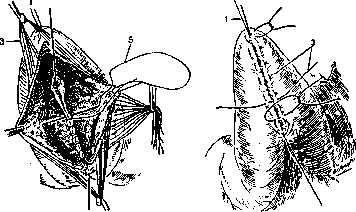
Figure 4.
Figure 2-5. Gastroduodenostomy according to Oehlecker-Finney: 1-thread fixing the pylorus; 2-posterior suture to the serosa; 3-anterior sutures to the serosa; 4-horseshoe-shaped incision of the stomach and duodenum; 5-posterior suture to all layers of the stomach and duodenum. Such an operation is created naturally with significant dilation of the prepyloric part of the stomach and with the pylorus pulled upward; both factors naturally bring the stomach and duodenum closer together. Therefore, in suitable cases, the operation is quite appropriate and was later used by other surgeons (Villard, Kronlein, Schnitzler, Kozlovsky, Dobrotvorsky) with good results. In functional terms, gastroduodenostomy has an advantage over simple gastroenterostomy in that it does not disrupt the digestive reflexes of gastric juice on the liver and pancreas and best protects the anastomosis from the development of subsequent peptic ulcers; furthermore, the possibility of circulus vitiosus is completely excluded. Conditions allowing for easy performance of the operation are encountered only in rare cases. (Jaboulay used it once for cancerous pyloric stenosis.) However, the operation of gastroduodenostomy can have expanded application if the Kocher method for 'mobilization' of the duodenum is used. This method consists of the following: after lifting the liver upward, moving the transverse colon downward and the stomach to the left, the vertical part of the duodenum is exposed, and, moving 2-3 cm from its outer edge, an incision is made in the parietal layer of the peritoneum, continuing it downward above the kidney to the mesocolon. Through the resulting gap, the vertical part of the duodenum, together with the head of the pancreas, is mobilized by blunt dissection using a finger (see Fig. 1). If the finger of the right hand is inserted through the lesser omentum behind the pylorus, the duodenum can be extracted from the abdominal wall wound; at the same time, the lower horizontal part of the duodenum is also lifted up to the place where it is crossed by the a. colica dextra; however, the kink that forms during this process smooths out after the intestine is replaced into the abdominal cavity. After proper mobilization, curved clamps are placed under the stomach and duodenum, and a lateral anastomosis is created between the anterior surface of the stomach and the duodenum, up to 4 cm in length. Analysis of cases operated on by this method by Kocher shows that both the immediate and long-term results are quite good. Technically, in this form, the operation of gastrointestinal anastomosis is, of course, more complex than simple gastroenterostomy, since for the mobilization of the duodenum, the abdominal wound must be extended with a transverse incision to the right through the rectus muscle. The scope of its application remains very limited. According to Kocher, it is indicated in cases where the exit from the stomach is only obstructed, but not completely blocked, and where there is no very severe dilation of the stomach, because in the latter case (due to mechanical conditions), it is more advantageous to perform a gastroenterostomy in the lowest part of the stomach. At present, gastroduodenostomy according to Oehlecker-Finney (see Figures 2-5) has gained wide application. Indications for the operation of gastroduodenostomy are cases where the primary process is not located in the pyloric part, for example: in gastroptosis, in cases of insufficient motor function of the stomach, and in ulcers located far from the pylorus. The operation is contraindicated in cases of adhesions that do not allow for easy mobilization of the duodenum, and in cases where there are reactive infiltrative processes in the walls of these organs; likewise, in cases of severe dilation of the stomach and ptosis combined with atony, preference should be given to gastroenterostomy. In cancer of the pylorus, the operation, naturally, should also not take place. In addition to the described operation (gastroduodenostomia lateralis), Schmidt, for some cases of benign strictures, proposed using the method of terminal gastroduodenostomy according to Kocher: the pylorus behind the stricture (distally) is cut across and sutured shut, and the end of the duodenum is sutured into the posterior wall of the stomach, as in a typical pyloric resection according to Kocher. The goal of this operation is to restore the continuity of the gastrointestinal tract in a form as close as possible to normal anatomical and physiological relationships (elimination of circulus vitiosus and secondary ulcers), but due to its complexity, this proposal has not yet met with sympathy and is not used by anyone. Finsterer has recently resorted to the method of terminolateral gastroduodenostomy in the two-stage method of excising duodenal ulcers proposed by him.
Related articles
Cite this page
“Gastroduodenostomy.” Soviet Medical Encyclopedia. English translation of Bolshaya Meditsinskaya Entsiklopediya, 1st ed. (Moscow, 1928–1936), ed. N. A. Semashko. https://sovietmedicalencyclopedia.pages.dev/article/gastroduodenostomy/