Goblet Cells
Historical document, translated for reference. It reflects medical knowledge of the 1920s–30s and is not medical advice.
Summary
Goblet cells are single-celled glands found in the epithelial lining of the digestive and respiratory tracts that secrete mucus. They were first described by Henle in 1837 and have a characteristic goblet or beaker shape with a narrow base containing the nucleus.
Encyclopedia article (1928–1936)
GOBLET CELLS (German: Becherzellen; Henle, 1837), cells of the covering epithelium that secrete mucus (single-celled glands), found in large numbers in the mucous membrane of the digestive and respiratory tracts among ciliated and ciliated epithelium (in fish - in the multilayered epithelium of the skin). In typical cases, the cell has the shape of a round goblet or wine glass with a thin stem; the upper expanded part is filled with mucus, while the compressed nucleus and the remainder of the protoplasm are located in the stem. Sometimes there is no stem, and the entire cell has the shape of an ovoid, at the base of which lies a flattened nucleus.
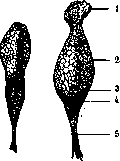
Goblet cells: 1-secreting mucus; 2-membrane; 3-nucleus; 4-nucleolus; 5-basal part of the cell.
of which lies a flattened nucleus. The free surface of the cell has a thin covering, theca, which bursts when mucus is secreted. In life and with appropriate fixation, the secret consists of grains that easily swell and turn into a homogeneous or reticular mass.
Related articles
Mentioned in
Cite this page
“Goblet Cells.” Soviet Medical Encyclopedia. English translation of Bolshaya Meditsinskaya Entsiklopediya, 1st ed. (Moscow, 1928–1936), ed. N. A. Semashko. https://sovietmedicalencyclopedia.pages.dev/article/goblet-cells/