Klikushestvo
Historical document, translated for reference. It reflects medical knowledge of the 1920s–30s and is not medical advice.
Summary
A historical overview of "klikushestvo," a form of hysterical psychosis prevalent among the Russian peasantry, characterized by seizures and beliefs in demonic possession or "spoiling." The article discusses its etiology, including early 20th-century theories on genogeography and ethnic distribution, as well as its clinical symptoms, history, and the shift from religious exorcism to psychiatric treatment.
Encyclopedia article (1928–1936)
KLIKUSHESTVO, a peculiar everyday variety of hysteria (see Hysterical Psychoses), widely distributed among the Russian peasantry and appearing either in the form of isolated cases or in the form of entire psychic epidemics. Patients ("klikushi") consider themselves victims of "spoiling," witchcraft, or believe that the devil has entered them. In general, the etiology of klikushestvo, like that of hysteria in general, has been studied very little. Based on his personal impressions, Lenz considers hysteria to be genotypically conditioned with dominant factors (polymerism) of inheritance. However, there are no reliable genealogical data on this topic, and it is quite difficult to collect them. Interesting in this regard is the study by P. I. Yakobiy. Appointed in 1893 to organize psychiatric work in the Oryol Governorate, he conducted a census of the mentally ill in this territory, and the data he obtained are of great interest even to this day. It turned out that both the total number of mentally ill and the number of klikushi (see map) were clearly unevenly distributed across the province, with the central districts being relatively densely saturated with these diseases, to the east they gradually decrease, and to the west the number of these patients falls sharply. When looking at this and other maps he provides, the thought involuntarily comes to mind that different districts of the province are inhabited by different nationalities, that in one of the latter (inhabiting the center of the province) the number of these patients is especially large, and that from it the corresponding genes are unevenly distributed to the west and east. Extensive linguistic and ethnographic studies undertaken by Yakobiy indeed led him to the quite probable conclusion that the center of the province is occupied by a tribe of Finnish origin (the Vyatichi), although fully assimilated, and that in the western districts (in the Bryansk and Sevsk districts) it is significantly diluted by a massive influx of a population of another nationality, attracted here by large industry (Maltsov factories). Furthermore, through a more detailed study of the concentration of these diseases by individual volosts, Yakobiy was able to show that all areas heavily affected by klikushestvo lie far from cities and from major transport routes and that, conversely, in those areas where one can assume the greatest Slavic immigration, the number of these patients is correspondingly smaller. Yakobiy's study was conducted before the existence of genetics as a science and, of course, long before the separation of an independent branch of the latter—genogeography. But the resu-
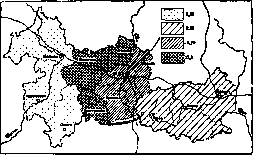
Klikushi of the Oryol Governorate (per 10,000 population).
lts of his work are in full unison with modern scientific concepts. For final conclusiveness, however, and above all for clarifying the question of the relative role of genogeography and external influences in the discovered facts, this study requires supplementation with genealogical data.
S. Levit.
The most striking symptom of the disease are seizures, which usually occur during divine service or when religious objects are presented. The klikusha suddenly falls to the ground, thrashes and writhes, hiccups, and screams in different voices, while "calling out" the name of the perpetrator of the "spoiling." Consciousness during the seizure is clouded; the patient mimics and pantomimes expressions of intense anguish, then terror, then anger, and obviously experiences vivid delusional states with various hallucinations (mostly visual and olfactory). After the seizure, there remains, for the most part, incomplete or partial amnesia, characteristic of hysterical clouding of consciousness. In addition to convulsive twitching, tremors, hiccups, globus hystericus, etc., the seizure of K. is often accompanied by vasomotor phenomena, such as: hyperemia of the face, cooling of the extremities, sweating, etc. Outside of the seizure, klikushi exhibit psychopathological symptoms in the form of anguish, anxious mood, obsessive or delusional thoughts about the "spoiling" that has befallen them or demonic possession, irritability, insomnia, palpitations, etc. The manifestation and spread of K. is closely connected with cultural backwardness and the influence of religion, which supports the superstitious belief in the existence of evil spirits. The predisposition to the disease of K. is strengthened by all factors causing "psychic weakness." These include, mainly, moral shocks, sexual psychotraumatism, overwork and exhaustion, and menopause. The seizures of K. are closest to the seizures of "grand hysteria" according to Charcot. Their hysterical character is revealed, among other things, in their contagiousness for persons who are correspondingly predisposed and exposed to the same environmental influences. K. affects women predominantly; men fall ill rarely. K. is spread throughout the entire USSR, especially in the center and in the northeast. The disease is related to the demonomanias that once raged in Russian and especially Western European monasteries. The first reports of K. appeared in Perm ("ikotnitsy") in the 11th century. In the 17th century, K. reached its apogee, which was facilitated by a strong exacerbation of mysticism and superstition caused by the so-called "Schism," when many klikushi were regarded as prophetesses and "sufferers for the faith." In this era, the person from whom the klikusha had allegedly suffered was brought to trial and subjected to torture, while the klikusha herself was only "exorcised." At one time (decrees of 1715-16), K. began to be viewed as feigned possession, intended to slander innocent people. A correct view of K. was established only in the second half of the 19th century under the influence of the doctrine of functional nervous diseases, in particular the doctrine of hysteria. The population treats klikushi by exorcism; in medicine, the main means of treatment is systematic psychotherapy combined with general education of the patient. Prevention of K. comes down to raising the cultural level of the population and fighting the influence of religious teachings. V. Grombakh.
Related articles
Mentioned in
Cite this page
“Klikushestvo.” Soviet Medical Encyclopedia. English translation of Bolshaya Meditsinskaya Entsiklopediya, 1st ed. (Moscow, 1928–1936), ed. N. A. Semashko. https://sovietmedicalencyclopedia.pages.dev/article/klikushestvo/