Mania
Historical document, translated for reference. It reflects medical knowledge of the 1920s–30s and is not medical advice.
Summary
This article discusses the psychiatric concept of mania, its historical classification, and the related term 'manna' used for a medicinal exudate. It details the symptoms, historical views, and the modern understanding of mania as part of manic-depressive psychosis.
Encyclopedia article (1928–1936)
MANIA (from Greek mania - madness, frenzy) together with melancholia is one of the oldest psychiatric concepts. With its help was designated a pathologically elevated mood, combined with motor excitement, sometimes joyfully good-natured, with a positive evaluation of one's own personality and the world, sometimes sharply aggressive - with destructive tendencies and severe clouding of consciousness. M., as well as melancholia, until the beginning of the 20th century was considered as an independent disease of the affective sphere with a relatively favorable prognosis. According to the degree, manic exaltation (exaltatio maniacalis), typical mania (mania typica) and severe form of mania (mania gravis) were distinguished. At present, the existence of M. as an independent disease is not recognized; the majority of the most vividly expressed cases of M., not complicated by other symptoms, entered the composition of the extensive group of manic-depressive psychosis (see). In a broader sense, "manic" is still called any state accompanied by motor excitement and elevated mood, whatever disease it occurs in (see Manic state). Besides the above-mentioned psychiatric understanding of M. and the manic syndrome in the general public, the term "mania" is associated with the idea of isolated violations of mental functions, having the character of some pathological drive, passion, persistent and strange habit. Such anomalies of drive Esquirol called monomanias. Possessors of such drives were called maniacs. Accordingly, to the word "mania" were attached various additional names. If the striving for suicide came to the fore, then suicidomania was spoken of; if increased interest in acts of a sexual character - erotomania, to theft - kleptomania, to arson - pyromania; the drive to sad thoughts - lypemania (lypemania, Esquirol's synonym for melancholia). From this period in the history of psychiatry such terms as mania of grandeur, mania of persecution have been preserved. However, in modern scientific psychiatry the term "mania" is no longer used in this sense. Lit.-see lit. to art. Manic-depressive psychosis.
Yu. Kannabikh. M A N N A (Manna, Ph VII), dried in the air juice from incisions made on the bark of the ash tree Fraxinus ornus L. (family Oleaceae), of a young (10--20 years) tree up to 3-7 m high. Manna is obtained mainly in Italy (northern part of the island of Sicily, but not in Calabria, where it is now collected at all) for medical use. In sale distinguish sorts: 1) M. cannellata (Manna a cannelo) - the best sort, tubular M.; triangular-grooved pieces up to 15 cm long, sweet taste, peculiar smell, soluble in water and hot alcohol. 2) M. e lesta (M. calabrina, old name) - flat and grooved, in fracture white pieces of sweet taste and honey smell. 3) M. c o m m u n i s (in sortis, sordida) - yellowish-gray or brownish soft sticky pieces of the worst sorts of M., contaminated with pieces of bark, sand and earth; not allowed for medical application. - The main constituent part of medical sorts of M. are mannitol (80- 4)0%, in the worst sorts falls to 25%), sugars (different) (2--11%), mucus, glycoside fraxin CeHuOs.O.C10H7O4 (traces) and other. - acids - 1-4%. M a n n i t - a six-atom alcohol, C6H14O6, obtained from M., rotates the plane of polarization to the right; sweet taste; dissolves in 7 parts of water, difficultly in cold alcohol (1:100); melts at 165°. From hot alcohol precipitates upon cooling in the form of needle-shaped crystals, from water - in large rhombic prisms. - In medicine the best sorts of M. are applied as a mild laxative without side effects; its action is conditioned by irritation of the intestine by mannitol and saccharine substances in combination with colloids. From M. prepare infusion, decoction, syrup (Sirupus Mannae), solutions and kashki; M. is also mixed with various laxatives: for example, Vienna drink (Infusum Sennae compos.) also contains M. (but Ph VII replaced M. in Vienna drink with purified honey). - M., obtained in other countries, in some places serves as a food substance. Even the ancient Egyptians knew "Manni", i.e. dried juice, collected from young branches of the shrub Tamarix mannifera Ehrenb. after bites of the plant by insects Coccus manniparus. This M. consists of a mixture of cane sugar (55 %), inverted sugar (25%) and dextrin (20%). Arabs consume the mentioned M. as food and consider it the one with which the Jews fed during their exodus from Egypt. This sort of M. is collected at present on Sinai and is called Sinai M. (Manna tamariscina). Persian sorts of manna are obtained from different shrubs and trees of the families of legumes (Papilionaceae), willows (Salicaceae), beeches (Fagaceae), apple trees (Pomaceae) and buckwheats (Polygonaceae), on the branches and leaves of which exudes sweet, congealing in drops juice. Persian M. is used as food and consumed as a delicacy. The M. mentioned in the history of the Jewish people ("heavenly") apparently represented a mass of lichen Lecanora esculenta Evers., sometimes appearing in abundance in the deserts of North Africa after strong rain or wind. These are small roundish pieces, mucous, gray outside, white inside, edible. In food sorts of manna there is no mannitol.
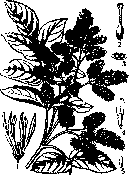
Manna: 1- flower; 2- pistil; 3- cross-section of ovary; 4- fruit; 5 - seed.
medical application. - The main constituent part of medical sorts of M. are mannitol (80- 4)0%, in the worst sorts falls to 25%), sugars (different) (2--11%), mucus, glycoside fraxin CeHuOs.O.C10H7O4 (traces) and other. - acids - 1-4%. M a n n i t - a six-atom alcohol, C6H14O6, obtained from M., rotates the plane of polarization to the right; sweet taste; dissolves in 7 parts of water, difficultly in cold alcohol (1:100); melts at 165°. From hot alcohol precipitates upon cooling in the form of needle-shaped crystals, from water - in large rhombic prisms. - In medicine the best sorts of M. are applied as a mild laxative without side effects; its action is conditioned by irritation of the intestine by mannitol and saccharine substances in combination with colloids. From M. prepare infusion, decoction, syrup (Sirupus Mannae), solutions and kashki; M. is also mixed with various laxatives: for example, Vienna drink (Infusum Sennae compos.) also contains M. (but Ph VII replaced M. in Vienna drink with purified honey). - M., obtained in other countries, in some places serves as a food substance. Even the ancient Egyptians knew "Manni", i.e. dried juice, collected from young branches of the shrub Tamarix mannifera Ehrenb. after bites of the plant by insects Coccus manniparus. This M. consists of a mixture of cane sugar (55 %), inverted sugar (25%) and dextrin (20%). Arabs consume the mentioned M. as food and consider it the one with which the Jews fed during their exodus from Egypt. This sort of M. is collected at present on Sinai and is called Sinai M. (Manna tamariscina). Persian sorts of manna are obtained from different shrubs and trees of the families of legumes (Papilionaceae), willows (Salicaceae), beeches (Fagaceae), apple trees (Pomaceae) and buckwheats (Polygonaceae), on the branches and leaves of which exudes sweet, congealing in drops juice. Persian M. is used as food and consumed as a delicacy. The M. mentioned in the history of the Jewish people ("heavenly") apparently represented a mass of lichen Lecanora esculenta Evers., sometimes appearing in abundance in the deserts of North Africa after strong rain or wind. These are small roundish pieces, mucous, gray outside, white inside, edible. In food sorts of manna there is no mannitol.
Related articles
Mentioned in
- Affective Psychoses
- Aidoiomania
- Amenomania
- Andromania
- Astenomania
- Catatonia
- Chorea
- Homicidomania
- Homilopathy
- Hydromania
- Hypomania
- Hysterical Psychoses
- Manic State (a state of psychiatric excitation, a symptom)
- Manic State (is a condition that may be feared to transition)
- Manic-Depressive Psychosis
- Megalomania
- Periodic Psychoses
- Psychoneuroses
- Theodor Meynert
- Vesania
Cite this page
“Mania.” Soviet Medical Encyclopedia. English translation of Bolshaya Meditsinskaya Entsiklopediya, 1st ed. (Moscow, 1928–1936), ed. N. A. Semashko. https://sovietmedicalencyclopedia.pages.dev/article/mania/