Mint
Historical document, translated for reference. It reflects medical knowledge of the 1920s–30s and is not medical advice.
Summary
Mint (Mentha) is a perennial herbaceous plant of the Labiatae family. The most common varieties used in medicine are Mentha piperita (peppermint) and Mentha crispa (curly mint). The article describes their botanical characteristics, chemical composition, medicinal properties, and industrial applications.
Encyclopedia article (1928–1936)
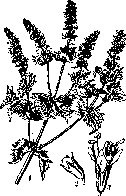
MINT (Mentha), a herbaceous perennial plant of the Labiatae family. Of the many varieties of mint, the most commonly used in medicine are Mentha piperita L. - peppermint and Mentha crispa Valerii Cordi and L. - curly mint. Ray first mentioned peppermint in 1696 in England, where it began to be cultivated and from where it spread to other countries under the name of peppermint or English mint. It is cultivated in England, USA, Italy, France, Germany, Japan, USSR and other countries. Its origin may be from Mentha viridis (Tikhomirov) or from Mentha aquatica (Kalning); Japanese mint is Mentha arvensis, Chinese mint is Mentha aquatica. The North American Mentha canadensis, used by Indians instead of true mint, is closely related to the latter. Mentha viridis: 1- top of a flowering plant; 2- floral bud; 3- bisexual flower.
The leaves of peppermint are opposite, attached to a four-sided stem, petiolate, egg-shaped with a pointed apex or lanceolate, with needle-toothed edges, bare, covered with hairs along the nerves, dark green on top and lighter underneath. The surface of peppermint leaves is covered on both sides with small, visible under a magnifying glass, yellow-brown glands of essential oil. The length of the petiole is 8-10 mm, the length of the leaves is 5-8 cm, width up to 3 cm. Curly mint (Mentha viridis) and its variety Mentha crispa L., s. Mentha crispa Schrader) have opposite leaves, sessile or nearly sessile, broadly egg-shaped, heart-shaped at the base, quickly tapering to the apex, the edges and entire surface of the leaf are curly. The width of the leaves is up to 3 cm. They are bare or covered in places with long hairs. Oil glands are located on both sides of the leaf. The smell and taste are pleasantly aromatic, sharply different from the smell and taste of peppermint M. In medicine, only dried leaves of M., collected from a flowering plant (from the end of June to August) are used. Dried leaves of peppermint M. should have a strong and pleasant smell and a burning taste, leaving a prolonged sensation of cold. - Adulterants to peppermint M.: Mentha silvestris, M. forest, growing wild, leaves almost without petioles, white-downy underneath and with a weak smell; Mentha aquatica, M. water - leaves egg-shaped or elliptical and downy; Mentha viridis L., M. curly (see above). The main component, by which the quality of the product is determined, is essential oil (0.3% in fresh leaves, 1.5% in dry). The essential oil of peppermint M. consists of menthol (see), mentone - C10H18O (7-17%) - a liquid boiling at 204°; of hydrocarbons: pinene and limonene C10H16 (up to several percent); of menthol esters with acetic, valeric acids (sometimes up to 27%) and a small amount of other substances. In the leaves of curly M., both fresh and dried, there is essential oil, which is carvol C10H14O dissolved in terpenes, a cyclic ketone, isomeric with carvol of caraway fruits and differing from it in the rotation of the plane of polarization to the left. The USSR's need for peppermint M. leaves is 8-9 tons annually. In addition, for the production of peppermint oil, about 4,000 tons of peppermint M. leaves are used. M. is cultivated mainly in Ukraine (in Poltava), in the Central Black Earth Region, Tatar Republic, in the former Tambov and Tula governorates. Peppermint M. leaves are exported. The USSR's need for curly M. leaves is insignificant. Curly M. leaves are exported in small quantities. Peppermint oil, Oleum Menthae piperitae (Ph. VII); is obtained by distilling peppermint M. with sufficient water; it is a transparent liquid, sometimes pale yellow, sometimes greenish-rainbow in color, with a pure smell of peppermint M. and a burning taste, leaving a prolonged sensation of cold on the tongue. The best English oil (mitcham variety) contains 42-63% menthol and 9-12% menthone. American peppermint oil contains 50-60% menthol and 9.16% menthone. Japanese oil contains 70-91% menthol. Dementholated Japanese oil, usually arriving on the market, contains 49-55% menthol and 21-30% menthone. German oil contains 48-55% menthol and 32-33% menthone. French oil contains 43.7-46% menthol and 8.8-9.6% menthone. According to the all-union standard, the amount of menthol in rectified oil should be at least 50%, menthone - no more than 18%. Specific gravity 0.895-0.912 at a temperature of 20°. Rotation angle 20-32°; non-volatile residue after evaporation on a water bath no more than 3%. One volume part of the oil dissolves in 4-5 volume parts of 70% alcohol. In quality, Russian peppermint oil is not inferior to the best varieties of American and German.-Peppermint oil on the skin causes irritation, manifested by a feeling of itching and hyperemia; the latter causes a sensation of heat at the site of action of the oil. On mucous membranes, peppermint oil also causes irritation, hyperemia, pain, burning; in the oral cavity - a pleasant taste sensation if there is little oil (in strong dilution), reflex increase in salivation, in the throat - a sensation of heat; appetite increases, secretion of gastric mucus increases; the feeling of fullness and pressure in the stomach disappears in cases of its overfilling with food. Somewhat weakening effect of small amounts of essential oil on the motor ability of the stomach and on the tone of its muscles, causing relaxation of the stomach sphincters, contributes to the disappearance of the feeling of fullness and pressure in the stomach, faster emptying of it and easier passage of gases, all the more so that small doses of peppermint essential oil simultaneously increase intestinal peristalsis. Large amounts of peppermint essential oil weaken the movements of the intestines, eliminate spasms and thus stop pain (colic). In this case, it should be assumed that the oil acts locally depressingly on the motor and sensory nerve endings in the intestinal mucosa. In addition, peppermint essential oil has an antiseptic effect, which is why during summer diarrhea, peppermint tea is given instead of drinking water. Peppermint oil is added to tooth powders not only for the pleasant smell and slightly cooling taste, but also due to its antiseptic effect. Peppermint oil is easily absorbed, but does not cause a general effect with relatively small doses. A cut heart under the influence of peppermint oil contracts more frequently, and then the acceleration is replaced by slowing and weakening of heartbeats. Large doses of peppermint oil after absorption, being excreted through the kidneys, could cause irritation of the kidneys. Peppermint oil is excreted from the body partly in unchanged form through the lungs and kidneys, but in much larger quantities it is excreted through the kidneys in modified form; it is oxidized and leaves the body, combining with glucuronic and sulfuric acids. From peppermint oil, Aqua Menthae piperitae (Ph. VII), Aqua Menthae piperitae spirituosa are prepared. Both peppermint waters are prepared from Oleum Menthae and are used in alkaline and other mixtures instead of distilled water as constituens and corrigens or as stomachicum.-Elaeosaccharum Menthae, oil-sugar with peppermint essential oil - as constituens and corrigens when preparing various powders.-Tinctura Menthae piperitae (peppermint drops) (Ph. VII); is used on sugar (2-3 drops), in mixtures with other tinctures as stomachicum, antispasmodicum. In folk medicine - for abdominal pain, colic, nausea. For the same purpose, Infusum fo 1. Menthae piperitae ex 5:200 is prescribed. - Trochisci Menthae piperitae; peppermint lozenges (Ph. VII); used as stomachicum. - Peppermint oil is widely used in dental preparations (rinses, pastes and powders). In Europe and especially in the USA, peppermint oil is consumed in huge quantities for the production of so-called "chewing gum", which are desugarized lozenges of gutta-percha and peppermint oil, which are sucked and then chewed for a long time. In 1925, 40,000 kg of peppermint oil was used for chewing gum.-Peppermint oil is used in the perfumery, food-flavor and pharmaceutical industries. The total demand for the USSR is approximately 100 tons of oil per year. Peppermint oil is exported. With sufficient export resources, exports can be increased to 100 tons or more per year. The procurement price of peppermint oil is on average 15-20 rubles per 1 kg.-Peppermint oil from curly M., Oleum Menthae crispae, is not used in medicine. Its demand is 10-12 tons per year for the perfumery industry; it is used mainly due to its significant content of linalool and only a little carvol. With this composition, Oleum Menthae crispae, produced in the USSR, differs from similar products produced in other countries, characterized by their significant carvol content.
Related articles
Mentioned in
Cite this page
“Mint.” Soviet Medical Encyclopedia. English translation of Bolshaya Meditsinskaya Entsiklopediya, 1st ed. (Moscow, 1928–1936), ed. N. A. Semashko. https://sovietmedicalencyclopedia.pages.dev/article/mint/