Valeriana
Historical document, translated for reference. It reflects medical knowledge of the 1920s–30s and is not medical advice.
Summary
Valeriana (Valeriana officinalis) is a perennial plant from the Valerian family, whose rhizome is used in medicine. The article discusses its chemical composition, therapeutic effects on the nervous system, various preparations, and historical medical applications.
Encyclopedia article (1928–1936)
Valeriana, Valeriana officinalis L. (pharmacy Valerian, maun, cat's herb), a perennial plant from the family Valerianaceae, commonly found in moist places and deciduous forests of central and northern Europe and cultivated in almost all countries. For medical purposes, the rhizome (Rhizoma Valerianae) is used from specimens that grow in dry, rocky, mountainous and forested places, densely covered with numerous (adventitious) roots; hence also the name - Rhizoma Valerianae minoris (montanae, silvestris), since the rhizomes from them are generally considered more active than from specimens growing in wet, low-lying places. The dried rhizome has a sharp, unpleasant odor and a rather sharp, bitter-spicy taste. The smell of the fresh root is significantly weaker than that of the dried one. The essential oil (about 1%) extracted from valerian root, Oleum Valerianae, contains two terpenes of the formula C10H16, boiling at 155-160°, numerous esters of formic, acetic and, especially, isovaleric acids, and borneol (borneol camphor, C10H18O), a considerable part of which is in the form of a complex isovaleric ester. During storage, the essential oil becomes acidic and contains free acids. The active constituents of the rhizome are very easily destroyed, and therefore the activity of extracts and tinctures obtained from it is very inconsistent. The therapeutic action of Valeriana is apparently due, mainly, to the terpenes and
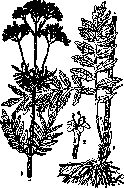
Valeriana officinalis: 1 and 3-flowering plant (1-upper part, 3-lower); 2-flower.
borneol; while valerianic acid itself, according to experimental data, is little active. Views on the therapeutic value of Valeriana sharply diverge; some authors believe that its calming effect on the excited central nervous system is of a reflex nature (from the side of the olfactory and taste organs), due to its unusual and unpleasant odor and taste, and is not due to the direct action of Valeriana on the cells of the nervous system after the drug is absorbed into the blood; others recognize a direct calming effect on the healthy and especially on the abnormally excited nervous system. If the reflex nature of the action does take place, it cannot be denied a certain degree of 'specificity', judging by the experiments of Semichev (from the laboratory of N. P. Kravkov), which showed that various essential oils have different effects on the gas exchange of the animals inhaling them, as well as on the basis of everyday practice in applying these fragrant oils to people. Numerous experimental investigations of comparatively recent times have shown that in small doses, the essential oil of Valeriana has an exciting effect on the central nervous system, especially on the respiratory and vasomotor centers, whereby respiration is strengthened, blood pressure is increased and reflex excitability is increased; while in large doses, on the contrary, it causes depression of the functions of the central nervous system, decreasing reflex excitability and lowering blood pressure. A striking example of such experiments is the old observation of Binz (1876), which showed that in rabbits that had previously been given valerian oil subcutaneously, convulsive doses of brucine and ammonium carbonate no longer have their characteristic effect. The reduction of painful sensations in the abdominal cavity, e.g., in gallstone disease, this author hypothetically explains by Valeriana's ability to lower the excitability of sensory nerves and relax the musculature of the bile ducts. The calming effect of Valeriana in various kinds of unpleasant sensations in the heart area can also be partly explained by the relaxation (dilation) of the coronary vessels, which is characteristic (according to experiments on the isolated heart) of one of the components of Valeriana - borneol. The presence of the latter in greater or lesser degree in various preparations of Valeriana, as well as the different content in them of other active components of Valeriana, should to a large extent be reflected in the results of studying the therapeutic action of Valeriana. After taking large doses of Valeriana, symptoms of acute poisoning may be observed, giving not always the same picture: thus, Trousseau, on himself personally after taking 30.0 of Valerian infusion, observed only a slight headache, decreased hearing, vision and muscular activity and fleeting dizziness. Other authors, however, point out that from approximately the same dose, belching, vomiting, abdominal pain, severe headache, increased pulse, increased urination, dilated pupils, blindness, staggering gait, sharp depression or excitation of the cerebral cortex were observed. Valeriana is apparently excreted by the skin and kidneys, judging by the smell of sweat and urine after taking valerian internally. Valeriana preparations are extremely numerous. Besides galenic preparations (infusions, tinctures and extracts), the activity of which is very variable, synthetically obtained compounds of borneol and its esters with formic, acetic and valerianic acids, as well as amides of valerianic acid (especially diethylamide), are also used, which, according to Kionka, act on the central nervous system similarly to the rhizome of Valeriana. In former times, Valeriana was considered almost a specific remedy for hysteria and epilepsy. Now Valeriana preparations are used in states of excitement, insomnia, nervous palpitations, in pains and convulsive symptoms, especially in hysterical, nervous individuals, in epilepsy, and also as a stimulating agent in asthenic conditions, decline of cardiac activity, collapse (for the latter indications, the ethereal tincture of Valeriana is considered more suitable than the alcoholic one). Of the preparations should be mentioned: 1. Infusum Rhizomae Valerianae (10.0-15.0 : 180.0)-a tablespoonful several times a day. 2. T-ra Valerianae spirituosa s. simplex; prepared by infusing 1 part of finely cut Valerian rhizome and 5 parts of diluted wine alcohol; a brown-colored tincture; 20-50 drops per dose, several times a day. 3. T-ra Valerianae aetherea; prepared by infusing 1 part of valerian root and 5 parts of Spiritus aethereus; yellow, subsequently browning, tincture; doses the same as the previous one. 4. Valyl, Valylum, C5H9CO.N(C2H5)2-diethylamide of isovaleric acid, sold in capsules (to prevent oxidation in the air) containing 0.125 each. Orally 1-2 capsules twice or three times a day. 5. Validol (see). 6. Bornsal (see). 7. Valisan, Valisamin, the ethereal ester of monobromo-isovaleric acid C5H9 : CH.CHBr.COO.C10H17, an oily liquid of weak, slightly aromatic odor and taste; insoluble in water. Contains 25% bromine. Given in gelatin capsules containing 0.25 each, several times a day, 1-3 capsules per dose. 8. Adamon (see). 9. Bromural-monobromo-isovaleranyl-urea.
Related articles
Mentioned in
Cite this page
“Valeriana.” Soviet Medical Encyclopedia. English translation of Bolshaya Meditsinskaya Entsiklopediya, 1st ed. (Moscow, 1928–1936), ed. N. A. Semashko. https://sovietmedicalencyclopedia.pages.dev/article/valeriana/