Navashin
Historical document, translated for reference. It reflects medical knowledge of the 1920s–30s and is not medical advice.
Summary
Navashin was a founder of genetic cytology who discovered double fertilization in flowering plants, establishing it as a characteristic of all angiosperms. His research also focused on nuclear variability within species and chromosome relationships.
Encyclopedia article (1928–1936)
Navashin Sergei Gavrilovich (1857-1930), one of the founders of genetic cytology. After graduating from Moscow University, Navashin was an assistant to Timiryazev at the university and at the Petrov Academy (1885-88), and an assistant in botany at St. Petersburg University under Borodin (1888-94). He defended his master's dissertation on the topic "On the disease of birch catkins." While studying this disease, N. traced fertilization in birch and made the discovery of oogamy in this plant. From this, N. took the topic for his doctoral dissertation, which he defended in Odessa, already being a professor at Kyiv University (1894-1915). In Kyiv, N. conducted a series of studies on fertilization, among which was the famous study on double fertilization in lilies. N. confirmed this discovery both in orchids, which he had the opportunity to study in Java, and in composite plants (sunflower). Consequently, double fertilization could be considered a characteristic common to all angiosperms. On the basis of this discovery, de Vries explained the phenomenon of "Xenia," which until then had seemed completely incomprehensible. The topic of N.'s further research became the variability of nuclear structure in individuals of the same species, mainly the size of chromosomes and their mutual relationships. On the basis of such differences, N.

established within the species two races: one with a symmetrical nucleus structure, the other with an asymmetrical nucleus. In 1917, N. was elected a full member of the Academy of Sciences. From 1915 to 1920, N. was a professor in Tiflis. In N.'s cytological works, keen observationability manifested itself, which, in connection with the microscopic technique raised by him to a high level, attracted to him a significant number of students. N. belongs to over 80 printed scientific and popular science works in Russian and German. The most important of them: "Lower organisms as causative agents of tumor-like formations in plants" (Russian Arch. Pathol., Clin. Med. and Bacteriol., Vol. IV, 1897); "Infectious diseases of plants" (chapter in the book "Medical Microbiology", edited by L. Tarasevich, Vol. III, P. - Kyiv, 1915); "The principle of continuity and new methods in the doctrine of the cell of higher plants" (J. Russian Bot. Soc., Vol. I, 1916); "On some principles of the internal organization of chromosomes" (Collection, dedicated to K. A. Timiryazev, M., 1916); "Units of life" (Works of the Timiryazev Scientific Research Institute, Series 2, Vologda, 1925); "Factor of organic evolution" (ibid., Series 9). . MANURE, Excrements and urine of animals, mixed with the bedding on which the livestock stands. - Accordingly, straw manure, peat manure and others are distinguished. N. is a valuable fertilizer in agriculture. In cities and other places, manure can pollute soil, water and air. The same can happen in rural-type areas where careless storage and untimely removal of N. is observed. In the chernozem zone of the USSR, manure is also used as fuel, which is now considered irrational in view of the loss of valuable fertilizing substances contained in N. - The amount of N. varies depending on the method of arranging livestock yards, the amount of bedding used, the frequency of cleaning stalls and the feed of animals. "Rules for cleaning settlements with sparse construction in the absence of sewerage", approved by the II All-Union Water Supply San.-Tech. Congress (1927), give the following norms for accumulation of N. per head of livestock per day (together with bedding): cow - from 0.040 to 0.080 m³, horse - from 0.030 to 0.055 m³, pig - about 0.010 m³, sheep, goat - about 0.007 m³. For approximate calculations, one can take accumulation of 1 m³ per head of livestock per month. From an agricultural point of view, cow manure is considered the best, containing more water and decomposing slowly in the soil. Horse manure is drier, its decomposition goes faster, and it heats up quickly, for which it is called "hot". The least value is manure from pigs and sheep. The fertilizing properties of N. depend on its composition, containing valuable substances for plants: nitrogen, phosphorus, potassium.
0.40,0.53 0.67 0.60 75.0 75.0:79.0 21.20 3.8 19.2 14.5 5.8! 6.5 0.39 0.50 0.58 0.18 0.26 0.30 0.45 0.63 0.50 Another basic property of N., making it a valuable product for agriculture, is its ability to restore the structure of depleted soils. Soil cultivation destroys the crumbly structure of the soil, turning its upper layers into a dusty mass. N. restores this structure, gluing soil particles into small clods, which is very important from the point of view of the water and air regime of the soil. Finally, by coloring the soil black, manure contributes to its better warming, and with its bacterial environment, it increases the number of nitrifying bacteria in the soil. The sanitary significance of N. is determined by three moments. Firstly, N. can pollute soil and water bodies with organic substances. This occurs with poor arrangement of livestock yards, manure storage facilities, when N. is dumped near wells, along river banks, etc. The method of strengthening dams with the help of N. deserves complete condemnation. Secondly, N. can be an environment in which pathogenic microorganisms persist. To diseases of people and animals, in the spread of which N. can play its role, should be included tetanus, anthrax, glanders and other diseases of livestock. In addition, due to the frequent use in our rural conditions of livestock yards as latrines, N. can contribute to diseases of typhoid fever, cholera, dysentery and other intestinal diseases. N. can also play a significant role in the development of helminthiases by contaminating pastures for livestock, water bodies and garden crops with helminth eggs. Thirdly, N. is a favorite place for breeding flies, and in the fight against flies, the method of storage, processing and removal of N. has primary importance. - To eliminate the harmful effects of N., the following measures should be carried out: proper arrangement of livestock yards, stables, a floor impervious to liquid (the simplest way for this is to lay a layer of compacted clay under a wooden floor), ensuring the flow of urine through impervious gutters or channels into an impervious receiver (urine or slurry collector). Absorption pits should be strictly prohibited. No less important is the timely removal of N. to specially equipped manure storage facilities. The latter are arranged either of the above-ground type or recessed into the ground. In Figure 1, an example of an above-ground manure storage in the form of a wooden box of grooved and tarred boards is given. The dimensions of the box depend on the number of livestock heads and the cleaning periods. Generally, it should be said that above-ground manure storage facilities are suitable only for temporary storage of manure on the assumption of its further removal to the place of consumption, why they can be recommended in cities and urban-type settlements. In Fig. 1, the dimensions are given as 2x2x0.89 m (calculation for 10 heads of large livestock with the condition of weekly cleaning). From above, the storage is covered with a wooden shield (for protection from flies). The box is installed on sleepers, to avoid soil contamination. For the same purpose, the place where the manure storage is installed should be paved or a special platform of compacted clay is arranged for it. In rural farms, storage facilities for N. recessed into the ground are usually arranged. Such can serve as receivers of concrete or brick ones. As the simplest type, the device shown in Figure 2 can be recommended. Finally, in large farms, special fermenters for N. are arranged, in which the loss of fertilizing properties of N. is minimized. Their type is shown in Figure 3.
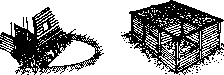
Figure 2.
Figure 3.
Figure 2. Manure storage pit with a well for liquid manure. The bottom and sides of the pit are tamped with clay. The bottom is made sloping toward the wellt. Figure 3. One of the simplest types of open fermenter. The method of open storage of manure in the form of compost heaps is also used. When arranging them from a sanitary point of view, care should be taken to protect the soil from contamination by equipping an impervious platform and a similar receiver for liquid (the latter, collected in liquid manure receivers, is used for watering the heap). From both sanitary and agronomic points of view, the German method for obtaining so-called high-quality manure (Edelmist) deserves the greatest attention. This method consists of the following. N. is stacked in very loose layers, as a result of which a high temperature (up to 70°) quickly develops in it due to the vital activity of aerobic bacteria. After 3-4 days, N. is strongly compacted by tamping it. The displacement of air stops the decomposition processes of N., the temperature inside it drops; N. until it is transported to the field remains in a semi-decomposed state, which helps to preserve nitrogen reserves, which with complete decomposition would have volatilized into the air due to the vital activity of denitrifying bacteria or would have been washed away by rains. It is not difficult to see that all methods of improved storage of N. also contribute to sanitary purposes, since the heating of N. in heaps, manure pits, fermenters, etc., causes the death of pathogenic microbes, helminth eggs, and fly larvae. Sometimes it is necessary to resort to treating N. with chemical substances. For this, bleaching powder (10% solution), tar in alkaline solutions, and iron vitriol (5% solution) can be recommended. However, these substances do not protect a person from roundworm eggs, since the shells of the latter do not allow salts, alkalis, or acids to pass through. To combat them, hot water or steam can be used. In large livestock farms, where the protection of livestock from diseases, including helminthiases, is of primary importance, the most radical measures for disinfecting manure should be taken. Under ordinary agricultural conditions, however, it is necessary to limit oneself to the daily removal of N. from stalls, the rationalization of its storage, as indicated above, i.e., to carry out those measures that, with the least expenditure, give the greatest effect in terms of obtaining fertilizer and disinfecting manure.
Related articles
Mentioned in
Cite this page
“Navashin.” Soviet Medical Encyclopedia. English translation of Bolshaya Meditsinskaya Entsiklopediya, 1st ed. (Moscow, 1928–1936), ed. N. A. Semashko. https://sovietmedicalencyclopedia.pages.dev/article/navashin/