Schick Reaction
Historical document, translated for reference. It reflects medical knowledge of the 1920s–30s and is not medical advice.
Summary
This article describes the Schick reaction, a test developed in 1913 to determine a person's susceptibility to diphtheria by injecting a small amount of diphtheria toxin into the skin.
Encyclopedia article (1928–1936)
SCHICK REACTION (Schick) was proposed in 1913 for determining the degree of susceptibility to diphtheria. The S. r. is performed by strictly intradermal injection of diphtheria toxin in a volume of 0.2 cm3, containing 1/40 Dim (see Diphtheria). The toxin is injected into the skin of the left hand; into the skin of the right hand, an equal amount of toxin heated at 100° for 10 minutes is injected for control. The results of the injection are noted after 24 and 96 hours, during which the following phenomena may be observed: 1. In the complete absence of reactive phenomena at the site of injection of the "control" (heated) toxin, redness and an infiltrate appear at the site of injection of the active toxin, accompanied by a sensation of mild burning and itching. These phenomena develop within the first day, reach a maximum on the fourth day, and then disappear, leaving pigmentation of the skin for some time. The degree of reaction can be judged by the size of the redness and infiltrate, which is designated as follows: + (a "suspicious" reaction—with an indistinct infiltrate and mild redness), + (with redness not exceeding 1.5 cm in diameter), + + (if the redness has a diameter from 1.5 to 3 cm) and + + + (if the redness is greater than 3 cm); this type of reaction is called a "positive" S. r. 2. In the absence of any reactive phenomena at the site of injection of both the heated and active toxin, an "negative" S. r. is said to exist. 3. If reactive phenomena are observed on both hands to the same degree, this phenomenon is designated as a "false" S. r. The degree of the false (with heated toxin) reaction is marked (similar to the positive) with one, two, or three signs. The reaction to heated toxin has certain qualitative differences from the reaction to active toxin: rapid appearance and disappearance (usually within 36–48 hours) and a predominance of exudative phenomena over infiltrative ones. 4. If reactive phenomena are observed on both hands but to a different degree, a "combined" S. r. is spoken of—when phenomena predominate on the side of the active toxin, and an "altered" S. r.—when phenomena predominate on the side of the heated toxin. The generally accepted views on the essence of the S. r. are as follows: if the test subject's blood does not contain antitoxin or it is present in an amount less than 1/30 AT in 1.0 ml of serum, the injected intradermal toxin causes reactive phenomena designated as a "positive" S. r. If, on the other hand, the test subject's blood contains a sufficient amount of antitoxin (according to Schick 1/30, according to Bering 1/100 and more AT in 1.0 ml of serum), the latter neutralizes the introduced toxin, resulting in an "negative" S. r. These positions are confirmed by the following observation: if a sensitive subject to diphtheria toxin is given a neutral mixture of "toxin-antitoxin", then as a rule no reaction is observed at the site of injection of this mixture. Furthermore, a whole series of simultaneous direct determinations of the amount of antitoxin in the blood by the Remer method were carried out in parallel with the S. r. (Schick, Ramon, Wexel, etc.). These experiments in most cases reveal the noted dependence of the result of the S. r. on the amount of antitoxin in the blood. The occasional discrepancies between these phenomena cannot shake the general rule, as they are quite rare: Jensen, for example, noted the presence of negative S. r. in 9% of cases with a negligible content of antitoxin (1/100 AT in 1.0 ml of serum). When evaluating the results of the S. r., it must be taken into account that in early infancy a negative S. r. is often observed in the absence of antitoxin in the blood. This is explained by the anergy of the skin inherent in early childhood. As for the so-called false S. r. and its variants (combined, altered S. r.), i.e., the reaction of the skin to heated toxin, it is explained by the sensitivity of the organism to thermostable products of diphtheria bacillus metabolism and substances of nutrient broth. This sensitivity is of an allergic nature. As Siegl showed, it consists of two components—specific and non-specific with respect to diphtheria. Zoller's observations showed the complete identity of the false reaction with the intradermal reaction to anatoxin (0.2 anatoxin diluted in a ratio of 1:100)—this is the so-called Zoller reaction. Depending on the result of the reactions to toxin and to anatoxin, Zoller divides all people into 4 groups (see table). Zeller imagines the process of immunization against diphtheria as follows: sensitive persons to diphtheria (Group I with a positive S. r.) upon meeting with the diphtheria bacillus (disease or carriage) or during artificial immunization become sensitized with respect to the microbe and its products. Their skin gives an allergic reaction; but since at this time not enough antitoxin has been formed, the skin reacts to active toxin as well (Group II with a false or combined S. r.). In the future, the amount of antitoxin in the blood increases to such an extent that the reaction to active toxin becomes negative, but the allergy still remains (Group III with an altered S. r.); finally the latter disappears, and a durable immunity characteristic of Group IV persons (with a negative S. r.) sets in. The significance of the S. r. as an immunoreaction is determined by the prevailing views on the nature of immunity in diphtheria. According to modern concepts, the latter is based on the presence of a sufficient amount of antitoxin in the blood. These concepts, as is known, determine modern practice of immunoprophylaxis of diphtheria (toxin-antitoxin mixtures, anatoxin). From this point of view, the S. r., conveniently replacing the cumbersome direct determination of antitoxin in the blood by the Remer method, can be considered an ideal method for clarifying the state of immunity, respectively, sensitivity, of a person to diphtheria. The question of the minimum amount of antitoxin in the blood necessary for the realization of durable immunity to diphtheria is controversial; in any case it must be noted the comparative rarity of diphtheria disease in persons having a negative S. r.; furthermore one can point to direct experimental confirmation of this question: Guetnrie, Marshall and Moss infected eight volunteers by smearing the throat with a virulent culture of diphtheria, of whom four had a positive S. r. and four a negative S. r. As a result, 4 persons of the first group developed a typical disease, and from the 4 persons with a negative S. r., 3 showed temporary carriage of the diphtheria bacillus without any signs of disease. A vast amount of work is devoted to the epidemiological significance of the S. r. It is evident from them that the S. r. represents a reliable method for determining the degree of the immune layer of a collective with respect to diphtheria. It turned out that if the positive S. r. are distributed by age, a curve (Zin-gher) of age sensitivity to diphtheria is obtained, which coincides quite accurately with the age distribution of diphtheria morbidity. The relatively high immunity of children in early infancy (up to six months) can be explained by passive transmission of immun-els through the mother's milk. As for the decrease in sensitivity to diphtheria with age (starting from one year), accompanied by the accumulation of antitoxin in the blood, some authors (Fried-berger and others) consider this phenomenon an expression of "physiological serogenesis", i.e., that the accumulation of antitoxin proceeds in a physiological order, accompanying such maturation of the human organism, while other authors (Zinger, Dedli, Ramon and others) consider that people accumulate antitoxin in the blood as a result of an obvious, more often "silent" infection by diphtheria (see figure). The epidemiological value of the S. r. also consists in the fact that it is convenient to use for the selection of persons subject to (in case of a positive result) active immunization against diphtheria. It is usually applied in children
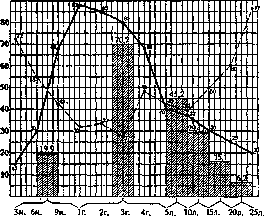
"-~-» $лиц, имеющих антитоксин в крови ( по Грееру) °--«> %лиц o положит, реакцией. Шика ( по Парку и Цкнгеру) столбики - заболевагмость дифтерией Распределение по возрасту: лиц, имеющих антитоксин в крови (в %); лиц c положительной реакцией Шика (в %); заболеваемости дифтерией (°/ooo каждого возраста). в возрасте свыше 5 лет, имея в виду относительную редкость отрицательней Ш. p. в возрасте до 5 лет. Наконец III. p. применяется и в качестве объективного контроля эффективности предохранительных прививок против дифтерии. Эта эффективность доказывается переходом положительной (до прививки) Ш. p. в отрицательную после вакцинации (обычно через 6 недель после последней прививки). Техника производства Ш. p.: 1. Для того, чтобы приготовить необходимое разведение токсина в нужном объеме, исходят из Dim токсина. Допустим Dim токсина = 0,0032. Чтобы приготовить токсин, содержащий I/4l) Dim в 0,2 объема, поступают так: берут lOODlm, в данном случае = 0,32, и добавляют физиологического раствора до 10,0, т. e. 9,68. Берут 1,0 этого разведения (т. e. 10 Dim) и прибавляют к 79,0 физиол. раствора. Тогда в 80,0 второго разведения имеется 10.Dim; в 1 см3 следовательно-V» Dim, a в 0,2-Vio Dim. При каждом разведении необходимо брать свежую сухую пипетку, промывая ee не менее 10 раз. При этом необходима особенная четкость отмеривания и точность пипеток (половину приготовленного т. o. разведения токсина переливают в отдельную колбу и ставят в кипящую водяную баню на 10 мин.; т. o. получают гретый токсин для «контроля»). B виду того, что токсин, разведенный физиол. раствором, быстро теряет свою активность, удобнее для разведения брать т. и. боратно-буферный раствор (см. Дика реакция), в котором разведенный токсин сохраняет свою силу в течение несколь-I ких месяцев. 2. Впрыскивание производится строго внутрикожно, всего удобнее при помощи туберкулинового шприца c платиновой очень тонкой иглой (№ 18, 19). Игла должна иметь короткую бородку. Бородку при инъекции надо держать кнаружи. Введение токсина совершается медленно c известным напряжением, характерным для внутрикожного введения жидкости, и в результате на месте укола образуется хорошо отграниченный пузырек (Quaddel), имеющий вдавления на месте волосяных мешочков. 3. Впрыскивание активного токсина производят в кожу предплечья левой руки, гретый токсин вводится в кожу предплечья правой руки. При массовой постановке III. p. рекомендуется производить двум врачам одновременно - один вводит активный, другой гретый токсин. 4. Отсчет Ш. p. производится два раза: через 24 часа для учета ложных реакций и через 96 часов, когда истинная Ш. p. достигает кульминационного пункта.
Related articles
Mentioned in
Cite this page
“Schick Reaction.” Soviet Medical Encyclopedia. English translation of Bolshaya Meditsinskaya Entsiklopediya, 1st ed. (Moscow, 1928–1936), ed. N. A. Semashko. https://sovietmedicalencyclopedia.pages.dev/article/schick-reaction/