Synapsis In Cytology
Historical document, translated for reference. It reflects medical knowledge of the 1920s–30s and is not medical advice.
Summary
Synapsis refers to the stages of reduction division in sex cells preceding tetrad formation. It involves the collection of chromatin into a compact ball of threads at one pole of the nucleus, with subsequent stages showing paired chromosomes and genetic recombination.
Encyclopedia article (1928–1936)
SYNAPSIS IN CYTOLOGY - stages of reduction division in sex cells, preceding the formation of tetrads. Morphologically, it consists of the fact that in young ova- and sperm-cytes, a collection of chromatin in the form of a compact ball of threads (synaptic ball) is observed at one of the poles of the nucleus, while the remaining space of the latter gives the impression of being empty (see fig.). At the next
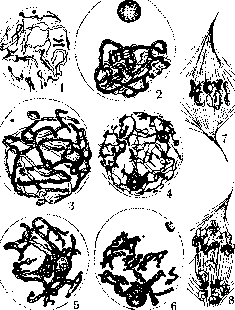
Reduction division in Adoxa moschatellina. 1- leptotene, the beginning of the approach of chromatin threads; 2- synapsis; 3-gradual thinning of the network, pachytene; 4-pachytene has filled the entire nucleus; 5-longitudinal splitting of pachytene; 6-strong spiral twisting of partners around each other; 7 and 8-first division of maturation. (According to Lagerberg from Tishler.)
stages from this compact mass, individual loops are distinguished, representing paired, intricately intertwined chromosomes. The final stage, characterized by paired chromosome threads oriented toward the adjacent centrosome of the nucleus, is called the bouquet stage. Careful study allows one to divide the processes occurring here into several stages of reorganization of chromatin substance: 1) leptotene stage - stage of paired, clearly visible thin chromosomes; 2) pachytene stage - chromosomes shorten, thicken, the space between them disappears; 3) streptotene stage - chromosomes again move somewhat apart and become visible as tetrads, representing paired connection of split chromosomes. At the stage of S. apparently conjugation of paired chromosomes occurs, as a result of which qualitative changes occur in the gene set contained in them - a circumstance of exceptional importance for all cytology of heredity. The morphological picture of S. itself is subject to doubt from the point of view of distortion of the true structure of nuclear substance during fixation. However, deviations from the in vivo structure probably cannot affect the essential aspects of the picture. Some authors (Gur
Related articles
Cite this page
“Synapsis In Cytology.” Soviet Medical Encyclopedia. English translation of Bolshaya Meditsinskaya Entsiklopediya, 1st ed. (Moscow, 1928–1936), ed. N. A. Semashko. https://sovietmedicalencyclopedia.pages.dev/article/synapsis-in-cytology/