Transcaucasian Resorts
Historical document, translated for reference. It reflects medical knowledge of the 1920s–30s and is not medical advice.
Summary
A historical overview of the resorts in the Transcaucasian region of the USSR, detailing the geological structure, volcanic history, and balneological characteristics of the area. It includes a classification of mineral springs and a list of major resort locations.
Encyclopedia article (1928–1936)
TRANSCAUCASIAN RESORTS. Under the name Transcaucasian Resorts is known a prominent group of resorts of the USSR, located on the territory of the republics of the Transcaucasian SFSR. Transcaucasia represents a part of the Caucasian Isthmus, extending south from the Main Caucasian Range to the southern limits of the Caucasus, and consists of the lowland valleys of the Rion and other rivers of the Black Sea coast in the N.W., the Kura River and the lower reaches of the Araks in the N.E., and of the mountainous country of the Lesser Caucasus in the south. The Lesser Caucasus is connected to the Main Caucasian Range by the Meskhi Range, which separates the Rion lowland from the Kura lowland. The Lesser Caucasus is a complex mountain system consisting of many ranges and plateaus. Being the northern part of the vast so-called Armenian Highlands, the Lesser Caucasus system has much in common with this highland in its structure and origin. The arcuate folds of the mountains constituting the Lesser Caucasus system, independent of the folds of the Main Caucasian Range, are merely a continuation of the mountain folds extending on one side on the Asia Minor peninsula, and on the other—in Iran. The first of these folds have a north-eastern, and the second—a north-western direction. The region where these folds, moving towards each other, collide, coincides with the Armenian Highlands. Thus, the mountain folds of the Lesser Caucasus lie in the region of the gradual transition of the ridges of the Armenian Highlands from a north-western to a north-eastern direction. The formation of these folds occurred in different geological periods: its beginning dates back to the most ancient geological epochs, but it occurred most intensely at the end of the Tertiary and in the Quaternary epochs. After the formation of the folds of the Lesser Caucasus, at the meeting point of the north-western (Iranian) direction folds with the north-eastern (Tauro-Armenian) direction folds, i.e., in the central part of the Lesser Caucasus, where the folding underwent the strongest bending to the north, huge faults of the earth's crust occurred, which broke these folds into separate giant blocks—fragments, partly having sunk below their former level, partly raised or set obliquely. Huge masses of lava, poured out from the cracks of the faults and the craters formed from them, again soldered these blocks and formed in the central part of the Lesser Caucasus huge lava flows, changing the hitherto folded country into a plateau. This part of the Lesser Caucasus is called the Central Volcanic Region of Transcaucasia. The marginal mountains of the Lesser Caucasus are divided into the marginal mountains of Eastern Transcaucasia (from the folds of the north-western Iranian direction) and the marginal mountains of Western Transcaucasia, which are formed by the termination of the folds of the north-eastern (Tauro-Armenian) direction.
Geology of Transcaucasia. The entire vast central volcanic region of Transcaucasia is occupied by a continuous cover of igneous rocks of the newest, predominantly post-Tertiary age (basalts, andesites, trachytes, etc.) and vast deposits of volcanic tuff. This cover of volcanic rocks makes the study of the geological formations lying beneath it extremely difficult; therefore, they appear more or less known only outside the central region in the area of the marginal mountains of Transcaucasia and its vast lowlands. Thus, the Meskhi Range consists predominantly of granite, intersected by veins of porphyrite and other crystalline rocks; besides them, the composition of this range includes sedimentary formations of the Jurassic, Cretaceous, and Tertiary periods. Outcrops of granite are encountered in Transcaucasia also in the south-western part of the western marginal mountains (in the Pontic Range), in many places of the eastern marginal mountains of Transcaucasia, especially to the N. of Lake Gokcha and in the Zangezur Range. Of other geological formations in the western marginal mountains, deposits of the Cretaceous period, Tertiary formations, as well as diabases and porphyrites are developed. Tertiary formations, composing a significant part of the western marginal mountains of Transcaucasia, extend further along the northern edge of the central volcanic region (along the Adzharo-Akhaltsikhe and Trialeti ranges) and constitute the predominant rocks of both the Black Sea and Caspian lowlands, as well as the Steppe Plateau with the Kakhetian Plain and other plains at the southern foot of the Main Caucasian Range (Mingrelian, Gori, and Mukhrani). In the marginal mountains of Eastern Transcaucasia, along with granites, deposits of the Cretaceous and Jurassic periods are encountered, as well as in some places (Southern Karabakh, Gokcha Range) Paleozoic schists. Moraine deposits and high river terraces, consisting of accumulations of pebbles and other river material, belong to the deposits of the Quaternary system in Transcaucasia. The newest formations are loess deposits in river valleys and on high plateaus. Significant spaces of the Caspian and Black Sea lowlands are covered, like the Erivan Plain, with modern alluvial deposits. Volcanic activity in the Transcaucasian region was especially developed in the Tertiary and post-Tertiary epochs. In historical time, volcanic activity in Transcaucasia has hardly manifested itself. A modern manifestation of mountain-building processes in Transcaucasia are frequent and sometimes strong earthquakes. The seismic centers in Transcaucasia are Ararat, the Akhalkalaki Highlands, and the vicinity of Gori. Balneology of Transcaucasia. The complexity of the geological origin and structure of Transcaucasia serves as a sufficient explanation for both the abundance and the diversity of the mineral springs of Transcaucasia. Balneological Transcaucasian resorts are very numerous. By the abundance of mineral springs, Transcaucasia (especially Georgia) occupies one of the first places in the USSR. Balneological lists count more than 200 mineral springs in Transcaucasia, but in reality, there are more, since springs are often scattered in inaccessible places and have not yet been described. Various groups of mineral springs are encountered in Transcaucasian resorts. According to the classification of Bertenson, many springs of Transcaucasia belong to the group of alkaline waters: the classes of carbonated and alkaline-carbonated waters include the springs of many Transcaucasian resorts, in the first place—Borzhomi; there are few alkaline-saline waters known in Georgia, in Armenia the Arzni springs belong here; alkaline-Glauber springs are almost unknown in Georgia; in Kurdistan (Azerbaijan) the Isti-su springs are famous. Of the sodium chloride waters, several weak springs have been noted in Georgia. Iron waters of various classes (pure iron, iron-alkaline, iron-saline, iron-calcareous) are quite numerous in Georgia and are most famous at the resorts of Tsagveri and Utsera. Bitter waters are noted in Georgia and Kurdistan. The group of sulfur waters is distinguished by the greatest wealth in Transcaucasia. Numerous both warm and cold sulfur waters are encountered in Georgia and Azerbaijan. The most famous and widely used both for treatment and in baths are the numerous sulfur springs of Tiflis. Popular from this group are the springs of Makhindzhauri, Abano, Zekari, Tsikhis-dzhvari, Kursebi, Khresili, and many others in Georgia, the Surakhany springs on the Apsheron Peninsula, and the springs of the Shemakha and Lenkoran uyezds in Azerbaijan. There are many calcareous waters in Georgia (Kobi, Shovi, etc.). Of the acratotherms in Georgia, the springs of Abastuman and Tskhaltubo are especially famous. The radioactivity of the mineral springs of Transcaucasia is low. Deposits of therapeutic mud in the form of a special Transcaucasian subgroup are listed in the article Mud-treatment regions. Of these, the therapeutic mud of volcanic origin in Akhtala is of primary importance. In addition to application on the spot, treatment with imported Akhtala mud is carried out in Tiflis, Borzhomi, and Batum. In Azerbaijan, it is planned to use the sedimentary mud of Lake Boyuk-Shor (near Baku). Climatic Transcaucasian resorts. The Caucasus in general and Transcaucasia in particular are distinguished by a great variety of climatic conditions. Through the work of numerous researchers, data have been collected for the climatological characterization of many points of the Caucasus. This made it possible for Figurovsky to compile the best and currently generally accepted classification of the climates of the Caucasus. According to Figurovsky's scheme, the following climates are noted on the territory of Transcaucasia: dry subtropical of the Asia Minor type 40 east of Greenwich.
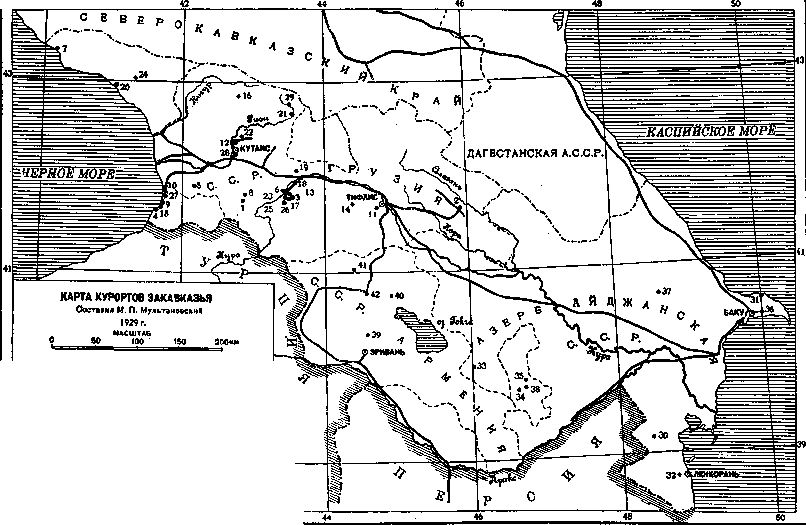
LIST OF RESORTS: 1. Abastuman, 2. Akhtala, 3. Bakuriani, 4. Batum, 5. Bakhmaro, 6. Borzhomi, 7. Gagra, 8. Zekari springs, 9. Zeleny Mys, 10. Kobuleti, 11. Kodzhori, 12. Kursebi, 13. Libani, 14. Manglisi, 15. Makhindzhauri, 16. Muashi, 17. Patara-Tsemi, 18. Sumbatovo, 19. Suram, 20. Sukhum, 21. Utsera, 22. Khresili, 23. Tsagveri, 24. Tsebelda, 25. Tsemi, 26. Tsikhis-Dzhvari, 27. Tsikhis-Dziri, 28. Tskhaltubo, 29. Shovi, 30. Arkevan springs, 31. Buzovny, 32. Verkhne-Andzhinskie springs, 33. Istisu, 34. Lysogorsk, 35. Stepanakert, 36. Surakhany, 37. Chukhuryurt, 38. Shusha, 39. Arzni, 40. Delizhan, 41. Dzhelal-Ogly, 42. Karaklis.
Railways. Resorts of the union, treaty, and autonomous republics and autonomous regions of the Transcaucasian Socialist Federative Soviet Republic (I), feather-grass steppes (II), dry continental Aral-Caspian type (III), humid subtropical (IV), Mediterranean subtropical (V), maize climate (VI), steppe Central Asian type (VII), high-mountain alpine region (VIII), moderately cold (IX), and cold (X). The distribution of these climates in Transcaucasia can be seen on the map of mountain climatic stations of the Caucasus (see Volume VII, pp. 751-752), where the climatic regions are numbered with Roman numerals corresponding to the numbers in the list just provided. Climatically, Transcaucasian resorts are divided into two groups: mountain and seaside. The complexity of the country's relief and the diversity of climatic conditions create the possibility for organizing mountain climatic stations at different altitudes. Mountainous areas scattered in many parts of Transcaucasia are considered suitable for climatic treatment. The number of such places noted in the literature for Transcaucasia reaches 90; the majority of them are not used. The best-known mountain climatic stations in use form the Borjomi, Adzharo-Akhaltsikhe, and Karabakh groups. Geographically, numerous resort areas located along the Caucasian coast of the Black Sea belong to Transcaucasia. Their northern part (Gelendzhik, Sochi, Matsesta, Krasnaya Polyana) is administratively part of the North Caucasian Krai. Their southern half, located within the limits of Abkhazia and Adzharistan (Gagra, New Athos, Sukhumi, Kobuleti, Batumi, Green Cape), is included in the group of Black Sea coast resorts. Sanatorium and seaside treatment is applied on the Absheron Peninsula. History of Transcaucasian resorts. The healing properties of many mineral springs of Transcaucasia have been known to the population since time immemorial. The ancient geographer and historian of Georgia, Prince Vakhushti, noted in the middle of the 18th century that the population had long used the waters of Abastumani and the muds of Akhtala for therapeutic purposes. The beginning of the scientific study of Transcaucasian resorts and the first measures for their improvement date back to the 1840s, when the Russian government carried out the equipping of Borjomi. Subsequently, main attention was also paid to the development of Borjomi and later Abastumani. The first measures for the use of mountain climatic stations, where summer camp sites for troops were set up and where government institutions were transferred for the summer, also date back to the second half of the 19th century. In the pre-revolutionary development of Transcaucasian resorts, several periods of renewed attention to resort affairs were noted, alternating with times of lull. The first such period of upswing is associated with the name of Remmert, who in 1869 was appointed manager of mineral waters of the Tiflis Governorate. In addition to the development of Borjomi, the improvement of Abastumani was initiated by Remmert; on his initiative, numerous analyses of the waters were performed. The second period of upswing is considered to be the years before and during the World War, when the government (represented by Fechner) and the Caucasian Society for the Promotion of the Development of Health Resorts took measures for the study and improvement of Transcaucasian resorts. Before the revolution, the majority of Transcaucasian resorts remained private property and were often used by the local population in primitive conditions. The Caucasian Medical Society in Tiflis played a major role in the study of Transcaucasian resorts. During the period of the revolution and the Civil War, Transcaucasian resorts fell into decay. With the establishment of Soviet power in Transcaucasia, a new period of state management of Transcaucasian resorts began. The decree of the Central Executive Committee and the Council of People's Commissars of the SSR of Georgia of February 3, 1923, established that health localities (resorts) constitute the property of the republic. The supreme administration of the health localities of Georgia was entrusted to the People's Commissariat of Health of Georgia, which organized the Main Resort Administration in Tiflis. The resorts of Borjomi, Tsagveri, Patara-Tsemi, Bakhmaro, Tsikhis-Jvari, Manglisi, Tskhaltubo, Batumi (beach), Kobuleti, Tsikhis-Dziri, Green Cape, and Makhinjauri were recognized as having national importance, and zones of mountain and sanitary protection were established for them. The resorts of Abkhazia are managed by a special resort administration. In 1925, a resort administration was separated within the People's Commissariat of Health of the SSR of Azerbaijan. More or less equipped among the Transcaucasian resorts are Borjomi, the climatic stations of the Borjomi group, Abastumani, Akhtala, Tskhaltubo, individual resorts of the Black Sea coast, Manglisi, Bakhmaro, Shovi, Stepanakert, Arzni, and Dilijan. The vast majority of Transcaucasian resorts have not been studied or equipped. Many even popular springs remain in a primitive state, and they are used only by the local population, who struggle to get there along inconvenient communication routes. In some places, there are some devices and facilities for visiting patients at the springs. In many places, however, visiting patients arrange their housing under carts or in tents; for bathing, they bring tubs and barrels with them, and heat the water with red-hot stones. Both the study and the equipment of Transcaucasian resorts, especially in Georgia and Azerbaijan, have advanced significantly in the post-revolutionary years. List of used Transcaucasian resorts. I. Georgia (including Abkhazia and Adzharistan). 1) Abastumani, 2) Akhtala-mud treatment, 3) Bakuriani, 4) Batumi-seaside, 5) Bakhmaro-climatic; 1,830 m, 6) Borjomi, 7) Gagra, 8) Zekari springs, 9) Green Cape-seaside, 10) Kobuleti-the same, 11) Kojori-climatic; 1,340-1,504 m, 12) Kursebi-balneological, 13) Libani-climatic, 14) Manglisi-the same; 1,250 m, 15) Makhinjauri-balneological, 16) Muashi-the same; Lower Svaneti, 17) Patara-Tsemi-climatic; 1,370 m, 18) Sumbatovo-the same, 19) Surami-the same; 730 m, 20) Sukhumi-climatic, 21) Utsera-balneological, 22) Khresili-the same, 23) Tsagveri-balneological and climatic; 1,022 m, 24) Tsebelda-climatic; 640 m, 25) Tsemi-the same; 1,116 m, 26) Tsikhis-Jvari-balneological, 27) Tsikhis-Dziri-climatic, 28) Tskhaltubo-balneological, 29) Shovi-climatic; 1,600 m. - II. Azerbaijan. 30) Arkevan springs of Lenkoran Uyezd, 31) Buzovna-climatic, 32) Upper Andzhin springs of Lenkoran Uyezd, 33) Isti-su-balneological, of Kurdistan Uyezd, 34) Lysogorsk-climatic and balneological; 1,920 m, 35) Stepanakert-climatic; 800 m, 36) Surakhany-balneological, 37) Chukhuryurt-the same, 38) Shusha-climatic; 1,368 m. - III. Armenia. 39) Arzni-balneological, 40) Dilijan-climatic; 1,280 m, 41) Jelal-Ogly-the same; 1,406 m, 42) Karaklis-the same; 1,324 m.
Related articles
Mentioned in
Cite this page
“Transcaucasian Resorts.” Soviet Medical Encyclopedia. English translation of Bolshaya Meditsinskaya Entsiklopediya, 1st ed. (Moscow, 1928–1936), ed. N. A. Semashko. https://sovietmedicalencyclopedia.pages.dev/article/transcaucasian-resorts/