Anesthesia
Historical document, translated for reference. It reflects medical knowledge of the 1920s–30s and is not medical advice.
Summary
Anesthesia is defined as a disorder of sensitivity where irritations from the periphery of the body are not conveyed to consciousness. The article describes various types of anesthesia including general, partial, dissociated, and their different distributions based on neurological pathways and pathologies.
Encyclopedia article (1928–1936)
ANESTHESIA (from the Greek a- negative particle and aisthesis-sensation), a disorder of sensitivity consisting in the fact that irritations transmitted from the periphery of the body are not brought to consciousness. If irritations are conveyed to consciousness not in full measure, one speaks of hypesthesia. If A. extends to all types of sensitivity without exception, it is given the name of general A. (anaesthesia totalis). If A. is limited to only certain types of sensitivity, it is customary to speak of dissociated or partial A. (anaesthesia partialis). In the case of partial A., with loss of tactile sensation, one speaks of A. in the proper sense (anaesthesia); with loss of painful sensitivity-analgesia (analgesia); with weakening of temperature sensation-therm-anaesthesia (therm-anaesthesia); with disorder of stereognostic sensation-astereognosis (astereo-gnosis). The dissociation of disorders (preservation of certain types of sensitivity with disorder of others) is explained by the fact that special conductors are designated for each type of sensitivity, which can be affected independently of others. When studying disorders of sensitivity, one does not limit oneself to only determining the character or degree of them, but also tries to establish their boundaries on the patient's body. A detailed study of disorders of sensitivity makes it possible to determine the location of the lesion, i.e., it is one of the most valuable means of topodiagnosis. Several types of A. are distinguished. With damage to peripheral sensory or mixed nerves (trauma, compression, neuritis), A. must exactly correspond to the areas of distribution of these nerves on the surface of the body; this is so-called peripheral type A. As can be seen from the illustrations, such A. is distributed according to polygonal fields (see illustrations 1, 2 and 5A). Diseases that affect the posterior roots cause disorders of sensitivity distributed on the surface of the body according to the root innervation of the skin and deep parts. Here, changes in sensitivity occupy almost parallel strips running along the length of the limbs, and on the trunk-across it; this is so-called root type of sensitivity disorders (see illustrations 3,4 and 5B). A mixed type between peripheral and root is found with damage to plexuses. With diseases of the spinal cord, disorders of sensitivity have different distributions, depending on the spread of the pathological process in the spinal cord across and along its length. With transverse disease of the spinal cord, A. usually occupies the entire surface of the body lying below the level of the lesion. In this case, using the root (segmental) scheme of innervation, it is not difficult to determine the level of spinal cord damage along the upper border of the sensitivity disorder; this is so-called conductor type of spinal cord A. Damage to one half of the spinal cord leads to a special distribution of sensory and motor disorders, known as the Brown-Séquard symptom complex: paralysis is observed on the side of the lesion, while disorders of pain and temperature sensitivity below the lesion are on the opposite side; muscle sense is usually disturbed on the side of paralysis. With disease of the gray matter of the spinal cord within the posterior horn and around the central canal, A. has a root character, affecting an area corresponding to the number of affected segments of the spinal cord. This is so-called segmental type of sensitivity disorders. In this case (syringomyelia, hematomyelia), with unilateral damage to the gray matter, A. is localized on the same side of the body, with bilateral-on both sides. In addition, this localization of the pathological process gives a dissociated disorder of sensitivity according to the so-called posterior horn type, i.e., leads to analgesia and therm-anaesthesia.
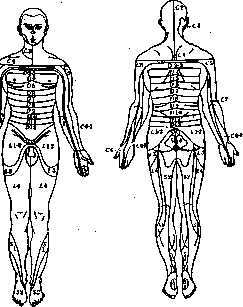
Illustration 3 and 4. Areas of distribution of skin sensitivity according to roots.
with preservation or slight decrease of tactile and deep sensitivity. With unilateral damage to the medulla oblongata
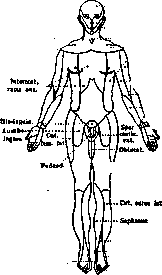
PlarUar. med Trigemimis ] Trigeminus III ' Trigemimis 11 Аипл. mago Cervic. Supraclavicul- ant. Intercept. "mi lit -Axillaris Cut. brach. med i'et intercostobracri. Musculocutan. Cut. antebraehb med.. ram. vol. ^Palmaris med. J'almaris uln. Badialis -Mcdianus - Ulnaris, ram. vol. --7Cut. femor. ant. (cruralis) Peroneus euperfic Calcaneus med. Suralis Plantar. lat. Peroneus prolundus- Occipit. tnajur
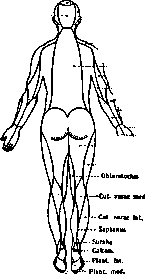
Ingenuous I ..Occipit. minor Auricul. magnus Supraclavic. .-Y-.Axillaris Intercost., ramp post. Cutan. post (Radialis) Cut. med. fat, aatebrach. dor*. f- (Radialis) Musculocutaneus Cutan. anlcbracli. med., rum. dors. Radialis Ulnaris. Cat. \ \^ram. dors lemor. y>Mediauus post. / Ulnaris, ram. volant ~ Cut. lemor. lat. Saphenus Illustration 1 and 2. Areas of distribution of skin sensitivity according to peripheral nerves. III brain and caudal part of the pons Varolii A. usually appears crossed: the same half of the face and the opposite half of the trunk lose sensitivity. Under these conditions, a dissociated disorder of sensitivity (syringobulbia, vascular diseases) may also occur. With disease of the thalamus and internal capsule, anesthesia occupies the entire side of the body opposite the affected hemisphere (hemi-anaesthesia). The limbs turn out to be the most anesthetized; the trunk and face show a lesser degree of insensitivity.
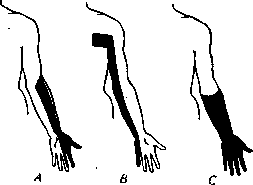
Illustration 5. A-anesthesia with damage to the left radial nerve at the shoulder; B-anesthesia with damage to the 8th cervical and 1-3rd thoracic roots on the left; C-hysterical type of anesthesia.
with disease of individual kinetic centers of the cerebral cortex causes a disorder of sensitivity extending to the corresponding area, with the degree of this disorder increasing toward the distal end of the limb; affected, predominantly, the sense of localization, the sense of position of the limb and stereognostic sense. From functional diseases of the nervous system, hysteria usually leads to a disorder of sensitivity. With this pathological form, A. can represent the most diverse distribution, simulating any of the listed organic A. Most often, however, hysterical sensory disturbance covers either half of the body (hemianaesthesia), spreading with the same intensity on the face, trunk and limbs, or individual segments of the limbs, being limited to so-called "amputation" lines [amputation type of sensory disturbance (see FIG. 5 C)].
Related articles
Mentioned in
Cite this page
“Anesthesia.” Soviet Medical Encyclopedia. English translation of Bolshaya Meditsinskaya Entsiklopediya, 1st ed. (Moscow, 1928–1936), ed. N. A. Semashko. https://sovietmedicalencyclopedia.pages.dev/article/anesthesia/