Kinesthesia
Historical document, translated for reference. It reflects medical knowledge of the 1920s–30s and is not medical advice.
Summary
This article from the 1928–1936 Great Medical Encyclopedia discusses kinesthesia, defining it as the sensation of position and movement of body parts, resistance, and weight. It covers the physiological mechanisms involving proprioceptors, methods of clinical examination including passive movements and weight discrimination, and describes the kinesiesthesiometer instrument.
Encyclopedia article (1928–1936)
KINESTHESIS (from Greek kinesis—movement and aisthesis—sensation), the sensation of the position and movement of individual body parts, as well as of the resistance and weight of external objects. This complex sensation (kinesthetic sensation), formerly incorrectly called the "muscular sense," is caused by the simultaneous activity of several proprioceptive organs located in the muscles, tendons, and joints. The entire synergetics of movements is closely related to the activity of the proprioceptive system. Kinesthesia and static sensations originating from the ear labyrinth, through joint coordinated activity, orient our consciousness relative to the external environment. The methodology for investigating kinesthesia adopted in clinical practice includes the study of passive movements and the study of the sense of the degree of voluntary muscular contractions. In the first case, with the subject's eyes closed and their musculature in a completely passive state, various movements are performed in the joints, obtaining from the subject an evaluation of these movements both in terms of direction and magnitude. Physiologists Frey and Meyer determined that the smallest angle that can be recognized by a subject during passive rotation of the elbow joint is 1'. For objective measurements of passive movements in various joints, a kinesiesthesiometer is used. To test the sense of the degree of voluntary muscular contractions, the method of comparative evaluation of weights of various loads is applied. The difference perceived by a normal person between two successively lifted weights, according to Weber's research for the upper extremities, is 1/10 of the weight of the initially lifted load. Kinesthetic impulses pass to the brain via the posterior root fibers of the posterior columns of the spinal cord. It should be noted that the experimental work of Frey and Meyer proved a decrease in the movement angle discrimination threshold during cocaine anesthesia of the skin in the region of the joints, on the basis of which one must assume that the skin is also an organ of the sense of position and movement of individual body parts. A kinesiesthesiometer (or kinematometer) is an instrument for measuring sensations of the position and movement of extremities. This instrument consists of a platform on which divisions are marked in an arc of a quarter or half of a circle. In the center of this arc, a lever is fixed in the form of a platform convenient for placing the hand (forearm) of the subject (see figure); this lever ends with a marker pointer of the lever movements; the magnitude of the movement is determined in degrees. When investigating the sensation of position, the experimenter moves the subject's limb from the initial position to a new one (passive movement) and asks them to determine how much the new position differs from the initial one. To investigate the sensation of movement, the subject moves the hand from the initial position to some new one and back; the degree of coincidence of the first and third moments is noted. The kinesiesthesiometer is used in experimental psychology, in the practice of clinical research of neurological patients, and
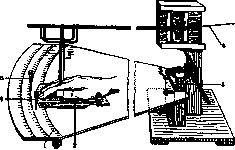
Kinesiesthesiometer: 1—arc with divisions, over which the lever (2) moves with the hand of the subject; 3—axis around which the lever moves; 4—pin at the end of the lever indicating the path traveled; 5—control pin indicating the starting point of movement; 6—small lever recording the movements of the hand.
especially widely in psychotechnical tests, and here, in connection with various target settings, special types of kinesiesthesiometers have been proposed by various authors.
A. Surkov.
Related articles
Mentioned in
Cite this page
“Kinesthesia.” Soviet Medical Encyclopedia. English translation of Bolshaya Meditsinskaya Entsiklopediya, 1st ed. (Moscow, 1928–1936), ed. N. A. Semashko. https://sovietmedicalencyclopedia.pages.dev/article/kinesthesia/