Brown-Séquard Syndrome
Historical document, translated for reference. It reflects medical knowledge of the 1920s–30s and is not medical advice.
Summary
This 1930s encyclopedia article describes Brown-Séquard syndrome, a condition resulting from unilateral spinal cord lesions, detailing the ipsilateral and contralateral motor and sensory symptoms.
Encyclopedia article (1928–1936)
BROWN-SÉQUARD SYNDROME, described by him in 1849, is observed in unilateral lesions of the spinal cord and is characterized by the following symptoms: I. On the side of the lesion: 1) paralysis, initially flaccid, then spastic; 2) disorder of muscle sense and bone sensitivity; 3) decrease or complete disappearance of the sensation of pain upon pressure on the bones, tendons, joints, muscles; 4) disorder of stereognostic sense when the process is localized in the cervical regions; 5) hyperesthesia of touch, pain, and temperature, which quickly disappears; 6) a zone of radicular anesthesia located above the upper boundary of hyperesthesia and corresponding to the posterior roots affected by the process; 7) a zone of hyperesthesia located above the previous one; 8) vasomotor disorders due to damage to vasoconstrictor fibers.- II. On the opposite side: 1) preservation of voluntary movements; 2) anesthesia, mainly of pain and temperature, and a decrease in the sense of place on the surface
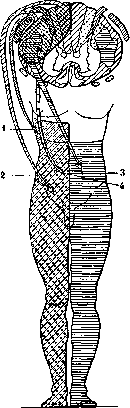
Brown-Séquard syndrome: 1-radicular anesthesia; 2-disorder of deep and partly tactile sensitivity; 3-disorder of pain, temperature, and partly tactile sensitivity; 4-paralysis.
of the body below the site of the lesion, with the upper boundary of anesthesia not corresponding to the affected segment, but observed two to three segments lower; 3) preservation of muscle sense and bone sensitivity; 4) a narrow strip of hyperesthesia above the zone of anesthesia.-The topography and intensity of paralysis and anesthesia vary depending on the localization and intensity of the process. In upper cervical lesions, hemiplegia is observed on the side of the lesion, sensory disturbance on the face (damage to the descending root of the trigeminal nerve), and on the opposite side, sensory disturbance of the hemiplegic type. When segments giving rise to the brachial plexus (C V - C VIII, D I) are damaged, paralysis of the upper extremity of the radicular type is observed, along with a sensory disturbance of the same character in that same extremity. When lower cervical segments are affected, eye symptoms are noted (myosis, enophthalmus, narrowing of the palpebral fissure) due to damage to the sympathetic center located in this region (C VIII - D I) or the fibers departing from it. When the lower parts of the spinal cord are affected, the roots also suffer due to their close contact at this level with the spinal cord, and therefore, in addition to the above-described syndrome, a radicular sensory disorder is also observed on the side of the lesion. In diseases of the lower parts of the spinal cord, disorders of the sphincters sometimes occur, but these symptoms are inconstant. The peculiar disorders in Brown-Séquard syndrome depend on the arrangement of fibers in the spinal cord: motor fibers (pyramidal tract) undergo decussation in the medulla oblongata and do not decussate further in the spinal cord, which is why paralysis or paresis is observed on the side of the lesion; the fibers of the posterior columns, which carry deep sensitivity, also do not decussate in the spinal cord, which is why they suffer on the side of the lesion; whereas the fibers carrying pain and temperature sensitivity decussate in the spinal cord, passing through the white commissure, as a result of which the disorder of these types of sensitivity is observed on the opposite side. As for tactile sensitivity, its disorders have not yet been definitively studied, nor has the course of the corresponding fibers within the spinal cord itself. According to some authors, it is conducted by the posterior columns (Schiff), while according to others (Rothmann, Petren, Borchert), it proceeds via two pathways: the posterior columns for uncrossed fibers and the lateral columns for crossed fibers, and thus it can be affected on either side. Brown-Séquard syndrome is observed in unilateral injuries of the spinal cord, in the initial stages of tumors, in myelitis, spinal syphilis, disseminated sclerosis, etc.
L. Brusilovsky.
Related articles
Mentioned in
Cite this page
“Brown-Séquard Syndrome.” Soviet Medical Encyclopedia. English translation of Bolshaya Meditsinskaya Entsiklopediya, 1st ed. (Moscow, 1928–1936), ed. N. A. Semashko. https://sovietmedicalencyclopedia.pages.dev/article/brown-sequard-syndrome/