Hemianesthesia
Historical document, translated for reference. It reflects medical knowledge of the 1920s–30s and is not medical advice.
Summary
This article from the 1928–1936 Soviet medical encyclopedia defines hemianesthesia as a loss of pain sensation on one side of the body, classifying it as either organic or functional. It details various types based on the location of the lesion, including cortical, subcortical, thalamic, and brainstem forms, and contrasts organic hemianesthesia with the complete, often functional, variant seen in hysteria.
Encyclopedia article (1928–1936)
HEMIANESTHESIA (from Greek hemi- half and anesthesia), a disorder of sensitivity expressed as the loss of the sense of pain on one half of the body. H. can be of organic and functional origin. Organic H. is most often encountered in lesions of the central nervous system; in conductive lesions it is more strongly expressed in the distal parts. The character of H. differs depending on the localization of the process; it can be observed in diseases of both the brain and spinal cord. The following varieties are distinguished: 1. Cortical H. develops in lesions of the posterior central gyrus and is rarely pure, without motor disturbances. In this form deep sensitivity is most affected; tactile sensitivity is affected less, and temperature and pain sensation may even be untouched. 2. Subcortical H. is also usually accompanied by movement disturbances and develops in lesions of the corona radiata over a long extent; the character of H. is the same as in cortical H. 3. Central (capsular) H. (see Figure 1). In lesions of the internal capsule, contrary to the teachings of Turet and Charcot, anesthesia does not occur (Dejerine, Long), unless the visual tubercle or the thalamocortical paths leading to the cortex are affected; in the latter case the process is assumed to be in the corona radiata. 4. Thalamic H. In the thalamic syndrome described by Dejerine and his pupils, H. is a constant symptom if the posterior inferior part of the external nucleus of the visual tubercle (the area of the loop's entrance) is destroyed. In this case there is more or less expressed H. for tactile, pain, and thermal sensitivity and sharp H. for deep sensitivity, often with complete astereognosis. To this are added a slight hemiparesis without contractures, hemiataxia, pseudo-athetoid movements in the anesthetized limbs, and finally very persistent and intense pains on the anesthetized side. 5. H. in lesions of the pons and medulla oblongata can be of syringomyelitic type, with stronger involvement of pain and thermal sensitivity, or of the reverse type, with significant involvement of deep sensitivity and relatively little affected thermal and pain sensitivity. These variations depend on the localization of the focus, since the paths for pain and thermal sensitivity (spinothalamic tract - Gowers' bundle) pass in the substantia reticularis, and the paths for deep sensitivity pass in the loop. In cases of H. caused by a pathological process localized in the crura, pons, or medulla oblongata, it is rarely isolated and is usually accompanied by hemiplegia or hemiparesis on the side of H. In foci in the medulla oblongata, most often due to occlusion of the posterior inferior cerebellar artery, H. has a crossed character - hemianaesthesia alternans (see Figure 2), because the descending root of the trigeminal nerve of the same side and the ventrally located systems conducting sensitivity from the opposite half of the body enter the focus of softening (see Alternating syndromes). 6. In half transverse lesions of the spinal cord, H. also develops, but in these cases the face is not paralyzed, and the boundary of H. on the body depends on the height of the focus, while superficial sensitivity and especially pain and thermal sensitivity are absent on the side opposite the focus, while deep sensitivity, primarily muscular and articular, is affected on the side of the focus; on this same side paralysis also develops (see Brown-Séquard syndrome). Pure H. depending on lesions of peripheral nerves is almost never encountered. H. in organic diseases has characteristic features: it is rarely complete; distal parts are affected more strongly, dissociation in one form or another is often encountered, and almost always H. is accompanied by other organic symptoms, mainly movement disorders.
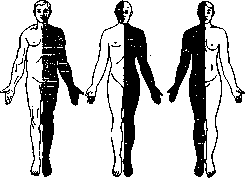
Figure 1.
Figure 2.
Figure 3.
Figure 1. Hemianesthesia in lesions of the internal capsule. Figure 2. Hemianesthesia in lesions of the medulla oblongata. Figure 3. Hysterical hemianesthesia. In these cases the face is not paralyzed, and the boundary of H. on the body depends on the height of the focus, while superficial sensitivity and especially pain and thermal sensitivity are absent on the side opposite the focus, while deep sensitivity, primarily muscular and articular, is affected on the side of the focus; on this same side paralysis also develops (see Brown-Séquard syndrome). Pure H. depending on lesions of peripheral nerves is almost never encountered. H. in organic diseases has characteristic features: it is rarely complete; distal parts are affected more strongly, dissociation in one form or another is often encountered, and almost always H. is accompanied by other organic symptoms, mainly movement disorders. The situation is quite different in hysteria. In these cases H. is complete, its boundary runs strictly along the midline, there is no difference in its intensity in distal and proximal parts, it spreads equally to all types of both deep and superficial sensitivity, and may not be accompanied by any other loss of function of the nervous system (see Figure 3). Patients often do not know of the existence of H., and it is discovered only upon examination. Despite complete H., including deep sensitivity, movements, not only gross but also the smallest and most delicate, are preserved; this is not true absence of sensitivity, but rather "ignoring of perceptions" or "self-suggested impossibility to feel". Hysterical hemianesthesia differs from organic in that in the latter strong pain irritations do not affect the condition of the pupils, while in the former the same pain irritations cause their dilation.
Related articles
Mentioned in
Cite this page
“Hemianesthesia.” Soviet Medical Encyclopedia. English translation of Bolshaya Meditsinskaya Entsiklopediya, 1st ed. (Moscow, 1928–1936), ed. N. A. Semashko. https://sovietmedicalencyclopedia.pages.dev/article/hemianesthesia/