Gowers' Tract
Historical document, translated for reference. It reflects medical knowledge of the 1920s–30s and is not medical advice.
Summary
Gowers' tract is a complex bundle of nerve fibers in the central nervous system, comprising the anterior spinocerebellar, spinothalamic, spinotectal, and spinobulbar tracts. It plays a crucial role in conducting sensory information, including pain and thermal sensitivity, and is involved in the cerebellar system.
Encyclopedia article (1928–1936)
Gowers' tract (Gowers) is located in the central nervous system and is a complex tract both in its structure and function. It includes the fasciculus spino-cerebellaris anterior, fasciculus spino-thalamicus, fasciculus spino-tectalis, and fasciculus spino-bulbaris. It originates in the lowest sections of the spinal cord, in the ganglion cells of the posterior horns, and partly in the group of Clarke's cells. Over the course of several segments (from II to V), it runs in the gray matter of its own side, then through the commissura alba anterior it crosses into the anterolateral column of the opposite side, where it occupies a position on the periphery, between the Löwenthal tract anteriorly, the Flechsig tract posteriorly, and the Monakow tract medially (see figure 1). Gowers' tract runs in an ascending direction, gradually increasing with newly entering fibers.
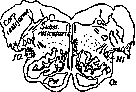
In the medulla oblongata, it remains in the lateral column, merging partly in the lower sections with the Flechsig tract; at this level, a small number of fibers depart from it into the corpus restiforme, into the nucleus lateralis of the medulla oblongata, into the oliva inferior, and into the substantia reticularis (see figure 2).
In the upper sections of the pons Varolii, fibers depart from Gowers' tract.
Figure 2. Cross-section of the medulla oblongata. Gowers' tract (f. G.) and locations of the corpus restiforme, oliva inferior (O. i.).
Nucleus lateralis et substantia reticularis.
Gowers' tract (proper), which...
Pyramidal tracts; Lemniscus medialis.
Upper sections.
In the superior cerebellar peduncle, forming a decussation in the velum medullare anticum (see figure 4), it crosses to the opposite side and with the superior cerebellar peduncle of the opposite side enters the cerebellum, where it terminates in the vermis inferior. In the cerebral peduncles, fibers run from Gowers' tract to the corpora quadrigemina posteriora (fasciculus spino-tectalis).
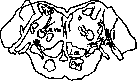
Corpora quadrigemina anteriora, not only on its own side but also on the opposite side, and in the substantia nigra (fig. 5). Higher up, the fibers terminate in the nucleus.
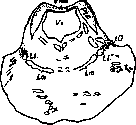
Figure 4. Cross-section of the pons Varolii in its upper sections: f. G. - Gowers' tract; LI. - lemniscus lateralis; Lm. - lemniscus medialis; P.c.s. - pedunculus cerebelli sup.; Pyr. - pyramidal fibers; Vma - velum medullare ant.; V4 - ventriculus IV. Ventralis thalami optici, a small number of fibers go to the internal sections (globus pallidus) of the nucleus lenticularis (see fig. 6). Some authors have noted that a portion of the fibers, without interruption, proceeds directly into the capsula interna to terminate together with the third sensory neuron in the gyrus centralis posterior. Gowers' tract is covered with myelin quite late; in a newborn, it is not yet fully covered by a myelin sheath. The part of Gowers' tract that occupies an external position, the fasciculus spino-cerebellaris anterior, belongs by function to the cerebellar system and carries stimuli from the periphery to the cerebellum (see Cerebellum). The other part, which occupies a more internal position - the fasciculus spino-thalamicus, spino-tectalis - is a conductor of superficial sensitivity - pain, thermal, and partly tactile (not all authors agree with this doctrine; some assign a wider place in the lateral column for conductors of pain and thermal sensitivity, and assign conductors of tactile sensitivity to the anterior column; see Sensitivity). Pain sensations come from the skin, from the integuments and deep tissues, and from internal organs. Fibers carrying sensitivity from the lower sections of the trunk and limbs occupy a more peripheral position in this tract. The fasciculus spino-tectalis, which also carries pain and thermal sensations and terminates in the corpora quadrigemina (sensory-reflex subcortical centers), causes the occurrence of part of the reflexes from the corpora quadrigemina. - Disease of Gowers' tract leads to a disorder of pain, thermal, and partly tactile sensitivity. When this tract is damaged, a so-called dissociation.
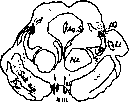
Figure 5. Cross-section of the cerebral peduncle: f. G. - Gowers' tract; Lm. - lemniscus med.; LI. - lemniscus lat.; N. r. - nucleus ruber; Aq. S. - Aquaed. Sylvii; Sub. nig. - substantia nigra; Pyr. - pyramidal fibers; n. III - n. oculomotorius.
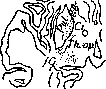
Figure 6. Cross-section through the cerebral hemisphere: f. G. - termination of Gowers' tract in the thalamus opticus (Th. op.), in the capsula interna (C. i.); G. p. - globus pallidus; Put. - putamen; V3 - ventriculus III.
Of sensitivity, i.e., pain and thermal sensitivity will be more disturbed than tactile sensitivity. In the case of a unilateral lesion of Gowers' tract, the disorder of sensitivity will be on the opposite side; a disorder of sensitivity from the internal organs will not be observed - apparently, their pathways pass in equal measure on both sides. The boundary of the sensitivity disorder on the body does not correspond to the affected segment, but is noted several segments lower due to the fact that upon entering the spinal cord, these fibers do not immediately cross to the opposite side, but run for several segments on their own side.
Related articles
Mentioned in
Cite this page
“Gowers' Tract.” Soviet Medical Encyclopedia. English translation of Bolshaya Meditsinskaya Entsiklopediya, 1st ed. (Moscow, 1928–1936), ed. N. A. Semashko. https://sovietmedicalencyclopedia.pages.dev/article/gowers-bundle/