Batalinskaya Bitter Water
Historical document, translated for reference. It reflects medical knowledge of the 1920s–30s and is not medical advice.
Summary
Batalinskaya Bitter Water is a mineral water from a source near Pyatigorsk, used as a laxative and for treating increased stomach acidity. The article details its composition, medical applications, and precautions for use.
Encyclopedia article (1928–1936)
BATALINSKAYA BITTER WATER, is obtained from a captured mineral source five kilometers from Pyatigorsk. It is not used on-site but is exported (in bottles). B. b. w. in strength occupies an intermediate position between Apenta and Friedrichshaller.

Composition: magnesium sulfate 8.46, sodium sulfate 8.48, sodium chloride 2.08, free carbonic acid 0.009, total solids 21.35; temperature 11°. Uses: 1. As a laxative from ½ to one bottle of natural temperature, due to its effect on transudation in the large intestine. Prolonged use and large doses can lead to irritation and medicinal colitis, which is why B. b. w. is usually administered in separate doses. Sometimes B. b. w. is also prescribed in mixtures with other mineral waters. 2. In the treatment of increased stomach acidity, particularly in stomach ulcers, from ½ to ¾ of a glass, heated (to exclude its laxative effect), on an empty stomach. Clinical experiments have shown that stomach acidity decreases if B. b. w. (½ glass-40°) is administered half an hour before a test breakfast. Prolonged use of Batalinskaya bitter water for 4-6 weeks in the same doses also leads to a decrease in stomach acidity.
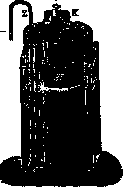
Figure 1. Initial form of the Leclanché element: Z-zinc electrode; T-porous vessel filled with depolarizing mixture; C-carbon electrode.

Figure 2. Grenet element: Z-zinc electrode, which can be raised upward by means of device a; C-carbon electrodes.
zinc, forming zinc chloride (ZnCl₂), and 2NH₄ breaks down into 2NH₃, remaining in solution, and hydrogen (H₂), which reduces manganese dioxide (MnO₂), with the formation of MnO and water. The main advantage of the element is that the zinc solution does not act when the element is not in operation. The electromotive force is approximately 1.6 volts. The same chemical process occurs in dry cells as well. But here for convenience of carrying the battery and its compactness there is no liquid: the ammonium chloride solution is saturated in wood shavings, located between the zinc cylinder, which at the same time serves as the vessel for the elements, and a bag with the depolarizing mixture. Often dry cells are made 'pourable'; they are sold dry, and only before use is water added (ammonium chloride is already contained in the shavings). The form and size of dry batteries are extremely varied. Small batteries of three elements with an electromotive force equaling 4.5 volts in total are constructed for pocket flashlights. For radiotelephony needs, high-voltage dry batteries consisting of a large number of small and compact elements are used. In medical devices, batteries of dry cells are also used (devices for faradization), but batteries of Grenet type elements are also used. A positive quality of these elements is their high electromotive force - 2 volts for each element. Here electrical energy is obtained by dissolving zinc in H₂SO₄. The negative electrode is zinc, and the positive is a carbon plate. The depolarizer is potassium bichromate, dissolved in water together with H₂SO₄. During the decomposition of K₂Cr₂O₇, chromic acid is released with the formation of chromium salts. A disadvantage of batteries of Grenet elements is that H₂SO₄ acts on zinc even when the element is not in operation. Therefore, such batteries are always provided with a device for raising the zinc
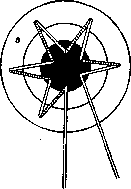
Figure 3. Thermobattery (view from the back).
electrodes (see Figure 2).-2. Storage batteries, from so-called secondary elements, requiring charging (see Accumulators). They are replacing the galvanic batteries described above: their electromotive force is large (about two volts per element), internal resistance is negligible; they allow obtaining very strong current without causing a noticeable drop in voltage between the poles. But the need to charge batteries makes them dependent on charging stations. Another disadvantage is the large weight of the lead plates of storage batteries. For portable batteries, there are also accumulators with light, non-lead plates.-3. Thermoelectric batteries are rarely used for obtaining current for practical purposes (B. Gülicher, heated by gas burners). They more often serve for measuring radiant energy or for measuring temperature. They are based on the thermoelectric effect in a circuit of dissimilar metals. In Fig. 3 is depicted a small thermoelectric battery used for actinometric measurements (see Actinometry). Here
~*
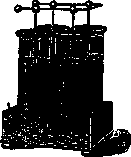
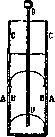
Figure 4. Battery of Leiden jars: A and B- external and internal linings of tinfoil; C-glass walls; D- electrode communicating with the inner lining.
sun's rays fall on a star-shaped wheel made of dissimilar metals, soldered together. One row of soldered joints is protected from heating by a white reflecting screen (ring) B, and the other is connected to a blackened disk heated by the sun. The greater the temperature difference between the soldered joints, the greater the electromotive force arises in the battery and the stronger the current flows in the connected recording instrument. 4. Battery of Leiden jars (see Leiden jar) consists of several jars connected in parallel. It serves for obtaining very powerful electrical discharges and for exciting electromagnetic oscillations (see Figure 4). Such batteries are used in d'Arsonval apparatus. The battery discharges here through a spiral winding placed on a wooden cage. Inside the cage is placed a person being treated with rapidly alternating currents.
Related articles
Cite this page
“Batalinskaya Bitter Water.” Soviet Medical Encyclopedia. English translation of Bolshaya Meditsinskaya Entsiklopediya, 1st ed. (Moscow, 1928–1936), ed. N. A. Semashko. https://sovietmedicalencyclopedia.pages.dev/article/batalinskaya-bitter-water/