Brachycephaly
Historical document, translated for reference. It reflects medical knowledge of the 1920s–30s and is not medical advice.
Summary
Brachycephaly is a human head form where the length-width index (expressing width as a percentage of length) is 80.0-81.9. Hyperbrachycephaly (85.0-89.9) and ultrabrachycephaly (over 90.0) are more extreme forms, with the latter occurring in conditions like hydrocephalus.
Encyclopedia article (1928–1936)
BRACHYCEPHALY (from Greek brachys- short and kephale- head), or short-headedness, represents a form of human head in which the length-width index, i.e., the index expressing width as a percentage of length, is 80.0-81.9; if this index equals 85.0-89.9, it is called hyperbrachycephaly, with an index of more than 90.0- ultrabrachycephaly. According to V. Vorob'yev's data, the greatest transverse diameter of the skull in a modern Great Russian is 152.9 mm, the greatest longitudinal diameter- 185.5 mm (in the skeleton, the greatest transverse diameter- 141 mm, the greatest longitudinal- 176 mm); the length-width index for a living Great Russian is thus 100×152.9/185.5, or 81, for the skeleton it is 100×141/176, or 80; the modern Great Russian is thus a moderate brachycephal, or mesocephal.
The short brachycephalic skull (according to Huxley).
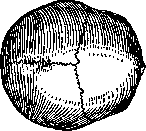
Hyperbrachycephaly occurs in certain tribes as a racial trait, as well as in the disease known as "mongolism" or "mongoloid idiocy"; ultrabrachycephaly is an anomaly and is also observed in patients with hydrocephalus, when the length-width index equals (according to Weber) 100.4, etc. The inheritance of skull shape apparently follows Mendelian laws.
Related articles
Mentioned in
Cite this page
“Brachycephaly.” Soviet Medical Encyclopedia. English translation of Bolshaya Meditsinskaya Entsiklopediya, 1st ed. (Moscow, 1928–1936), ed. N. A. Semashko. https://sovietmedicalencyclopedia.pages.dev/article/brachycephaly/