Budget Studies
Historical document, translated for reference. It reflects medical knowledge of the 1920s–30s and is not medical advice.
Summary
Budget studies are a statistical method for the economic and social-hygienic study of various population groups, examining both value budgets and time budgets to understand the formation and expenditure of living resources.
Encyclopedia article (1928–1936)
Budget Studies, a statistical method for the economic and social-hygienic study of various population groups. Budget studies have as their object value budgets and time budgets. They study the budgets of all main population groups: workers, peasants, employees, students. The task of budget studies for any population group is to study the process of formation and expenditure of living resources. However, the specific content of budget studies and the structure of each group's budget are determined by its socio-economic nature; this determines the deep differences in the structure of the budgets of the mentioned population groups. The worker's budget studies the magnitude of consumption, its structure and dynamics. Methodologically, this reduces to the predominant study of the expenditure part of the budget, which characterizes consumption. The income part of the budget, which gives an idea of the process of formation of living resources (their state and sources), is greatly simplified when studying the worker's budget, since the main source of living resources in the worker's budget is wages. This shifts the interest in studying the income part of the budget from the structure of income to establishing the degree of correspondence of income as a whole to the needs of the worker, i.e., it considers the income itself in the plane of the consumption problem. From this typical for capitalist society scheme of the income part of the worker's budget, there are a number of deviations that increase the importance of this part of the budget: 1) an example can be the budget of a worker in the USSR during the years of the civil war, when the share of wages (in all its forms - monetary and natural) in its income part decreases and elements of individual-production and trading-commercial activity of the worker appear as sources of existence; 2) the budget of a worker in the USSR in recent years in its income part represents a deviation from the same scheme, reflecting, on the contrary, the healthy social policy of the workers' state.
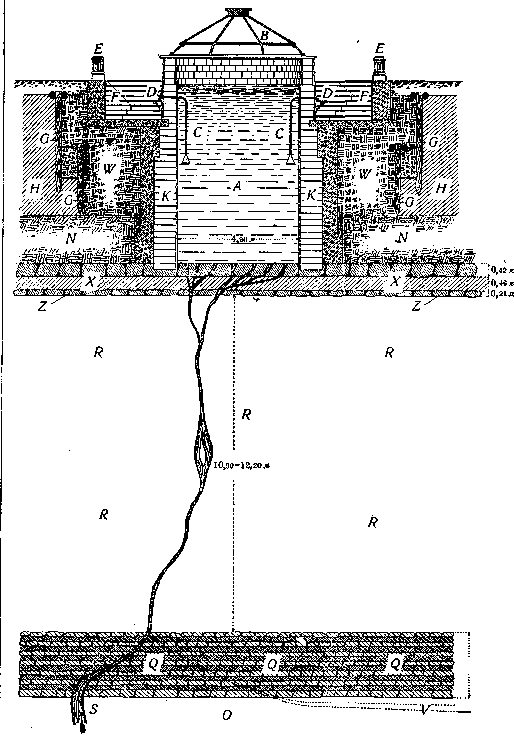
Figure 4. Capture of the Narzan source in Kislovodsk. A-well; B-pavilion; C-inner part of the pipes; D-pipes to the baths, distribution plant, and gas plant; E-barriers for protecting access to the water taps; F-ladder; G-piles; K-stone walls of the well; H-deposits of the Olkhovka River; X-dark sandy clay; V-fresh water; W-wide clay; O-dolomite; Q-suite of limestone-rudstone layers alternating with black clay; S-mineral-gas water; N-sulfurous limestone-clay sandstone; Z-limestone-rudstone; N-clay sandstone. In the income part, along with wages, other forms of state security (social insurance benefits) appear on the one hand, and on the other hand, unidentified incomes: natural forms of service (free medical aid) and expenses paid at lower rates than other population groups (rent and so on). Such a structure of the worker's budget income part, while increasing interest in it, however, leaves the main attention of B. i. to questions of consumption, i.e., to the expenditure part of the worker's budget. Completely different distribution of attention between the income and expenditure parts is given by contemporary budgets of the peasant. B. i. of the zemstvo period and in relation to this group of population had a consumer orientation. The basis of such an approach lay in two circumstances: 1) studies of this period, reflecting the populist ideology, did not set themselves the task of studying the class distribution of the peasantry; the economic grouping they produced was by land, labor force, and draft animals, and later-by sown area, i.e., by signs that do not constitute elements of B. studies; 2) interest in the income part of the budget, shown at a later stage of B. i., the so-called organizational-production, or neopopulist school, had as its starting point the study not so much of the incomes of the peasant economy and their structure, as of the role of personal consumption as a driving force of economic development. The methodology for studying the class structure of the Soviet peasantry has not yet been finally established. However, all well-founded attempts at such a study proceed from the rejection of sown area as a grouping criterion. To answer the question about class relations in the Soviet countryside in contemporary studies, the following grouping is proposed: a) by means of production, b) by use of one's means in another's economy (alienation of labor force, renting out of equipment) and others' in one's own (hiring of labor force and equipment). Since the first criterion allows one to capture mainly the economic, and not the social-class structure, and its application is limited only to economies where the main form of production is agriculture, most attempts to study the class differentiation of the peasantry are based on accounting for the use of means of production. These class characteristics can be accounted for either in physical terms (in days of hiring-alienation) or in monetary terms (income from alienation of labor force, renting out of equipment; expenditure on hiring of labor force, equipment). The second form of expression has advantages, allowing one to establish the proportion of this hiring (alienation) in the budget's income (expenditure). This grouping can be continued-and thus refined-by forms of hiring and alienation (going away, batrachestvo, etc.). Thus, the contemporary class grouping of the peasantry is entirely based on data from B. i. and, to a large extent, on the income part of the budget. Naturally, contemporary B. i. of the peasantry are freed from the consumer bias and begin to serve for characterizing social relations in the contemporary countryside, and through them-for analyzing the class structure of the peasantry. The differences between the worker's budget and the peasant's budget are not exhausted by the significance of the budget's income part and its place in B. research. The expenditure part of the worker's and peasant's budgets also has a different structure. In the worker's budget it reflects expenses related to the personal consumption of the worker-single or of a worker's family; in the peasant's budget, along with the personal consumption of the peasant family, there also appears the productive consumption of the peasant household, i.e., expenses related to the management of the peasant economy. But even personal consumption, reflecting the different levels of cultural development, the different economic and sanitary type of life of these population groups, is far from homogeneous either in content (by the list of expenses and their ratio to each other) or in form (commodity-money form of consumption in the worker's budget, natural and monetary consumption in the peasant's budget). This character of the peasant's budget corresponds to its structure. The peasant's budget includes, besides the income and expenditure parts in monetary and natural terms, also accounting of property and means of production, i.e., it gives not only a picture of the productive and consumer activity of the peasant household, but also its initial and final economic and living conditions. Despite all the differences in consumption of individual social groups, B. i. provide material for illuminating a number of general national economic problems related to mass consumption. These include: market capacity, characterization of demand and prices, planned regulation of production, etc. If the economic study of the budget arose and for a long period developed under the sign of illuminating, predominantly, problems of consumption, then B. i., as a method of social-hygienic study of the population, in most West-European and Russian works of the zemstvo period of Russian sanitary statistics had an even more limited field of vision: they considered only phenomena of the so-called 'physical consumption' and the features of sanitary life conditioned by it. In this case, living conditions were considered as an element of the sanitary characterization of a given population group, and not as a factor of its sanitary state; for this reason, the main signs of sanitary state (physical development, morbidity, illness, mortality, etc.) were rarely considered against the background of living conditions, in a combined connection with these conditions expressed in budgetary indicators. Such use of B. i. in social-hygienic study of the population completely does not correspond to the modern understanding of its content. Modern social-hygienic research cannot abandon any of the elements of the economic characterization based on budget data: without this it is powerless in most cases to give a social-class and economic typification of the sanitary state of the population, on the one hand, and to substantiate these typological differences in the sanitary state of individual population groups-on the other. In other words, before B. i., as a method of social-hygienic study of the population, stand the tasks: 1) social-class grouping-in the study of the peasantry, and economic differentiation-in the study of worker groups, in order to within these groupings to carry on a differentiated study of demographic and sanitary signs of the population; 2) economic characterization of the conditions of labor and life of different population groups as factors of the sanitary state of these population groups. The first task in its introductory part lies entirely in the plane of methodological techniques of economic analysis indicated above. As for the second task, the possibilities of B. i. are not equivalent in characterizing the conditions of labor and life. Conditions of labor can receive from the data of the value budget only the most general outline and that, mainly, in relation to peasant population groups, the income part of whose budget can give not only a list of occupations that are a source of income, but also their alternation, combination, duration, and the associated labor load. Closer, more direct, and more concrete are these conditions characterized in relation to any social group by the time budget, which allows one to reveal conditions even of such unorganized labor as is connected with the concept 'household economy'. However, in this area none of the types of B. i. is a basic method. On the contrary, this is precisely the role of B. i. in the study of living conditions, its economic and sanitary typification. B. i. can give the following system of indices for social-hygienic characterization of living conditions of different class and economic groups of the population: a) indices of the living level (degree of satisfaction of physical needs) and its influence on social-biological and social functions of the population (fertility, marriageability, family status, etc.); b) indices of sanitary culture (mode of personal hygiene, hygiene of dwelling, etc.); c) indices of the mode of personal life (sexual life, alcoholism, drug addiction); d) indices characterizing forms of collective living conditions (public catering, etc.); e) indices of health protection and social security. In the formation of these social-hygienic indices of living conditions, along with the value budget, it is necessary to have the participation of the time budget and sanitary examination.
A schematic demarcation of the role of these methods can be presented as follows: mass materials of the value budget provide an idea in monetary and natural forms of the size and degree of satisfaction in quantitative and qualitative relations of various aspects of living conditions; the time budget, collected on a narrower scale, reveals the forms of organization of individual and collective living conditions on these material foundations; and, finally, the sanitary examination gives a final normative-hygienic assessment of the material content and organizational forms of living conditions. Thus, the significance of the main method in the socio-hygienic study of living conditions remains with the study of the value budget. This socio-hygienic approach to the analysis of the value budget should correspond to the structure of its income and expenditure parts: in the nomenclature of sources of income and in the purpose of expenses, more detailed designations reflecting this special approach should be highlighted. However, the general economic structure of the budget also ensures (with certain limitations) its socio-hygienic analysis. When conducting a budget analysis, a number of conditions must be observed. Budget analysis cannot be constructed without considering the possibility of comparing budgets in two directions: a) budgets of different socio-class or economic groups for the same period; b) budgets of the same group for different periods of time. This leads to a number of requirements for the analysis process itself: 1. The size of the income part of the budget does not characterize the real level of living: the cost of living (depending on the difference in prices in different regions and their dynamics in the same region) changes the real value of the same amount of budget in its monetary expression. This issue is one of the main ones in the working class's struggle for real wages, in other words-for the real level of living conditions. This determines the importance of the cost of living in the process of budget analysis. The cost of living is determined by means of budget indices, which, despite all the diversity of their systems and calculation methods, basically represent the ratio of the cost of living for any population group at a certain moment to its cost for the same group at another period taken as a unit of comparison (e.g., the ratio of the post-war cost of living to the pre-war level). Despite all the complexity of constructing indices, they, at best, make it possible in budget analysis to judge changes in the real resources that are provided by the monetary income of this group to satisfy its needs. But even when taking into account the cost of living, comparing budgets for different periods does not give an idea of the dynamics of needs and, consequently, of the change in the ratio between resources and needs,-i.e., corrections for the cost of living are still insufficient to establish the dynamics of the well-being of this group, understanding it as the dynamics of satisfying needs that are not artificially stabilized at a certain moment, but growing quantitatively and qualitatively. This growth of needs and the degree of their satisfaction due to a number of factors cannot be sufficiently taken into account when comparing the budget of a certain population group in its historical development. The method applied by S. Solntsev in the analysis of the budget of Berlin workers is much more adequate to this task. This method consists in that for studying the dynamics of the budget, simultaneously collected budgets of different income levels but socially homogeneous population groups are taken. The different structure of expenses (needs) in different income groups is considered as stages in the evolution of needs and consumption when changing income levels from lower to higher groups: 'From changes, fluctuations and perturbations in budget scales we conclude about changes and perturbations in needs' (Solntsev). The advantages of this method consist in that, answering the main question of analysis, 'how does the relation between developing needs and the means of satisfying them change', it is free from complex and not exhaustive operations for calculating the real value of income in its monetary expression. However, the application of this method is very limited: it is quite appropriate for a normative study of the budget, which aims to establish certain regularities in the process of growth of needs and their satisfaction. But the first path of analysis remains largely inevitable for clarifying the dynamics of the budget of a known population group for a certain period of time,-2. Consumption of families of different sizes and age-sex composition will be deeply different with the same real resources of these families and the same level of their needs. This obliges converting budget data from calculation per family to calculation per consumer unit. There are a number of consumer unit systems constructed on an attempt to establish the relative magnitude of consumption of each age-sex group in relation to an adult male. The construction of these systems is very conditional and in most cases is based on physiological norms of consumption and characteristics of physical development of different age-sex groups. This also determines the applicability of existing systems to measuring needs: satisfactorily determining expenses for food per consumer unit, these systems are little suitable for bringing other types of consumption to one unit of comparison. In relation to a number of needs, calculation is therefore not per consumer unit but per capita. The imperfection of these methods in a number of cases forces one to resort to selecting equal-sized and homogeneous in age-sex composition families for comparing consumption. The conditionality and limited applicability of this method are quite obvious. An analysis of consumption constructed taking into account these methodological requirements must first establish, to what extent the structure of consumption depends on the possibility of satisfying needs (on the size of the income part of the budget) and on the level of development of needs. The pressure of the level of needs goes in two directions: in the striving to increase insufficient income, and with its inevitable insufficiency-in the striving to maintain at least at a minimal level the satisfaction of some needs at the expense of maximum compression or even exclusion of others. An illustration of the first position is the structure of the income part of the budget of a Moscow working family in 1919-1920, when the insufficiency of wages was compensated by a significant increase in 'non-labor income'. In this direction, the modern budget of a worker in its income part is also indicative: the growth of needs in connection with the cultural growth of the working class has expanded in recent years the specific weight of 'wages of secondary family members' in the total income; since the wages of family members as less qualified workers grow slower than that of the head of the family, this indicates a greater involvement of the family in production. One of the factors of this involvement, although not the only one, is the inevitable, for now, lag of the growth of the head of the family's wages from the growth of his needs. Table 2. Budget of a worker in the USSR in 1925. Budget groups by the amount of the head of the family's wages Up to 30 chervonets rubles 30-50 »
Another line of influence of insufficiency of the income budget is the change in the structure of consumption, which proceeds unevenly with respect to different needs. The picture of changes in the structure of consumption depending on the size of the budget is given in table 3, compiled by S. Solntsev from materials collected by the Berlin Statistical Bureau (1900). From table 4 it is seen that, as income falls, the absolute amount of expenses for physical maintenance also sharply falls; however, this decline proceeds not proportionally to the decrease in income, but at a slower pace and stops at a certain minimum limit, beyond which physical existence is impossible; this determines the increase in the specific weight of this group of expenses in the overall plan of consumption in groups with decreasing income. This process in the reverse direction can be characterized as follows: the increase in income is used unevenly—expenses for physical needs in their growth lag behind the growth of means of subsistence; all other expenses, on the contrary, grow at a faster pace and thus increase their relative importance in the expenditure budget. The consideration of the specific weight of expenses for food and housing in different population groups by income level allowed Engel, with respect to food expenses, and Schwabe, with respect to housing, to establish that, the smaller the family income, the larger part of it is spent on food (housing) and the worse these needs are satisfied in qualitative terms (see table 5). The laws of Engel and Schwabe in the conditions of a capitalist state have received numerous confirmations not only when comparing budgets of different income groups, but also when studying the growth of the budget of a certain population group over a certain period of time. In the conditions of a workers' state, the growth of needs of the working family introduced a correction to Engel's law in its application to the dynamics of budgets. According to materials of budget investigations (B.i.), organized by the Central Statistical Administration and the All-Union Central Council of Trade Unions in the main regions and branches of industry and covering annually over 2,000 worker budgets, this position appears in the following form: Table 3. Average size of income in the budget. Expenditure on food as % of the total amount of expenses. 30.7 47.7 36.4 43.9 44.6 49.4 52.2 47.1 50.4 47.9 Despite the growth in income, the relative amount of expenditure on food does not fall, as it should according to Engel, but is stabilized, reflecting the parallel increase in income the absolute growth of need and the degree of its satisfaction in quantitative and qualitative relations. According to the same materials, table 6 was compiled—per adult consumer of a working family of the USSR. The correction introduced by the social policy of the USSR to Schwabe's law is even broader: Table 5. Income (in marks) from-to Expenditure of Berlin worker families consisting of 4 persons (with 2 children) on Food (without beverages) Apartment Heating Lighting Clothing, shoes and linen In marks In % In marks In % In marks In % In marks In % In marks In % per person per person per person per person per person 900-1,000 136.0 58.1 50.5 21.62 6.4 2.73 3.1 10.6 2.27 1,000-1,100 139.8 51.9 57.1 21.19 7.4 2.74 3.3 1.23 20.6 7.63 1,100-1,200 144.2 50.4 61.6 21.56 8.9 3.12 3.5 1.23 13.8 4.82 1,200-1,300 153.9 49.7 58.8 18.98 9.0 2.90 3.9 1.25 18.6 5.53 1,300-1,400 170.6 50.3 63.6 18.71 11.8 3.47 4.0 1.18 21.3 6.01 1,400-1,500 187.6 51.7 60.0 16.70 11.7 3.24 4.2 1.15 21.8 6.00 1,500-1,600 190.7 49.1 66.5 17.19 10.5 2.71 4.8 1.24 32.0 7.83 1,600-1,700 200.9 49.2 66.3 16.10 12.3 2.99 4.6 1.11 35.3 8.33 1,700-1,800 206.9 47.8 76.9 17.60 12.5 2.86 4.4 1.02 35.5 8.10 1,800-1,900 216.5 47.4 71.6 15.47 13.1 2.84 4.4 0.94 41.7 9.01 1,900-2,000 234.0 46.7 74.1 15.25 14.1 2.90 4.2 0.87 44.3 9.12 2,000-2,100 236.1 47.0 73.5 14.39 11.7 2.29 3.9 0.76 54.8 10.72 2,100-2,200 242.0 46.6 79.8 14.83 14.7 2.61 5.8 1.08 46.7 8.68 2,300-2,400 266.7 42.9 80.3 13.55 14.7 2.38 6.7 1.13 67.8 11.04 2,400-4,000 - - - - - 900-4,000 203.3 47.5 70.4 16.46 12.4 2.90 4.7 1.10 35.4 8.09 Table 6. Proteins Fats Carbohydrates Calories In grams Including animal origin Including animal origin Years Total Including animal origin 1926 92 57 9 2,920 1928 94 59 10 3,030 1930 96 61 11 3,140 Table 7. Size of budget per adult consumer in budgets. rub. up to 10- 15- 21- 26- 30 and more Expenditure on housing as % of total expenditure. 5.4 6.9 7.1 7.0 7.2 7.6 The basis of this phenomenon, along with the improvement of housing conditions for groups with increasing income (which also takes place in capitalist countries but does not lead to an increase in the relative amount of expenditure on housing for these groups), is the increase in payment per unit of area from lower to higher income groups. It is necessary, however, to stipulate that the entire expenditure on housing, including expenses for fuel and lighting, and in the conditions of the USSR varies in different economic groups, without violating Schwabe's law (in lower groups it falls on the budget with V/t times greater burden than in higher groups). But this must be to some extent connected with the improvement of apartment amenities: for example, the number of electric lamps per apartment is the same in both lower and higher groups (1.7 lamps), and only the number of candles is somewhat greater in higher groups than in lower ones. The indicated features of the budget of workers of the USSR, together with the growth of needs, have significantly changed the entire structure of the expenditure budget (see table 8). Table 8. Expenditure budget of Leningrad workers. Items of expenditure Housing............. Fuel and lighting materials . . . Food............... Clothing and toilet.......... Household items........ Hygiene ............... Treatment............... Cultural and public expenses . Tobacco and alcohol .......... Other expenses........... 1908 12.8 6.3 2.1 2.1 3.6 1.3 3.9 5.3 4.4 Total . 1926 5.9 7.9 6.5 3.3 1.6' 0.5 5.8 4.1 5.6 * Together with expenditure on washing, separated from expenditure on clothing. Analysis of consumption cannot be limited to establishing the dependence of the structure of consumption on the size of means of subsistence. It must also be tested in relation to the problem of well-being and its dynamics, i.e. it must aim to establish the growth of needs and the degree of their satisfaction. The main trends in the development of the budget in this direction can be judged by the nature of absolute and relative changes in various items of the expenditure budget: a) absolute and relative growth of expenditure indicates that the need is still very acute and far from saturation; as the degree of satisfaction increases, it, while continuing to grow absolutely, will begin to lag relatively, giving way to others; b) thus, absolute growth of expenditure with its relative decrease indicates that the need is on the verge of saturation or is constrained in its development by more active needs; c) absolute and relative decrease of expenditure reflects the dying out of the need. These criteria, constructed by S. Solntsev on the material of budgets of Berlin workers, retain their significance for modern budgets of workers of the USSR (see table 9). It is quite obvious that budget analysis can provide regular conclusions only with the correct methodology of collecting Table 9.
The budget of workers in the USSR in 1925. In kopecks per adult consumer. As a percentage of the total. Economic groups by size of budget in budget rubles. Types of expenditure. Fuel and lighting. Food. Clothing. Housing. Household items and furnishings. Cultural-educational and socio-political. Other. Total physiological expenditures. All expenditures. (100% of budget data). In modern practice, budget studies have preserved all three historically developed methods of collecting budget data: expeditionary, questionnaire, and bookkeeping (keeping budget records). The first two are based on the 'exploitation of memory' of the surveyed family, and this, aside from a number of other defects of these methods, already indicates their unsuitability. The method of keeping budget records to the greatest extent meets the task of obtaining reliable material. It consists: a) of systematic records by the surveyed family of their income and expenses under the control and with systematic instruction by special persons on forms of a specific design, and b) of additional survey with subsequent processing of all records into budget schemes. This method is receiving ever wider recognition both abroad and in the USSR. Budget studies, due to methodological and material difficulties, cannot be comprehensive. This raises with great acuteness in their organization the question of the representativeness of the sample study; the representativeness of the objects selected for budget studies must be verified in two respects: qualitatively (representativeness of those selected for the socio-class or economic groups which they are intended to characterize) and quantitatively (the number selected for each group should reflect the proportion of this group in the total population). Along with this, it is necessary for budget studies to be representative in terms of time of year: in the USSR, for budget studies of workers, the winter months (November-December) have been established. When collecting peasant budgets, it is necessary to cover all income and expenses with the greatest care, not only in monetary but also in natural terms. The program of budget studies should provide as detailed as possible and, from the perspective of the research objective, a detailed breakdown of sources of income and items of expenditure.
Related articles
Cite this page
“Budget Studies.” Soviet Medical Encyclopedia. English translation of Bolshaya Meditsinskaya Entsiklopediya, 1st ed. (Moscow, 1928–1936), ed. N. A. Semashko. https://sovietmedicalencyclopedia.pages.dev/article/budget-studies/