Anthropometry
Historical document, translated for reference. It reflects medical knowledge of the 1920s–30s and is not medical advice.
Summary
A historical overview of anthropometry as a method for studying human physical characteristics through quantitative measurement. The article details its applications in public health, military recruitment, and pediatrics in the early Soviet Union, emphasizing the need for standardized methodology and instrumentation.
Encyclopedia article (1928–1936)
ANTHROPOMETRY (from the Greek anthropos—man and metron—measure), a method of studying a human being based on the quantitative recording of their properties. In a broad sense, anthropometry encompasses every measurement performed on a human; however, anthropometry is usually understood as a narrower field—the measurement of external morphological and a few functional traits; this does not include psychometry or a range of clinical examinations, such as thermometry, hemometry, etc. On the other hand, anthropometry includes certain descriptive characteristics obtained by inspecting the human body—somatoscopy (see). Anthropometry was used in antiquity by artists and sculptors. With the development of anthropology, anthropometry began to be used to characterize racial features. In the middle of the 19th century, Quetelet applied anthropometry to establish a general "norm" for the physical properties of a Central European inhabitant. In the second half of the 19th century, the use of anthropometry expanded to characterize the physical development of military conscripts. In the field of preventive medicine, the importance of anthropometry as a method of mass socio-hygienic research, allowing for a quantitative characterization of the physical state of individual population groups, is extremely great. Alongside demographic statistics and statistics on morbidity and causes of death, the statistics of the physical state of the population, based on mass anthropometric studies, reflect the statics and dynamics of the sanitary state of the collective. Studies conducted in the last quarter of the 19th century in Russia by Erisman, Dementyev, Peskov, Levitsky, and others proved that anthropometry is a method suitable for the partial characterization of the sanitary state of large professional groups. With the development of social hygiene, the importance of anthropometry grew—at present, anthropometry is used during recruitment for military service, for admission to physical exercises, for the monitoring and recording of athletic achievements, in vocational guidance and professional selection, and when recording the results of stays at health resorts and rest homes. Anthropometry constitutes an important element in studying the course of development of the child's organism and monitoring it. In studying the changes that occurred in the course of the physical development of children during the period of war and famine, the significance of anthropometric data as a kind of barometer showing the influence of socio-economic factors and socio-hygienic measures on physical development was particularly clearly revealed. Anthropometry has direct practical significance in the field of designing school and work desks, clothing (for example, in the American army and in the Red Army), etc. In the clinic, especially in pediatric and psychiatric clinics, anthropometry is used as one of the main methods for characterizing so-called constitutional features of the organism. Anthropometry is also important for criminology (see Anthropological study of criminals). Depending on the objects and purpose of the study, anthropometry can be subdivided into racial, military, pedological, professional, clinical, etc.; depending on the areas of the organism being measured—into osteometry, craniometry, pelvimetry, etc. The necessary prerequisites for a correct anthropometric study are: 1) precise anthropometric instrumentation; 2) unified methodology and measurement techniques; 3) special qualification of the personnel performing the measurements. The importance of these points was not taken into account by the broad mass of physicians until recently, who treated anthropometry as a method that was too elementary and did not require special attention. Such an approach to anthropometry resulted in the accumulation of abundant useless material, the discovery during repeated examinations of completely unbelievable changes in anthropometric data in the same individuals, etc. Without compliance with the specified requirements, anthropometric studies are devoid of any value. In relation to a number of groups (children, athletes), repetition and dynamism of examinations are necessary, which simultaneously guarantees the refinement of measurements by comparison with previous data. The credit for the first detailed development and refinement of anthropometric methodology belongs to Broca. General agreement regarding the most important measurements was reached at the international anthropological congresses in Monaco (1906) and Geneva (1912). In the most recent period, much has been done in this field by Martin. In the USSR, at the end of 1923, on the initiative of the Military Sanitary Administration of the Red Army and the Institute of Social Hygiene of the People's Commissariat of Health, a commission for the unification of anthropometric studies was formed at the Anthropological Institute of the 1st Moscow University, which issued corresponding instructions. In 1925, the Central Anthropometric Bureau was established at the Institute of Social Hygiene of the People's Commissariat of Health for the purpose of coordinating and unifying mass anthropometric studies. The immediate tasks of the Central Anthropometric Bureau include, in particular, the standardization of anthropometric instrumentation and the periodic compilation and publication of standards for physical development for individual regions, social, professional, and national groups of each age and sex. Anthropometry, which was previously included only in the anthropology course in natural science faculties, has been taught in the USSR since 1924 to medical students as well, within the course on social hygiene. — Anthropometric programs. Depending on the purpose, scope, and possibilities of the work, programs for anthropometric studies can vary within very wide limits. A minimal program includes measurements of weight, chest circumference (in a state of quiet breathing), height, sitting height, and a description of the development of the musculature and fat layer. Detailed programs, aiming for a more thorough characterization, include a series of measurements of the skull, limbs, individual segments of the torso, etc.—up to 60 measuring and descriptive traits. All measurements must be performed on a naked subject; otherwise, a series of inaccuracies is inevitable. Measurements should be performed at a specific time, preferably in the morning hours, since both weight and height show noticeable fluctuations during the day. — Linear measurements should be performed only between completely defined and easily found points on the body, so-called anthropometric points (see Figures 1 and 2); all measurements should be taken in one vertical or horizontal plane, but by no means in an oblique plane. Anthropometric instrumentation and measurement techniques. For measuring height and other lengths, the following are used: 1. A stationary wooden stadiometer—a wide, massive board with centimeter divisions, 2 meters long, fixed on a stable platform. A tightly fitted and easily sliding slider moves along the board, which can be replaced by a right-angled triangle applied to the head. For measuring sitting height, a folding bench at a level of 40 cm (for children—25 cm) from the stand is used, or a stool of appropriate height is placed. It is necessary to monitor the stability and vertical position of the stadiometer board; the stand and the bar must be strictly horizontal. The divisions of the stadiometer must be verified throughout their length against a tested scale (for example, with a metal meter stamped by the State Metrology Department). The person being measured must be in a position of military posture—straightened up, chest slightly forward, stomach tucked in, arms at the sides, heels together, toes apart—and lean against the back of the stadiometer with the heels, buttocks, and shoulder blades, holding the head in the position of the "German horizontal" (the upper edge of the tragus of the ear and the lower edge of the orbit on the same horizontal plane). When measuring sitting height, the person being measured touches the back of the stadiometer with the buttocks and shoulder blades, the head in the same position; it is important to ensure that they sit straight and that the height of the stool is subtracted. The accuracy of measuring height and sitting height is 0.5 cm. For measuring infants, a stadiometer is used, which is a smoothly planed board 100 cm long and 10 cm wide; a vertical bar is fixed at one end; a slot is made along the middle of the board, through which another vertical bar moves freely. The board must rest on legs of equal height and have a stable horizontal position; the divisions on the board are in 1/2 cm. This device measures the height of children up to 2–3 years old (with the child in a lying position). 2. A metal anthropometer of Professor Martin's system (see Figure 3)—a rod 2 m long with millimeter divisions, consisting of four parts that fit tightly into each other. A precisely fitted slider with a cutout in the form of a window and a transverse sleeve fixed at the upper end slides along the rod, in which a ruler moves (horizontally), corresponding to the slider of the stationary stadiometer. It is necessary to monitor the stability of the rulers and the slider. The person being measured—in the same position as when measuring with a stationary stadiometer—leans against a vertical wall of the room without a baseboard or against a specially constructed wall. With the help of this anthropometer, the height of any anthropometric point can be measured.
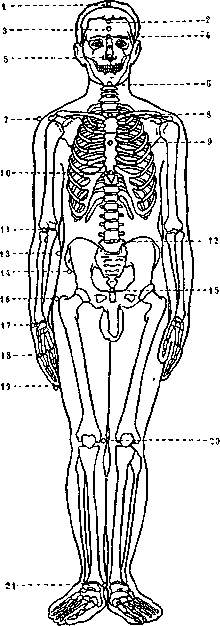
Figure 1. 1—top of the head (vertex); 2—upper forehead (trichion); 3—forehead (metopion); 4—upper nasal (nasion); 5—subnasal (subnasion); 6—chin (gnathion); 7—shoulder (acromion); 8—suprasternal (suprasternale); 9—mid-sternal (mesosternale); 10—lower sternal (xyphion); 11—radial (radiale); 12—umbilical (omphalion); 13—iliocristal (iliocristale); 14—iliospinal (iliospinale); 15—pubic (symphysion); 16—trochanteric (trochanterion); 17—styloid (stylion); 18—phalangeal (phalangion); 19—digital (dactylion); 20—tibial (tibiale); 21—malleolar (sphyrion).
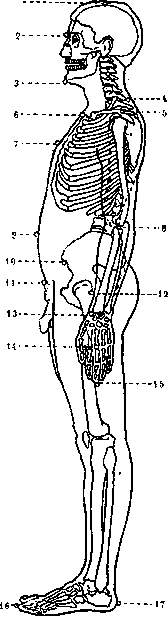
Figure 2. 1—top of the head (vertex); 2—upper nasal (nasion); 3—chin (gnathion); 4—cervical; 5—shoulder (acromion); 6—suprasternal (suprasternale); 7—mid-sternal (mesosternale); 8—radial (radiale); 9—umbilical (omphalion); 10—iliospinal (iliospinale); 11—pubic (symphysion); 12—trochanteric (trochanterion); 13—styloid (stylion); 14—phalangeal (phalangion); 15—digital (dactylion); 16—terminal (akropodion); 17—calcaneal (pternion).
above the floor and, by subtracting from it the height of another, lower point, obtain any longitudinal measurement. The horizontal ruler must be turned with its point downward; the measurement result is read in the window along its beveled edge. For measuring diameters and small lengths, the following are used: 1. A sliding caliper, a wooden or metal rod 50 cm long, with a fixed upper transverse ruler corresponding to the zero division of the scale. A sleeve with a second transverse ruler moves along the rod. The upper part of the Martin anthropometer (Figure 3)
can easily be converted into a sliding caliper, as well as into a spreading caliper (see Figure 4). 2. The spreading caliper, large (Baudelocque's pelvimeter), consists of two steel legs, tightly touching each other and fastened by a hinge. At the middle of the instrument's length, the legs diverge, curving outward in an arc, and meet again with button-like ends on the midline. On one of the legs, a transverse ruler is fixed with a pin, with divisions exactly corresponding to the divergence of the ends of the caliper legs; on the opposite leg, a movable metal sleeve is attached with a pin, the front wall of which is replaced by a beveled plate used for reading (see Figure 5). The length of the instrument in a straight line is 47 cm; the distance between the most distant points in the curved part is 14 cm. The small spreading caliper differs from the large one only in dimensions (25 cm and 8 cm respectively). 3. The sliding caliper is a steel ruler, 25 cm long, with millimeter divisions on both sides. To the end of the ruler corresponding to the zero division, a metal strip is fixed, sharpened at one end and blunt at the other (the sharp ends are used for measurements on a cadaver). A similar strip is attached to a sleeve sliding along the ruler, along the beveled edge of which the measurement result is read (see Figure 6). For measuring circumferences, a steel tape is used.

Figure 4.
A tape measure, 150–200 cm long, with millimeter divisions. If another tape must be used, it must be periodically checked against some standard scale. The chest circumference is measured in a state of quiet breathing with the subject's arms lowered. In men and children (without signs of puberty), the tape is passed behind under the angles of the scapulae, and in front along the lower edge of the areolae. Figure 6. In women, the tape is passed in front along the fourth rib. Weighing is performed on lever-type weightless scales of the Fairbanks type (see Figure 7), with a maximum load of 200 kg and divisions of no less than 2 mm, corresponding to a weight of 50 g. (Children's scales are of the same design but smaller in size, with a maximum load of 25 kg and divisions of no less than 2 mm, corresponding to a weight of 20 g. A trough-like depression for the child and a removable seat for sitting are placed on the platform). The fixed and movable pointers of the lever scales in a state of rest must strictly correspond to each other. The accuracy of the readings is tested with appropriate weights (the load must be at least 20 kg). To verify the sensitivity of the scales, a person standing on them is given a weight of 50 or 100 g, and the scales must accurately record this addition. All instruments must be carefully verified upon purchase, before starting, and after finishing a series of observations. For other anthropometric measurements, instruments, and somatoscopy, see under the corresponding words (Spirometer, Scoliosometer, etc.). Processing of anthropometric data. The obtained anthropometric data must be processed by the variational-statistical method (see Biometry, Variational Statistics, Correlation). It is first necessary to clear the material of cards with obvious errors and the absence of necessary data (for example, age, height),
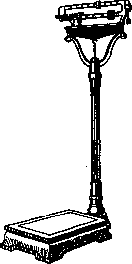
Figure 7.
and to exclude pathological deviations. Homogeneous groups (by sex, age, nationality, socio-economic composition) that are sufficiently saturated must be identified. The problem of a summary characteristic of physical development based on anthropometric data is very complex. Previously, the method of indices (see) was widely used, expressing the ratio of the values of some traits to others. Now many apply comparison with standard values (assigning the measured subject to one class or another, for example, to the "normal" class by height, "subnormal" by weight). The most accurate is the method of scales (see Variational Statistics, Correlation, Regression).
Related articles
Mentioned in
Cite this page
“Anthropometry.” Soviet Medical Encyclopedia. English translation of Bolshaya Meditsinskaya Entsiklopediya, 1st ed. (Moscow, 1928–1936), ed. N. A. Semashko. https://sovietmedicalencyclopedia.pages.dev/article/anthropometry/