Constitution
Historical document, translated for reference. It reflects medical knowledge of the 1920s–30s and is not medical advice.
Summary
An overview of the doctrine of human constitution from the 1928–1936 Great Medical Encyclopedia, tracing its historical development from ancient Greek medicine to modern 20th-century typologies and constitutional pathology.
Encyclopedia article (1928–1936)
CONSTITUTION (from Latin constitutio — state, composition, property), the qualities of the organism, physique, and the like, chiefly those properties of an individual that influence the onset and course of diseases. Human constitution has long been considered to also include temperament, predisposition to various diseases, and so forth. I. General Doctrine of the Constitution. Constitutional properties of the organism play a significant role both in the normal life of an individual and in the development of pathological phenomena. Therefore, physicians have long paid special attention to the properties and characteristics of the sick person and based their prognosis and therapy on an evaluation of their individual constitution ("treating the patient, not the disease"). The modern physician must also properly take into account the constitution of the organism for a better understanding of etiology and pathogenesis, for prognosis and rational treatment, as well as for preventive purposes. The field of studying the constitution and applying research results in practice is now expanding in various directions: it is of interest in pedology, in the rational structuring of physical education, in vocational guidance, in the physiology of labor, for elucidating pathological predispositions, and others. In connection with the study of the constitution, the doctrine of "constitutional prophylaxis" has also been put forward (Tandler, Yudin, and others). History. Constitutional types of people were noticed long before the emergence of scientific medicine and grasped so accurately that some types turned out to be vividly conveyed in many works of ancient art of various nations. In the art of the Egyptians, for example, one can find not a few examples of fine representations of human constitutional types. One of the masterpieces of Egyptian art of the Memphite period—the statue of the "Sheikh el-Beled" (dating back more than 5 thousand years BCE)—is a strikingly accurate specimen of pyknic constitution. Asthenic constitution and typus degenerativus (in the sense of J. Bauer) are particularly emphasized in many representations and statues of Amenhotep IV, Tutankhamun, and others. Regarding Tutankhamun, thanks to the recent discovery of his mummy, the similarity of his images to the original was confirmed. In contrast to primitive medicine, which tended to attribute all diseases merely to special external factors (mostly of a supernatural order), scientific medicine from its very inception in the medical schools of ancient Greece and its colonies attached great importance to human constitution, paying attention both to external factors of the disease and to the characteristics of the diseased person. Of the two medical schools that flourished in the 5th century BCE (Knidian and Cosan), the latter became especially famous in connection with the name of Hippocrates (see). In the works of Hippocrates, significant factual material on human constitution is already cited, it is noted that the onset and course of a disease depend on the properties of the organism, several types of constitution are enumerated (good and bad, strong and weak, fat, moist, etc.), a strikingly clear description of some typical features of asthenic constitution is given, an unfavorable prognosis of consumption in habitus phthisicus and a favorable one for individuals with broad chests are pointed out, and many other interesting data are reported that have retained their significance to a certain extent to the present time. Hippocratic medicine distinguished many diverse causes of diseases. Most often, it saw them in an irrational lifestyle not corresponding to temperament, in inappropriate nutrition, as well as in many climatic and telluric-cosmic factors. But all these influences affect different people in different ways. As is well known, Hippocratic medicine saw the essence of diseases in the improper mixture of the four main humors of the body: blood, phlegm, yellow bile (from the liver), and black bile (from the spleen), which corresponded to four special "qualities": heat, cold, dryness, and moisture. An improper mixture of humors ("dyscrasia") causes diseases, while a proper one ("eucrasia") causes health. It is interesting to note that already at that time there was the notion that with a less significant violation of the proper mixture, it is not a disease that results, but rather certain features of the individual constitution of a person, a special temperament. The predominance of one humor or another determines people's temperament — sanguine, phlegmatic, choleric, and melancholic. The doctrine of Galen (see) also bore a quite definite character of constitutional pathology, closely adjoining in many respects the humoral pathology of Hippocratic medicine and containing the doctrine of predisposition. Hippocratic-Galenic humoral pathology with its doctrine of dyscrasias, diatheses (see), and the like, undergoing various changes, was preserved in general for a long time. Ancient solidar pathology for its part also produced a number of concepts (status strictus and laxus, which later turned into the concepts of tonus and atonia, etc.), which played no small role in the development of the doctrine of constitution. A significant turning point in medical views occurred during the period when Morgagni in his book De sedibus et causis morborum proclaimed that the "seat of the disease" (sedes morbi) is the diseased tissue or organ itself. This dealt a long-term blow to the old Hippocratic-Galenic view, which had always seen in local phenomena only symptoms of a general disease. The anatomical-localistic principle found particularly vivid expression in Virchow's cellular pathology. The subsequent dominance of pathological anatomy largely distracted scientific medical thought from the study of the general problems of constitution. Moreover, the rapid and striking successes of bacteriology, the discovery of various external pathogens of diseases so relegated the individuality of the patient and the entire constitutional pathology to the background that for a long time it was abandoned and almost completely forgotten. It is significant that, for example, in the multi-volume Real-Encyklopädie der gesammten Heilkunde, published in 1909–1915, there is not even the word "constitution." Under the influence of this one-sided tendency, the gradually accumulating undoubted facts remained unnoticed and improperly evaluated for a long time—namely, that even the development of infectious diseases, such as tuberculosis, depends, apart from the presence of the pathogen, on the properties of the organism itself. Attempts by Rosenbach (1891), who pointed to the different course of infections under various predispositions, the work of F. Kraus ("Die Ermüdung als ein Mass der Konstitution", 1897), and others did not exert any significant influence on medical thought, and only somewhat later did the numerous works of Martius (1849–1909) continue the path toward recognizing the importance of constitutional factors in the pathogenesis of many diseases. The development of the ideas of constitutional pathology was also facilitated by the fact that separate pictures of general constitutional anomalies were isolated and described: exudative diathesis (Czerny, 1905), asthenia (Stiller, 1907), status thymico-lymphaticus (Paltauf, 1889), hypoplastic constitution (Bartels, 1908), and others. Alongside this, the doctrine of human types (typology, clinical morphology) developed, elaborated mainly in Italy by de Giovanni (1877) and his followers (Viola, Pende) and the French school of Claude Sigaud (1894–1908) and others (see below). In connection with the study of individual susceptibility and resistance of the organism, with the development of the doctrine of internal secretion and the vegetative nervous system, and especially in connection with the biological study of variability and heredity, with the precise analysis of hereditary determinants and the analysis of individual development, the aforementioned one-sided assessment of exogenous factors began to gradually smooth out, and a sort of rebirth of constitutional pathology occurred, the elaboration of which now rests on more scientific methods. At the present time, the field of studying the constitution is in a period of lively development: new problems arise, new methods are applied, and different directions in the study of the constitution are outlined. Some researchers (Tandler, J. Bauer, and many others), aiming to make basic concepts more precise and more consistent with the terms of modern biology, narrow the concept of constitution, referring to it only the hereditary basis of the individual, the genotype, and contrasting the hereditary constitution of the individual under the name of "condition" with everything acquired during intrauterine and extrauterine life. Others (Kraus, Brugsch, and many others) strive to keep the empirically arisen concepts of the constitution as broad as possible, without the specified limitation, and transform the doctrine of the constitution into the medical doctrine of personality (Medizinische Personallehre) or the biology of personality, in which latter case, as Fr. Kraus points out, the very term "constitution" may prove superfluous. Along with this, anatomical and anthropological studies are conducted in the direction of isolating and studying mainly morphological types as definite variants of humanity existing within each race (Weidenreich, Meyerhofer, and others). Many authors bring to the fore the understanding of constitution as the expression of the organism's capacity for physiological and pathological reactions (Fr. Kraus, Bogomolets, and others). Thus, at the present time in the doctrine of constitution there is still much that is unfinished and barely begun.
Quite a few entirely unscientific survivals remain, various empirical data that do not measure up to modern scientific requirements. The directions and paths of individual researchers vary, and so does the terminology. Nevertheless, a vast and theoretically and practically important body of factual material subject to study has already fairly clearly emerged in essence, a more precise formulation of general and special problems has become possible, and precise scientific methods of modern biology (especially genetics—"hereditary-biological analysis of the personality", etc., and developmental mechanics, studies of internal factors and the environment), physiology [functional tests of individual organs and systems ("executive, working organs", the autonomic nervous system, incretory organs)], microchemistry and physical chemistry, anthropometry (somatometry), serology (isohemagglutination), and many others have begun to be applied to the study of the constitution. Basic concepts and terminology. Based on modern biological data, the development of any living being (individual) can be schematically expressed, somewhat modifying Johannsen's scheme, as follows: hereditary factors (genotype) + external factors (environment) = realized individual (phenotype). However, the contribution of various factors—genotypic or external—in the development of each specific trait varies and must be carefully studied in each individual case. In the development of certain traits (including diseases), both the hereditary factor and the influence of external factors play a major role. These basic concepts must naturally also lie at the base of the modern doctrine of the constitution of the individual. But since the doctrine of the constitution arose in very remote times, when correct biological concepts did not yet exist, there is still no generally accepted definition of the concept of constitution (see above). It is hardly expedient to classify all individual traits without exception as constitution, as some authors propose, thereby identifying constitution with "personality" and "individuality". In most cases, constitutional properties and features are considered to be only those whose influence affects both the morphology of the individual (habitus) and the individual character of his physiological reactions (Aschner, Fischer, Siemens, and others), and which to any significant and lasting extent affect the organism's resistance and its ability to react to various influences. It is more expedient and practical not to restrict the concept of constitution (which arose empirically from practical medical needs) exclusively to hereditary properties (genotype), but to reckon with the total aggregate of properties (phenotypic) that essentially characterize a given individual, especially in his relations to various influences (in particular, to external conditions causing diseases), and that characterize the peculiarity of the course of physiological and pathological processes in him, and so forth. Wishing to precisely demarcate the components of the constitution caused by hereditary factors, one can also speak of a genotypic (idiotypic) constitution, assigning the name paratypic constitution, if necessary, to properties acquired during individual life thanks to external influences. The exact same factual relationships are designated by various other authors by different terms, as can be seen from the accompanying table (Table 1).
The human constitution encompasses the entire totality of both physical (somatic) and mental properties characterizing the individual in the above-mentioned relations. The mental properties of a person characterizing his mental constitution can to a certain extent be encompassed by the concepts: mental abilities (intelligence), character, and temperament. Some authors apply the term constitution only in the anatomical sense, while using the term "temperament" to characterize physiological features (MacAuliffe). To characterize changes in constitutional features as the individual develops, one speaks of age constitution (see Pedology) and evolutionary anomalies of the constitution (J. Bauer). The concept of constitution must embrace not only pathological properties. Every person has an individual constitution inherent to them. If, however, the constitutional features of a given person lie beyond those limits within which these features vary in the majority of normal people, if they are unfavorable to health, one can speak of anomalies of the constitution (J. Bauer) or of a pathological constitution (Lenz). Certain predispositions are usually associated with certain constitutions: a tendency to tuberculosis and anemia is associated with the asthenic constitution; a tendency to metabolic diseases is associated with the pyknic (arthritic) constitution, and so on (see constitutional types below). The concept of diathesis (see) denotes a special constitution characterized by a special form of predisposition to certain symptomatic manifestations. Idiosyncrasies are also usually classified among predispositions (see Idiosyncrasy). The constitution of each individual is composed to a certain extent of the constitutions of individual tissues, organs, and organ systems (Marfan). Therefore, one can speak not only of a general constitution, but also of partial constitutions of individual parts of the organism. Nevertheless, it must be kept in mind that the general constitution of the individual does not represent a simple sum of his partial constitutions, since the constitution is also determined by individual differences in the coordination and regulation of individual parts of the organism and their functions. When assessing the constitution, it is therefore necessary to pay attention to both individual parts and the entire organism as a whole. General pathology and genetics of the constitution. The human constitution manifests itself in his general appearance, habitus (in the exterieur of animals and plants), in the morphological and functional properties of individual organs and systems, in the properties of correlations between them, in the features of his individual development, in predispositions to certain diseases, to a peculiar course of the disease, and so forth. In the habitus (see) of the individual, the constitution is in many cases expressed so definitely that one can already outline the constitution type from the features of the habitus (see below). Individual constitutional features may be predominantly of hereditary (genotypic) origin, mixed, and predominantly or even purely acquired (of paratypic origin), as can be seen in the attached scheme by Pfaundler (Table 2). For the construction of a more precise and complete doctrine of the constitution, it is especially important, first of all, a thorough and comprehensive study of the individual features (components) of which the constitution is composed—both anatomical (cf. the studies of Beneke, Shevkunenko, and others) and, in particular, physiological, biochemical, and psychological; it is necessary to study the nature of the trait and its variation, the mechanics of the development of the trait, its correlation with other traits, and so forth. The variability of internal organs in their correlative connection with the variation of habitus (on the shape and position of the heart and other organs in various types, see below) has not yet been studied sufficiently. Kaup divides organs into two groups: 1) brain, liver, kidneys with adnexa...
constriction by amniotic bands. Spasmophilia, vagotonia, neuroarthritism. Lordotic albuminuria, some habitual constipations, cardiopathia adolescentium. Post-measles predisposition to infections (to tuberculosis, diphtheria). «Goiter heart» with adrenals and spleen, and 2) pancreas, thyroid, thymus, testes. Based on correlation calculations, he establishes that the first group does not depend in any noticeable way on the habitus. In general, with the exception of the heart, internal organs show insignificant correlations with the habitus. The properties and features of the connective tissue system (features of mesenchymal reactions, properties of the reticuloendothelial system) participate in the creation of the habitus and determine many constitutional properties of the organism (Ju. Bauer, Bogomolets). According to Ju. Bauer, the essence of asthenia boils down to a general insufficiency of mesenchyme (mesoderm) derivatives, in particular to a disruption in the formation of fibrillar substance, which explains both the main manifestations of asthenia—weakness and insufficiency of all connective and supporting tissue with all the consequences (tendency to visceral ptosis, formation of varices, hernias, prolapses, etc.)—and the delicacy of the skeletal system—weak (skeletal) musculature, hypotonia of all smooth muscles, hypoplasia of the vascular system, etc. At the same time, it should be kept in mind that individual features of connective tissue can be caused both by hereditary factors and by various exogenous influences. The participation of endocrine organs in the formation of the constitution is still evaluated differently. Most researchers believe that the development of glands with internal secretion, the so-called «personal endocrine formula» (Stern), itself depends on constitutional factors. It is believed that the constitution is determined both by local properties of tissue and «working organs» and by the features of internal secretion organs in combination with the properties of the vegetative nervous system. According to other authors, the constitution in general is determined mainly by internal secretion (Pende, Sternberg, Mandelstam, Poyurovsky, and others). The issue is also complicated by the fact that the susceptibility (sensitivity) of tissues to a hormone depends on hereditary-constitutional properties, but can also change under the influence of external factors, e.g., nutrition (Abderhalden), etc. The equilibrium, harmony of the work of organs with internal secretion remains stable in some individuals throughout life; in others it turns out to be unstable (Falta), and under certain conditions during periods of life when increased demands are placed on the endocrine system (during puberty, pregnancy, etc.), temporary disorders occur, for example, features of acromegaloid constitution, eunuchoidism, hyperthyroid constitution, etc. According to the theory of Fr. Kraus and S. Zondek, the constitutional setup of the organism is determined by the entire «vegetative system», consisting of the colloidal system of boundary surfaces in cells (in muscles, in internal organs), electrolytes, vegetative nerves, and hormones. Tone is a direct reflection of the processes playing out in this general «vegetative system» (Zondek). It also determines the «depth personality» (Tiefenperson) of a person (see Kraus's doctrine). Very characteristic of the constitution of an organism are the tempo and course of the life processes taking place in it (Bogomolets). The fact that the supply of inherited plastic energy of the organism, the supply of its capacity for chemical regeneration in individual individuals is very different and that it is spent in turn depending on the constitution and external conditions, serves as the basis for the dynamic study of the problems of constitution (Hofmann, Bogomolets). Constitutionally, an abnormal course of development, premature, uneven development, premature aging, various types of aging, etc. (all kinds of «evolutionary disorders» of Ju. Bauer, «Vegetationsstörungen» of Kundrat) can be caused. Certain constitutions find their expression also in predispositions of both a general and a special character. Constitutional weakness and inferiority can selectively concern a defined system of organs, or a single organ, or even a part of it. A constitutionally inferior organ usually represents the most vulnerable spot of the organism, its locus minoris resistentiae. Such an organ is for the most part the most accessible point for the action of all kinds of external influences that can generally cause various diseases. This includes the predisposition to otitis media, endocarditis, kidney diseases (nephritis, nephrosis, and nephrosclerosis), stomach ulcers, etc. And among asthenics, for example, in one person, due to a corresponding local predisposition, atony and stomach ulcer develop, another suffers from a floating kidney, etc. Constitutional predispositions in the pathogenesis of various diseases can take a greater or lesser part. In some cases, the constitutional weakness of the tissue is so great that normal life conditions, which do not harm a healthy organism, can already lead to diseases. In other cases, for the occurrence of a disease along with the corresponding predispositions, external exposure is absolutely necessary (infection with pathogenic bacteria, chronic intoxication, etc.). It must be noted that the course, localization, and outcome of many infections (syphilis, tuberculosis, etc.) are largely determined by the constitution. Sometimes the predisposition is so insignificant that it can manifest itself only under special conditions. Personal susceptibility to certain diseases also plays a very large role in occupational diseases: attention is drawn, for example, to the varying intensity of the process of self-cleaning of the lungs with the help of ciliated cells, individually varying sensitivity in relation to various hazards that have to be encountered in production processes, etc. In view of all the aforesaid, when studying occupational diseases, it is also necessary to take into account constitutional moments. The genetics of the constitution has been studied quite insufficiently. There are no data, for example, on individual genes of constitutional traits, on the influence on these genes and their development of other genes, external influences, etc. Individual clinical observations indicate that some constitutional types (e.g., asthenic habitus) are inherited as a whole. However, individual components of the constitution can be inherited in isolation. Weidenreich, for example, indicates that when crossing pure leptosomic (narrow) types (see below) with pure eurythermic (wide) types, the forms and proportions of each individual part of the body can be inherited separately: e.g., a leptosomic nose can be on a eurythermic face or a head with a eurythermic structure on a leptosomic torso. A careful study of human hereditary anomalies has shown that numerous traits are determined by individual hereditary factors-genes (see). Thus, for example, according to the studies of B. Aschner and Engelmann, individual traits or even the finest details of the structure of the human peripheral movement apparatus (bones, joints, ligamentous apparatus, muscles, etc.) are determined by many individual hereditary units (genes): some genes are related to the typical development of a given trait, others to the normal number, for example, of finger phalanges, still others to a specific localization of a given trait, etc. Along with genes causing enchondral bone growth in length, there are also those on which periosteal and endosteal bone growth in width depends; there are qualitatively different groups of genes or their complexes causing the normal development and function of joints, wherein the correct development and position of articular surfaces depends on some, and the provision of the possibility of correct movement in a given joint depends on others, etc. As for the mechanisms causing the frequently repeating typical combination of individual traits of which the constitution is composed, they are insufficiently studied: they can depend either on pleiotropy (see) of genes, i.e., on the fact that the same gene in different parts of the organism causes different phenotypic traits, or on linkage of genes due to their localization in neighboring regions of the same chromosomes, etc. It is also conceivable that there are few genes determining, for example, the development of this or that endocrine gland, the function of which affects the determination of a number of external traits. In any case, for a correct understanding of the questions of the genetics of the constitution, it must be kept in mind that although a certain gene can determine many heterogeneous traits in different parts of the organism, many reactions, it is still only a member of the entire genotype, the entire gene formula constituting the hereditary basis of the individual, and that real traits caused by certain genes always develop under conditions of a known environment during the close and complex interaction of genes and external factors.
It has also not been studied to what extent certain constitutional traits can be modified due to the impact of various external factors (environmental influences), how all kinds of damaging influences on the germ cell [blastophthoria (see), chronic poisonings, X-rays, infections, etc.] affect the general constitution type and its individual components, to what extent infections such as tuberculosis and syphilis can change the habitus, for example, and what the limits of variation of the phenotypic manifestations of various constitutions are under the influence of various conditions of upbringing, way of life, labor, etc. Systematics. Constitution Types. Since an individual constitution is inherent to every person, one can say that there are as many constitutions as there are people (with the exception of monozygotic twins who possess an identical genotype). However, the natural need to single out individual, most characteristic constitution types has been felt for a long time. Many authors have given various groupings and descriptions of types identified on the basis of the most diverse features: habitus (De-Giovanni, Sigaud, and others), various muscle tone ( Tandler), the state of the vegetative nervous system (Eppinger, Hess), the nature of metabolism (French clinicians), and so on. Morphological features of the habitus are especially frequently used for these purposes. Without dwelling on older, poorly substantiated attempts, it should be noted that De-Giovanni, one of the founders of clinical morphology, on the basis of careful studies (measurements of individual characteristics, etc.), distinguished the following 3 types based on the predominance of certain properties: I morphological combination, characterized by the predominance of a long chest, small size of the heart and arterial system (similar to a certain degree to the later designated respiratory, asthenic, and asthenic-infantile type); II morphological combination, close to the average ideal type, characterized by a good muscular system and a developed heart; III morphological combination, distinguished by a special development of the abdominal cavity (similar to the later designated digestive, pyknic type). People of the first type are prone to tuberculosis, the second to acute diseases, cardiovascular disorders, and the third to metabolic diseases, etc. This three-part division found further development in Kretschmer's system, which distinguishes 3 main types: 1) asthenic (Fig. 1); 2) athletic; and 3) pyknic (Fig. 2)
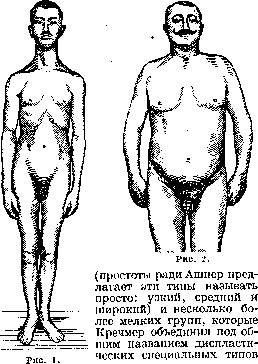
and which entirely represent deviations from the average type and are partly in close morphological connection with gross dysfunction of the endocrine glands.
The asthenic (leptosomic) habitus, according to Kretschmer, generally coincides with the picture of asthenia that was outlined by Stiller. Individuals belonging here are characterized by small dimensions in width with an unreduced, on average, height in length; these subjects are thin, usually with sickly, bloodless skin, with narrow hanging shoulders, with a thin long neck, with a long narrow flat chest, with thin limb bones, etc. (Fig. 1). The asthenic type, known to physicians since the time of Hippocrates, corresponds to a certain degree to the respiratory and partly to the cerebral type of Sigaud's classification (see below). - The athletic type is distinguished by a strong development of the skeleton, musculature, and skin: broad shoulders, a magnificent chest, and so on. In general, it appears as if an intermediate type between the 1st and 3rd types. Many features of this type coincide with Sigaud's muscular type. - The pyknic type at the height of its development in middle age is characterized by a strong development of the cavities (head, chest, abdomen) and a tendency to fat deposition on the trunk with a more delicate development of the shoulder girdle and limbs. Pyknics possess a broad, stocky figure, a wide face sitting between the shoulders on a short neck, and a large abdomen growing out from beneath a chest expanding downwards. According to Kretschmer's studies, the somatic types (physiques) outlined by him also correspond to a typical psyche (certain characters and temperaments), which does not lose its characteristic features either in normal people or in psychiatric patients (see below). Henkel studied the variation of individual dimensions in the 3 main types (Fig. 3): narrow, leptosomic (asthenic, according to Kretschmer), muscular (middle), and wide eurythermic (pyknic type) and calculated some correlations (see below). The named types also differ in many other respects. Thus, for example, Ozeretskov studied body structure and motor aptitude (using special tests developed by him together with M. Gurevich and N. Bernstein) in 263 metalworker workers (trainees of the Central Institute of Labor) and found that people of asthenic physique enter into work somewhat slower than athletics and pyknics, work more economically, their strength is insignificant: 30-35 by dynamometer (in pyknics 45-50), and so on. In a professional sense, striking and pressing operations are worse for asthenics than assembly operations. The pyknic type works slowly, but for a long time; general motor aptitude is better, manual dexterity is worse than in asthenics, and so on. According to Sigaud's fairly widespread classification, all people can be divided into 4 main types: respiratory (type respiratoire), digestive (t. digestif), muscular (t. musculaire), and cerebral (t. cerebral). - Typus respiratorius (Fig. 4) is characterized by a particularly long chest, low standing of the ribs reaching almost to the iliac bones, an acute epigastric angle, a relatively small abdomen, a long neck, an enlargement of parts of the skull and face serving for respiration, and due to the large size of the frontal and maxillary sinuses, a large distance between the zygomatic processes is obtained, so that the entire face acquires the shape of a hexagon; the vital capacity of the lungs is very large. - Typus digestivus (Fig. 5) is distinguished by the fact that the lower third of the face is developed particularly powerfully, so that a particularly large distance is obtained between the base of the nose and the chin, and the entire face with widely spaced rami of the lower jaw forms as if a pyramid with a base on the lower jaw and a vertex on the crown; a large mouth with a well-developed protruding lower jaw, eyes are small, provided with fatty eyelids. Striking is the short neck, wide but short chest. The abdomen is strongly developed, with an obtuse epigastric angle, mostly protruding, with a tendency to fat deposition. Individuals of this type are mostly corpulent. - For typus muscularis (Fig. 6), a harmoniously formed skull is characteristic, mostly brachycephalic, the three parts of the face in length and in width are often equal to each other, so that the face has a sort of square shape. The hairline on the forehead has the appearance of a straight line and forms a right angle on both sides, whereas in the digestive type this line forms an arc, and in the cerebral type in the middle of the forehead it forms a blunt protrusion forward, and on the sides acute angles plunging inward. The hair cover, especially beard and mustache, is strongly developed. The back, chest, and abdomen are formed proportionally, the abdomen does not protrude, the epigastric angle is of medium size, the shoulders are wide and high. On the limbs, sharp modeling of muscles and tendons is noticeable. This type corresponds to the classical ideal of Greek beauty. - Typus cerebralis (Fig. 7) is characterized by a certain discrepancy between a delicate, thin figure and a large skull, and due to the strikingly strong development of the frontal part of the face, the entire face takes on the appearance of a pyramid with the vertex turned downward. Limbs are short, especially small are the legs. Besides these four regular "pure" types, Sigaud and MacAuliffe noted also
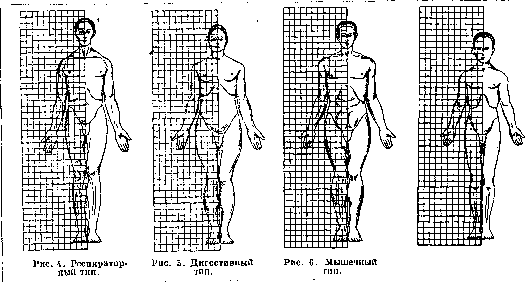
Figure 7. Cerebral type.
described two more groups of irregular types: several varieties (according to the degree of modeling, etc.) of the round type (t. rond) and the flat type (t. plat). General ideas about the main types of Sigaud are given in the accompanying figures (Figs. 4, 5, 6, and 7). Many other classifications have also been proposed. Bogomolets, believing that the morphological constitutional type and the biochemical features of the constitution are determined by the state and vital activity of the mesenchyme, outlines 4 mesenchymal types of the constitution: asthenic (thin, delicate connective tissue predominates), fibrous constitution (characterized by dense fibrous connective tissue), pastose constitution (with a predominance of moist, loose connective tissue), and lipomatous constitution (with abundant development of adipose tissue). When systematizing constitutions, it should be borne in mind that different authors under various names describe essentially the same or similar types, as can be seen from Table 3. Table 3. Comparative table of names under whatever names they figured): the "narrow"-leptosomic and "wide"-eury-somic (formerly called among us the "phthisic" and "apoplectic" complexion). In addition to the two extreme types, many authors (see table) nevertheless consider it necessary to distinguish an intermediate type, to some extent corresponding to what others call the muscular type. The two most studied main constitutional (morphological) types of man are characterized by the following features (according to Weidenreich) (Table 4). Weidenreich's studies established the existence of these 2 main types in representatives of different races. These types, as the named author proves on the basis of the study of fossil skulls, mummies, statues, drawings, etc., existed not only in all historical times, but also in prehistoric times, in the Paleolithic and Neolithic epochs. As for the relationship of constitutional types to races, although among the modern population of Europe the Alpine race is similar to a certain extent to the pyknic type of Kretschmer, and the northern race to the leptosomic type (Pfuhl, Hirsch, and others), nevertheless, special studies have established the presence of constitutional types within each race (Weidenreich, Henkel). The Japanese types "hoshiu" (thin) and "satsuma", like analogous phenomena among other peoples, are apparently constitutional types and not racial ones (Weidenreich). Table 4. Leptosomic (narrow-bodied) type Eury-somic (wide-bodied) type General height Tall, narrow Short, wide General character of physique Tall, thin Short, dense General state of nutrition Inclined to leanness Long, narrow Inclined to fat deposition Trunk Short, wide Limbs Long, thin Short, dense Neck Long, thin Short, wide Shoulders Sloping Straight, high Shoulder breadth Narrow Wide Thorax Long, narrow, flat (expiration type) Short, wide, deep (inspiration type) Chest circumference Small Large Ribs Lowered Raised Costal angle Acute Right or obtuse Diaphragm Flat High-convex Heart Small, elongated, located more vertically Large, more rounded, located horizontally Abdomen Small, flat Large, bloated Stomach Located longitudinally, displaced to the left Located transversely in the form of a "bull's horn", displaced to the right Liver Small, located more to the right Large, deviates significantly to the left Small intestines Short Long Head as a whole Long, narrow Short, wide Structure of the face Oblong-oval Round, "like the moon" The distribution of types among the population can be judged by the following data. Among 2,000 men examined by J. Bauer in the Vienna polyclinic, only about 18% showed a pure respiratory habitus, 9% muscular, 3.9% cerebral, and 3.8% digestive. If we include mixed forms in which one or another type more or less clearly predominates, then in general men of the respiratory type were found in 43.1%, muscular in 23.8%, cerebral in 18%, and digestive in 6.6%; the remainder of 8.5% could not be included anywhere even under this condition. Some data on the distribution of types among the population of the USSR are given in the accompanying table compiled by B. N. Vishnevsky in such a way that the different classifications are reduced to a three-term formula, with respiratory ones assigned to the leptosomic type, digestive to the eury-somic type, and muscular and mixed to the mesosomic type (Table 5). The classification of women (Bauer, Aschner, and others) and children (Maslov and others) according to the cited types is performed with greater difficulty than in relation to adults, fully formed men, yet with a certain skill Lederer succeeded in many cases (in 109 out of 221) in noticing the types according to Sigaud in infants and small children. With age, the distribution of types and the very type of habitus (in individuals, according to some authors, mainly in individuals of a mixed type) changes. In infants in Vienna, Lederer found the leptosomic type in 4.5% (Bauer in adults 18%), the eury-somic type in infants in 5.9% (in adults 3.8%), etc. Fat deposits with age can change body shape. Along with changing types (Goethe, for example, was leptosomic at 30 years old, eury-somic at 46, and had a cerebral type at 83), there are people who preserve their constitutional features during all periods of life. The study of the problem of demarcation between permanent and changing types has great both theoretical and practical significance. There is reason to assume that intense physical labor during the growth period (for example, in blacksmith apprentices) can lead not only to an increase in muscles, but also to enhanced growth in width; on the other hand, apprentices of professions associated with insignificant Table 5. Tribal group Author Number of cases Leptosomic type Mesosomic type Eury-somic type In percent Russians former Penza province Bunak 212 7 80 13 Northwestern region Chernorutsky 13 64 22 men Nikolaev 2.000 10 70 20 women Berlin, Wolfson, and Pankratov 1.884 18 58 24 students Vishnevsky 16 72 12 peasants Kharkov district I Gagaeva-Vishnevskaya 11 65 24 Ukrainian peasants Kharkov district I Vishnevsky 13 70 17 Ingush men Gagaeva-Vishnevskaya 43 52 5 Osetians, northern 68 30 2 Tajiks men 36 32 32 women Uzbeks men 10 82 8 women 20 75 5 physical tension (clerks), with progressive growth become narrow-chested (Kaup). Constitutional motor abilities change with age and possess plasticity, the ability to change from external conditions, from pedagogical measures, exercises, and subsequently from profession. At the same time, the main features of this motor appearance remain, but individual components are more or less amplified, and their synthesis produces a general change. The limits of variability require further study, which is of enormous importance for pedagogy and vocational guidance.
It should be kept in mind that while in some cases the characteristic features of a certain constitutional type can be expressed quite distinctly, the boundaries of types (as of other natural phenomena) are blurred, and due to this the naming (classification) becomes to a certain extent a matter of convention (Weidenreich). At the present time, comprehensive study of types continues from the standpoint of pedology, physical culture, sports, in relation to professions and labor physiology, the distribution of blood groups (hemoagglutinins) according to body build types, etc. When studying the electrocardiogram in people of different types (according to Kretschmer), Stoss found that the electrocardiogram, while remaining generally normal, exhibits features characteristic of each type. Apparently, a characteristic picture of the capillaries corresponds to certain body build types (Maslov, Toropova, and others), but this picture is subject to a strong modifying influence from various exogenous factors, and it can change abruptly in various diseases (Müller and others). The study of the correlation of types with certain blood groups, those very stable genotypic constitutional properties, has not yielded encouraging results (Hilgers, Wolfel and Knetzke, Shchigolev, Rubashkin, and others). It turned out that a certain constitutional type (or habitus) is not always associated with one and the same group. A certain connection sometimes seems to be outlined after all (Warnowsky and the indicated authors).-There are attempts to express constitution in the form of various indices (see) "constitutional formulas." Although individual types have still not been studied sufficiently, distribution by types has already proven fruitful primarily in the medical respect, since a certain connection of types with certain diseases has been outlined.-According to Bauer's opinion, the respiratory type (the cerebral less so) is predisposed to pulmonary tuberculosis, the muscular and digestive habitus to syphilitic diseases of the aorta and kidney diseases, the muscular type generally to various kinds of "rheumatic" diseases (neuralgias, myalgias, arthralgias). Catarrhs of the upper respiratory tract, as well as nervous heart diseases, are encountered more frequently in individuals of the muscular type, whereas possessors of gastric and duodenal ulcers frequently exhibit a respiratory habitus. Neurasthenics and hysterics belong predominantly to the cerebral type. Citing the division into 2 main types—hypersthenic (pyknic, digestive) and asthenic, Chernorutsky gives the following table characterizing the correlation between the two constitutional types and morbidity. Metabolic diseases ...... Pulmonary tuberculosis ...... Arteriosclerotics ...... Tubercular patients (according to Bauer) Hypersthenic type in % 83.3 1.4 Asthenic type in %. 6 0.9 82.9. Dysmenorrhea was discovered by Hirsch in asthenic women in 85%, in pyknic women in 2%.-Henkel, calculating the numerical value of correlation coefficients, provided more rigorous proof that, for example, between muscular habitus and rheumatic diseases or between leptosomatic habitus (Henkel combines close types, respiratory and cerebral, into one under the name "leptosomatic") and pulmonary tuberculosis, etc., a certain connection does indeed exist. He showed that between muscular habitus and rheumatic diseases the correlation coefficient is +0.162; between leptosomatic and pulmonary tuberculosis +0.277; between muscular and digestive (pyknic) habitus and aortitis +0.40; between the same habitus and kidney diseases +0.127. If we take into account that, as Henkel points out, between such undoubtedly interrelated traits in humans as fair hair and light eye color, the correlation coefficient is +0.225, the cited figures can with a certain right be considered conclusive.-Based on the calculation of the correlation coefficient, Andreyev established a clear connection between pyknics and cycloids (correlation coefficient +0.45), between asthenics and schizoids (correlation coefficient +0.43). In addition, there are numerous studies on the connection of constitutional types with surgical diseases (K. Bauer, Hueck and Emmerich, and others), in particular with orthopedic ones (Aschner), with cardiovascular diseases (Aryev), with obstetric-gynecological phenomena and diseases (Aschner, Isaacson, Serdyukov and Melnikov), with the structure and anomalies of the eyes (Cholina), with nervous and mental diseases (Kretschmer, Yudin, Andreyev), with alcoholism (Xenokratov), etc. To what has been said about types, it can be added that I. P. Pavlov under exact experimental conditions succeeded in demonstrating the reality of individual physiological types of the nervous system in dogs. The 2 extreme types turned out to be particularly sharply expressed; one (corresponding to the sanguine temperament of the ancient classification) is characterized by the predominance of the excitatory process, the other (melancholic) by the inhibitory process. Depending on the type under identical conditions, various diseases develop in dogs. Any rational and scientifically grounded systematics of pathological constitutions does not yet exist. There can be no certainty that individual types recognized by authors actually exist in the form of isolated, more or less constant combinations of certain traits and that certain hereditary factors underlie each of them. A great obscurity reigns in the literature in the sense of boundaries and relations to each other, e.g., status thymico-lymphaticus, neuro-arthritis, and exudative diathesis; status thymico-lymphaticus and infantilism, etc. Chernorutsky for the given period of the doctrine of constitution considers it expedient to limit himself to distinguishing 2 main groupings of general constitutional anomalies corresponding to 2 main constitutional types, namely: 1. Hypersthenic (see above) constitutional anomaly—arthritic (bradytrophic), having as its basis a slowing of metabolism and encompassing exudative diathesis, lymphatism, and arthritis. 2. Asthenic constitutional anomaly—pretuberculous (tachytrophic), having as its basis an acceleration of metabolic processes and general sluggishness of tissues; it encompasses infantilism, enteroptosis, and general congenital asthenia. According to Chernorutsky, these two types differ not only in morbidity; their character, symptomatology, course, and outcome for the same disease are different, which stands out clearly in the example of arteriosclerosis, pulmonary tuberculosis, and enteroptosis. In syphilis of the nervous system, according to Razdolsky's data, tabes dorsalis develops predominantly in the asthenic, while vascular and acute inflammatory forms, as well as general paralysis, develop in the pyknic. Women of the asthenic type and all forms of infantilism yield the highest percentage of complications during childbirth and require surgical intervention more often than pyknic women, for whom a short duration of the postpartum period is characteristic; on the other hand, the latter fall ill with eclampsia more frequently (5.4%) (Serdyukov and Melnikov). Other authors distinguish several separate general constitutional anomalies. Hart describes the following types of pathological constitutions: 1) status thymico-lymphaticus, 2) exudative or arthritic diathesis, 3) infantilism, 4) eunuchoidism, 5) asthenia universalis, 6) neuropathic and psychopathic constitution. Yu. Bauer, dividing all constitutional anomalies into morphological, functional, and evolutionary (anomalies of developmental processes), cites as the latter infantilism (general and partial), premature sexual maturation, and premature aging (senilism general and partial), pointing to Gilford's progeria as a combination of features of infantilism with senilism; then he describes status thymico-lymphaticus, status hypoplasticus, asthenic constitution, exudative diathesis (according to Czerny, 2 types: fat-pastous and thin), neuropsychopathic constitution, and arthritism (arthritismus, herpetismus, lithaemia). Along with the indicated pathological constitutions, the majority of authors also describe constitutions of endocrine origin. 1. Hypothyroid constitution (with hypothyroid temperament). 2. Thyrotoxic constitution (hyperthyroid temperament). Thyro-labile constitution (instabilité thyroïdienne) is spoken of in cases of a combination of signs of hypothyroidism with hyperthyroidism. 3. Hypoparathyroid constitution (in children expressed in the so-called spasmophilic diathesis). 4. Hyperpituitary (acromegaloid) constitution. 5. Hypogenital constitution (in this case there may be, as Tandler and Gross point out, two different habitus's—eunuchoid tall (disproportionate growth) and eunuchoid fat growth). 6. Hypopituitary constitution. 7. Hypergenital constitution (pubertas praecox, etc.). 8. Hyposuprarenal constitution. (For details, see Internal Secretion.)—Along with general constitutional anomalies embracing the entire organism in all its parts, there is a continuous series of increasingly narrow complexes ("minor constitutions" of Haecker, partial constitutions) down to individual hereditary anomalies. In former times, great importance was attached to certain anomalies, the so-called "degenerative stigmata," which were considered marks of degeneracy. Data of modern genetics (see) have clarified the entire erroneousness of such a judgment. The significance of the doctrine of constitution.
Since ancient times, dating back to Hippocratic medicine, doctrines of human constitution have found practical application in medicine. Today, many modern clinicians, alongside diagnosing a specific disease, follow Czerny's requirement to establish a constitutional diagnosis, noting the constitutional type (see below Yu. Bauer's constitutional sheet). This constitutional diagnosis serves as the basis for more rational therapy and a more accurate prognosis, for establishing an appropriate regimen and prevention in later life (since possible dangers for, say, an asthenic and a pyknic are far from the same), and so on. Even during a brief examination of a patient in the routine work of an outpatient clinic, it is useful to notice constitutional features, if only through simple inspection or with the help of a few additional measurements (see Yu. Bauer's sheet attached below). Knowing the constitution of an infant, for example, is essential for providing rational nutrition (Czerny, Vorobyov, and many others). In women of various constitutional types, complications during childbirth occur with varying frequency, and the need for surgical intervention arises. According to the studies of Serdrakov and Melnikov per 1,000 women, the percentage of surgical interventions during childbirth in women of the astheno-infantile type is 17.1% (in pure asthenics 5.8%, in infantile asthenics 6.7%, with general infantilism 4.6%), whereas in pyknics it is much lower—6.8% (in pure pyknics 1.8%, in infantile pyknics 3%, in uncharacteristic pyknics 2%), while in women of the hypoplastic type it is 4.2%, and the athletic--0%. Accounting for constitutional properties has great practical value for the obstetrician and gynecologist from the standpoint of timely prevention. Regarding the widespread type of women with pronounced asthenia, with its characteristic enteroptosis, neurasthenia, and the like, physicians strive to achieve practical results through purposeful prevention: physical culture, hydrotherapy, and suitable living and working conditions. Since certain constitutions entail specific predispositions, knowing them and carefully studying all exogenous factors that, on the basis of these predispositions, can cause more or less severe diseases, as well as investigating all methods that under various constitutional conditions can prevent the development of disease, are of major preventive significance. On the basis of such research, rational prevention is possible. Constitutional therapy has the constitution in the sense of the phenotype as its object, and its main goal is to alter pathological manifestations, modifying pathological norms of reactions through appropriate influences, but not to change the genotype (which, as a hereditary complex established at fertilization, remains unchanged). However, this latter circumstance cannot serve as a basis for therapeutic pessimism or therapeutic nihilism, since it is known, for example, that typical hereditary (constitutional) hemolytic jaundice can be practically and successfully cured by splenectomy, Basedow's disease by strumectomy, severe hypothyroidism by thyroid preparations, and so on. In pediatrics, appropriate measures, partly of a preventive nature (for example, rational nutrition, general regimen), can successfully influence various constitutional anomalies such as exudative diathesis, lymphatism, neuropathies, and others, and it is often possible to achieve a profound change in the organism's disposition almost back to normal. Methods of Studying the Constitution. Since the tasks of studying the constitution, as is evident from all the foregoing, are numerous and diverse, only the most brief indications of the general methods of research into the constitution can be given here (for details, see the manuals of Brugsch, Brugsch and Lewy, Borchardt, Krontovsky, and others). In studying normal and pathological constitution, as follows from what was said above, it is necessary to obtain various kinds of data: on the general habitus, on the type of individual, on his various (anatomical and functional) properties and features, and then—depending on possibilities, completeness, and the purpose of the study—to carry out further analysis: single out the most essential, characteristic constitutional signs, elucidate the connection between them, determine as far as possible how much they depend on inherited predispositions and how much on environmental factors, and clarify, if data for this are available, the genotypic basis of the constitution, performing a hereditary biological analysis of the personality. The factual data obtained from research can be divided for practical convenience into 4 sections. A. Habitus, long considered very important for evaluating human constitution (exterieur for evaluating animals). The scientific study of human bodily features usually consists of 8 main parts: inspection and description (somatoscopy), anthropometric measurements (somatometry), and obtaining images through scientific photography (somatography), obtaining fingerprints, and so on. General inspection is usually carried out according to specific schemes, and the results are recorded in special somatological sheets. Such sheets have been developed by Yu. Bauer (see below), Kretschmer, Borchardt, Maslov, Sternberg, Mandelstam, Poyurovsky, and others. For clinical study of the constitution, Yu. Bauer gives the scheme: Constitutional status. Habitus. 1. Body measurements. a) Body weight (P). b) Height (body length - L). c) Length of the upper half of the body (crown-symphysis) (Q). d) Length of the lower half of the body (symphysis-sole) (U). e) Maximum arm span. f) Height (height) in the sitting position (Si). g) Chest circumference at expiration (T). h) Abdominal circumference (A). i) Dist. jugulo-pubica (D). From this the indices are calculated: y) Becher-Lenhoff = 1/10 P δ) Pirquet (Pelidisi) = ————— ε) Pignet = L - (T + P) c) Florschütz = ————— 2A - L η) Relative (proportional) chest circumference = ————— 2. Structure of the skeleton (massive-sturdy, fragile-weak, acromegaloid). 3. Musculature (strong, weak, hyper-, hypo-, normotonic). 4. Fatty layer (abundant, insignificant, distribution according to 4 main types). 5. Skin (color, pigmentation), turgor, moisture, fat content. 6. Hair and hair cover [color, property (silky, coarse, greasy, curly, etc.)], amount and distribution. 7. Skull (meso-, dolicho-, brachycephalic). 8. Neck (long-thin, short-thick). 9. Chest (long-narrow, short-wide; epigastric angle). 10. Abdomen (in relation to the chest, proportional, small, large; protruding; tone of abdominal muscles). 11. Pelvis (in relation to the trunk, normal, wide, narrow). 12. Limbs (relatively long, short, fingers relatively long-narrow, short-clumsy). 13. Type according to Beneke-Viola (asthenic, microsplanchno-apoplectic, stocky, megalosplanchnic). 14. Type according to Sigaud (respiratory, muscular, digestive, cerebral; better—leptosomatic, mesosomatic, and eurysomatic types).--Other constitutional signs. 1. Degenerative stigmata (see above), especially partial infantilism and partial aging. 2. Endocrine stigmata. 3. Partial inferiority: a) personal predisposition to diseases; b) familial predisposition to diseases. 4. Belonging to the group of neuropathy, arthritism, exudative diathesis, status thymico-lymphaticus.--Schemes for studying types and constitutions have been developed with particular detail and precision by the Munich anthropologist Martin. Somatometry is carried out in accordance with the requirements of modern anthropometry using special instruments (see Anthropometry), largely according to Martin's method. The practical task of orientation in the somatic habitus and somatometric characterization consists in determining the type from a relatively small number of measurements and indices. When replacing Borchardt's instructions with more precise measurements according to Martin, the following measurements will definitely prove necessary: height, weight, trunk length, chest circumference during quiet respiration, arm length, leg length, and head height, as well as, to characterize breadth development besides chest circumference—chest transverse diameter, shoulder width, distance between the iliac crests, and width in the hip region. Some also measure the epigastric angle, conjugata externa, and so on. Since the exact somatometric study of the constitution has only just begun, it is still impossible to finally outline brief general measurement schemes that would sufficiently characterize the general constitution of a person and more detailed special schemes for studying individual issues. The practical value of somatometric measurements is evaluated differently. Many authors attach great importance to them; on the other hand, Yu. Bauer believes that in everyday medical practice for a general assessment of constitution and type (with a certain experience and skill in this regard), one can be content with a simple but purposeful inspection (supplemented under certain conditions by a few measurements); whereas in special studies, for example when studying external influences, profession, climate, and the like, the same author attaches great importance to exact somatometric measurements.
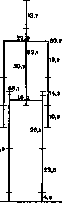
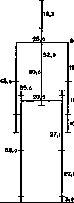
As regards the general suitability of various indices and formulas for characterizing habitus and constitution in general, it should be kept in mind that the values entering into the indices or formulas are usually determined by a whole series of factors, depending on many diverse conditions, partly of a constitutional character and partly entirely devoid of it. In general, since human constitution is not determined by those two or few data that enter into the indices, but represents a definite combination of many diverse morphological and, furthermore, functional traits and properties, not a single one of the general indices by itself can adequately characterize the constitution of an individual. Further studies are still necessary to clarify which specific indices, in what respect, and to what extent can aid the study of constitution and what the boundaries of their application are. On the basis of figures obtained from the measurement of a given person, a schematic, graphical representation of this person's proportions can be constructed. Not so long ago, for example, the schema and «canon» of Fritsch, Friedenthal, the «underground root» of Breitman, and others were widely distributed; however, in the scientific literature, a critical attitude toward them has appeared on the part of authoritative anthropologists. Now, the schema of proportions drawn (on graph paper) solely with the aid of those points and values that are used for anthropometric measurements is frequently employed (Figure 8).
I
N
Figure 8. Schema of proportions (after Martin). Height is taken as 100. I—young man; II—heavy athlete. Since one of the chief tasks of the modern study of constitution is to characterize and evaluate as accurately as possible, with the aid of impeccable scientific methods, the principal properties of an individual person, of each individual, individual graphic charts, «profiles», the so-called «deviation tables» (constructed on the basis of biological variation statistics) (Figure 3) have recently been acquiring greater and greater importance. According to these, one can easily judge not only the magnitude of each individual trait of the investigated individual, but (what is especially important) also correctly orient oneself as to what the relation of each trait is to definite «norms», to the general variation series. B. Morphological and functional properties of individual organs and systems (including the properties of the psyche) are investigated in various ways both anatomically (e.g., on corpses) and physiologically. To investigate functional traits, the most diverse physiological, resp. clinical methods are applied. C. Development of the individual. It is judged both by data of the habitus (e.g., on the basis of somatometric measurements), establishing the degree of development (physiological, somatic ages), and by anamnestic data, etc. Facts characterizing the «individual development curve» (Hoffmann), the dynamics of development, are gathered. D. Predispositions. Along with the investigation of the habitus and individual differences in development, structure, and functions of organs and systems, the most important task of the study of constitution from a medical point of view is the elucidation of predispositions, the finding of the vulnerable part of the organism, locus minoris resistentiae, inherent in the given constitution, and the study of the mechanisms of these predispositions. The timely finding of such weak systems and organs is extremely important so that one can outline in advance the appropriate conditions of ordinary and professional life, carry out definite prophylactic measures, etc. To elucidate predispositions, one frequently resorts to the calculation of correlations between the presence of a definite constitutional trait and the development of a definite disease (see Correlation). After obtaining a series of factual data characterizing the habitus, the state of internal organs and systems, their functioning, development, etc., for the understanding of the personality as a whole, it is important to know how the individual discovered traits and phenomena are interconnected, what the genesis of the given constitution is, and what their dependence on external factors (environment) is. Furthermore, it is extremely important to perform as far as possible a genotypic analysis of the constitution and to ascertain which specific properties and features of the individual constitution have as their basis individual hereditary factors or one combination or another of them, and which are caused by various external influences, congenital (intrauterine) infections, etc. For the hereditary-biological analysis of personality, the methods generally applied for the study of heredity are used (see Heredity): family-hereditary study of constitution, investigation of constitution in monozygotic and dizygotic twins, etc.
A. Krontovsky. II. Constitution in children. The doctrine of constitutional children's types, based on the aspiration to approach the cognition of the child's individuality, is new in pediatrics and not yet finally crystallized. The rapid pace of growth and development, sharp age-related changes in external habitus, body proportions, the sharp influence on the entire organism and its structure of various diseases characteristic of children's age (rickets, nutritional disorders)—all this extremely complicates the development of the doctrine of constitutional types in children, which must encompass all their diversity. The number of proposed classifications of constitutional types is quite significant, and their number grows every year. Many of the authors simply transfer the constitutional types of adults to children's age. Such are the types of Viola, Aschner, Tandler, Kretschmer (see above). Analogously to these schemas, children's classifications have been constructed by Pesker (narrow-cavity type, middle-cavity, and wide-cavity, where form is taken as the basis), Nevsky (brachymorphic, mesomorphic, and dolichomorphic types, where leg length and chest width are taken as the basis). Common to all these classifications is that they all proceed from the notion of a certain normotype, an average type, with the isolation of two mutually opposite types according to the laws of variational variability. The relative simplicity and logicality of construction is their alluring side and conditions a certain sort of popularity among clinicians. But in this simplicity and schematic nature lies also the most controversial point: the notion of the normotype, the average type, is an abstract value, artificially isolated. Furthermore, the diversity of human types is difficult to characterize by such a simplified method as a single external form or a single quality. Other classifications discard the notion of the normotype and create a series of separate normotypes. These classifications predominantly have a four-part form (Virrenius's, Bogomolets, Sigaud). Of these classifications, the types of Bogomolets and the types of Sigaud must be recognized as the most suitable for children's age. The types of Bogomolets are undoubtedly real for a portion of children and in some cases are easily revealed. But to lay this principle as the basis for all children is rather difficult: it is sharply revealed only in pathological constitutions; after subtracting them, a large group of normal children remains, where ascertaining the state of connective tissue does not appear possible. The types of Sigaud, constructed on the study of external habitus taking into account the state of development of internal organ systems, are also undoubtedly real and easily revealed in children's age. The study of Sigaud's types in children in recent years has occupied very many pediatricians in the USSR and abroad, where possibly of all classification systems this system is the most popular and most widespread. The muscular type is easily definable already in infancy. The child has the appearance of being well-nourished, proportionally built, with good turgor and subcutaneous cellular tissue. The skull is usually brachycephalic, the face somewhat square in shape, the forehead small and flat, the hairline, like the eyebrows, rectilinear. The nose is small, the mouth and lower jaw do not stand out, the frontal part of the face is almost equal to the oral part. The distance from the anterior angle of the fontanelle to ophryon is on average about 5-6 cm. The auricles are small, closely adjoining the head. The shoulders are wide, the chest well-protruding, the chest circumference gives high figures and exceeds the head circumference already from birth. The chest and abdomen are developed proportionally, the epigastric angle is of medium size. The limbs are rather short. The musculature is well developed. Throughout the entire period of childhood, in weight and chest circumference, children of the muscular type are ahead of children of other types; in height they are taller than digestive and cerebral ones, but shorter than respiratory ones (Figure 9). Their Pignet index is greater than that of other types (96-100). Erismann's chest-height index (see Indices of physical development) is higher than that of other types, and at all ages higher than +1. Bedusi's index, height minus sitting height nn --------------- xl00, is lower than sitting height
"
"
Jgpiratory type, and is compared with it only at the age of 11-12 years (Fig. 10). The digestive type is also revealed in infancy by good nutrition, an abundant subcutaneous fat layer with general proportionality; but in contrast see 145 140 135 130 125 120 115 PO 105 100 .--' ----------Digestive / o -Respiratory - / o / / ^G. ,*' / '/V - / "V $ / Ts] / / / / § / , i / '/ ...,- / / t , ' "0 / * '/ > /y / // / CHEST1 / l X' and sch ^ c / II 1^ / / ^ >» 1 '/ .' CH ' '' ;* V? «*" ' ^g o /// 4, /-' "^ AGE 1 4 C < \ I 10 AND 12 13 14 15 years Figure 9. Height, weight, and chest circumference in boys of various Sigaud types (after Miller). from the previous type, the chest is less prominent, the shoulders are less wide, and the abdomen is more prominent, the circumference of which exceeds the circumference of the chest. The arms are relatively short. The head is brachy- or dolichocephalic. The contours of the face are pyramid-shaped, the forehead is low, the nose is small, but the lower part of the face stands out with a wide mouth and a wide lower jaw. The alveolar processes of the jaw in infancy are convex, folded, tuberous, with a wide chewing surface and transverse borders on the hard palate behind and small teeth in place of the canines. The auricles are small, not fully adjacent. The hairline of the head has an arcuate border. The distance from the fontanelle angle to ophryon is less than 6 cm. The head circumference of the newborn is greater than the chest circumference. The height of digestive children is lower than that of muscular ones. Especially they begin to lag in growth from 10 years, which is mainly explained by the lag in the growth of the lower extremities. In weight, these children go for the entire childhood period on a par with muscular ones, but lag behind them in chest circumference. Their Pelidisi is only slightly lower (95-97.8). The Erismann index approaches 0 by the age of 12 and stays at small figures (from 0 to +1) up to 15 years. Their Bedusi index gives the lowest figures of all types, brightly illustrating their relative short-leggedness. Only at the age of 13 is there some increase in it. The respiratory type in infancy is not very characteristic in view of the incompleteness of the development of the facial skeleton and chest, but after 1 1/2-2 years it is already revealed. The most characteristic for this type are the face and chest. The development of the nasal part of the skull, equal in size to the frontal and oral ones, with a wide or elongated nose, a wide bridge of the nose and nasal slits, catches the eye. The contours of the face are egg-shaped or hexagonal, narrowed downwards due to a slightly hypoplastic lower jaw. Hair on the head is abundant, with an arcuate border. The neck is elongated, the shoulders are wide, the upper aperture is strongly inclined, the chest and back are slightly flattened, the angle of the ribs is greater than 90°, the ribs almost reach 100g.
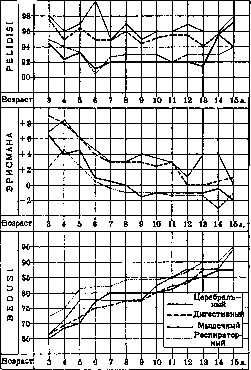
Figure 10. Pelidisi, Erismann, and Bedusi indices
in boys of various Sigaud types (according to Miller) reach the level of the iliac bone. The abdomen is relatively small. The musculature is moderately developed. In terms of growth, children of this type are ahead of other children; their particularly strong growth begins after 10 years of age. In weight, they are lower than the first two types; they also lag behind them in chest circumference. Their Pelidisi index gives comparatively low figures (90.5-95). The intersection of the chest circumference with half-height occurs in them very early—from 6 years and up to 15 years it holds at figures below 0. On the contrary, Bedusi gives high figures (72-95) for them throughout childhood, which indicates an enhanced growth of the lower extremities and their relative long-leggedness. The features of development of children of this type possibly depend on the activity of the sex glands. The cerebral type is easily determined already in infancy. Children of this type have a narrowed chest and narrow shoulders. The cerebral cranium with a protruding wide forehead clearly dominates in them. Cerper had to introduce prepubescent, rachitic, and other forms in addition to the above-listed ones. This is a characteristic indicator that type variations in life are more numerous and do not fit completely into the scheme. Pure Sigaud types were found by Matuschak in children in 61.4-72.8%, Lederer in 47.5%. Miller could isolate pure types in only 38.5%, mixed in 30.9%, indeterminate in 30.6%. At the same time, in preschool age, pure types were noted in only 29%, whereas in school age in 43.7%. The distribution of individual types in children is presented in Table 6. Table. Authors Lederer. . . Cerper . . . , Mochan . . . . Nikolaev . . Miller . . . Dombrovskaya Lebedev . . . Shtefko ... Types (in %) muscular 14.5 25.0-30.0 16.2 8.4-17.2 6.6 20.0 10.0 26.0-16.0 digestive 6.0 21.0 14.1 3.5-4.0 12.1 14.0 30.0 6.0-20.0 respiratory cerebral Note 5.0 9.1 9.1 7.4 12.3 4.0 36.0 32.0-26.0 1.8- 22.0 4-5 3.4 1.0-2.1 7.9 24.0 24.0 0-1 YEAR School-age children » 3-17 years Ukrainian schoolchildren Children 3-16 years » up to 1 year » 0-15 years » 16-18 » The head has a somewhat pear-shaped form. The nose is small, the lower part of the face as well; on the contrary, the ears are relatively large and protrude from the cranium. The hair on the head is abundant, long, protruding forward. The fontanelle is large, and the distance from the anterior angle to the ophryon is 7-11 cm. The predominance of the head circumference over the chest circumference often persists even after a year. Over the further period of development, children of the cerebral type retain a delicate skeleton, weakly developed musculature, moderate growth, and all the above-mentioned proportions. In height, these children are the shortest, lower than all other types, and only in the period of 12-13 years do they temporarily overtake the digestive children. In average weight, they also go in last place, giving the smallest figures. The same is true regarding the chest circumference: it gives the smallest figures at all ages compared to other types. The Pelidisi in cerebral children is distinguished by low figures (91-96). Their chest-height index is lower than that of other constitutional types; by 8 years of age, an intersection with half-height occurs, and after this, a negative value of the Erismann index (from -0.5 to -2.0) is noted throughout childhood. The Bedusi index gives low figures with the exception of the age of 6-9 years, which indicates the relative short-leggedness of children of this type. Such is the brief characteristic of the main Sigaud types. All the diversity of the child organism naturally does not fit completely1 into 4 types. Along with pure types, a large number of combinations of these types with each other are encountered. There are not a few children in whom it is not possible to establish the Sigaud type either in pure or in mixed form—these are the so-called indeterminate types. Taking into account the features of the development of children, Cerper The quantitative ratio of various types among different nationalities is not the same. What clinical and practical significance does the biotypization of a child in infancy and at a later age have? There are several attempts to approach the resolution of this question, but they are still far from resolving this question in all its complexity. First of all, the types are of great importance for the correct assessment of the individual physical development of the child in the sense of morphology and physiology. Each type goes its own way, maintains its interrelations of individual parts and features of reaction to the environment. To some extent, the type also anticipates the mental characteristics of children. As a rule, children of the muscular type in infancy gain weight well, learn to stand, sit, walk early, and show a maximum of activity. Children of the digestive type also progress well in weight, but early reveal a tendency toward obesity and pastosity; they are less active and react to external harmful factors with large weight losses. Children of the cerebral type are very active, but at the same time heightenedly nervous, develop worse physically, giving an uneven spasmodic weight curve, but develop better mentally than others. These individual features of infancy persist for the entire subsequent period. An extremely important question is the elucidation of the connection between morphology and the functions of the entire organism and its individual systems and the ensuing predisposition to the violation of these functions. The clarification of such predispositions plays a major role, making it possible to determine the locus minoris resistentiae of the organism. Unfortunately, this side of the doctrine of Constitution has been studied relatively little, and its clarification encounters difficulties in the conditions of external life, which play a significant role. There are only separate fragmentary observations of individual clinicians, based rather on impressions than on large statistical material. Children of the digestive type, for example, exhibit an increased reaction to a change in food and to various harmful factors both from the side of the intestine and from the side of the skin and mucous membranes (tendency to exudative diathesis). Children of the cerebral type exhibit a tendency to dyspesias of a so-called constitutional character, reduced tolerance of the digestive organs; pylorospasm, neurasthenia, and spasmophilia are more frequent in them. Dombrovskaya presents the following table of the frequency of diseases in infants. Table 7. Pathological processes and diseases Types (in %) <1E I ^3 k k O Pi Exudative diathesis . . . Neuropathy ........ Respiratory tract diseases . . Dyspepsia on breastfeeding. . Dyspepsia on complementary feeding. . 48 30 52 15 60 26 13 20 8 10 16 50 10 52 20 7 18 25 10 These fragmentary data are undoubtedly insufficient; it is necessary to accumulate further material, studying the ways of development of individual biotypes, their physiological features, and their manifestations in pathology.
M. Maslov. III. Mental Constitutions. Just as in the somatic field, many authors understand neuro-psychic constitution to be the combination into a single unified whole of all the organism's characteristics that manifest in perception, movements, emotions, and instincts and that determine human behavior, i.e., they identify the concepts of constitution and "personality". Similarly, in the field of studying mental constitution, the question arises regarding the relation of genotypic and phenotypic characteristics of the psyche, and the interrelation between the genotype and the influence of environmental conditions. Recently, the majority of authors agree to understand constitution as a phenotype which, however, with the aid of genetic methods, can be most thoroughly subjected to analysis, thanks to which the genotypic basis of the constitution is clarified, and the variability of this basis as well as its development in connection with the environment can be more easily understood. Understanding constitution as the combination of the entire organism into a single whole, as personality, and as phenotype, we must, for a more precise study of constitution, strive for the possible analysis of this complex constitution. Here, a whole series of various divisions has been proposed (Klages, Utitz, Janet, Bleuler, Kretschmer, Kraus, and others). First of all, one has to speak of the "deep personality"—the type and tempo of emotions, instincts, and temperament (especially closely connected with the entire animal life, the endocrine glands, the autonomic system, and the general somatic structure), and the direction of drives; then of the features of the motor system (psychomotricity); and finally of the cortical personality, wherein one distinguishes, on the one hand, the features of cortical analyzers (features of sense organs: hearing, vision, and others) and, on the other hand, the features of the conditioned-reflex mechanism (attitude toward the external world). In studying the features of the "deep personality," great importance was attached to the isolation of mental diseases (schizophrenia, manic-depressive psychosis, epilepsy), the genetic study of mental illnesses (Rüdin, Hoffmann, Kahn, Yudin), and Kretschmer's doctrine on the dependence of physique and temperament. At the present time, authors distinguish here the cycloid circle of temperament features with its accessibility, simplicity, sociability, mildness, and with the poles of temperament fluctuation ranging from manic to depressive; the schizoid circle (withdrawn, cold, principled, with affective outbursts) with the poles cold-sensitive; and the epileptoid circle with the poles irritable-massively monotonic, attached to things. Cycloid temperament is closely connected with the pyknic physique, schizoid mainly with the leptosomatic (asthenic); the epileptoid circle corresponds to a robust, massively muscular physique and partly to a dysplastic one. The connection between temperament features and physique, confirmed at present by over 4,000 cases from various authors in different countries, clearly testifies to the significance of the organism's structure as a whole in the origin of mental characteristics. Along with these rather sharply delineated types of temperament, some authors also distinguish other types: the paranoid (Bumke, Genil-Perrin, Yudin, and others), which is to a certain extent similar to the feminal type of build (wide pelvis); the pseudological-mythomanic (Dupré, Yudin); the anxiously scrupulous, psychasthenic, and others. By the degree of expression, these features—ranging from overtly mentally ill schizophrenics, through less pronounced schizoid psychopaths, to normal characters of the same type—reach the schizothymics (resp. manic-depressive psychosis - cycloid - cyclothymic; epilepsy - epileptoid - epileptothymic). Ewald, producing a more detailed analysis of temperament features according to their intensity, distinguishes: 1) the degree of affective height (impressionable - indifferent, Eindrucksfähigkeit); 2) degree of affective duration (attention good - bad, easily trainable - poorly trainable, Retentionsfähigkeit); 3) degree of activity (agile, slow; fantasy - intrapsychische Verarbeitung); 4) degree of reaction persistence (independent, suggestible, easily reacting, sluggish - Ableitungsfähigkeit). On the basis of special formulas, Ewald thinks thus to create a more precise classification of types. The Jaensch brothers distinguish two types of eidetics based on features of visual retainability: tetanic and basedowoid. Some authors closely connect temperament features with the peculiarities of endocrine gland functioning (Pende). Thus, for example, individuals having hyperfunction of the thyroid gland are usually very irritable, unstable, prone to affects of fear, anxiety, melancholy, and anger, and incapable of prolonged exertion, although at the same time these people are lively and acutely perceptive; with increased pituitary function, calmness, good nature, and sluggishness are noted, yet with good intellectual abilities; with decreased function of the sex glands (eugenoidism [eunuchoidism]), infantilism, timidity, lack of independence, and shyness with general lightheartedness, etc. Undoubtedly, genetic features and pathological changes in the endocrine glands sharply affect the deep life of the personality, just as a genetic defect or diseases (pathological loss) of some center in the cerebral cortex do; but in determining the general type of personality, all mechanisms act in close connection with each other as inseparable determinants, and the features of the endocrine glands must be considered only in connection with the general whole as a part of the entire gene structure of the personality. A significant role in isolating and clarifying the types of mental features and temperament is also played by the genetic analysis of the heredity of psychoses. By studying large genealogies, it is so far possible to compile only hypotheses about the genetic structure of the core of each temperament circle. Regarding the schizoid circle, the conclusion has been reached that only recessive genes enter into the schizoid radical, wherein schizophrenia determines at least two pairs of recessive genes (aabb), while schizoid and schizothymic features are heterozygotes of the same formula (AaBb, aaBb, AaBb, AAbb, aaBB). Genetic analysis of the genealogies of manic-depressive psychosis leads to the conclusion that, besides the dominant cycloid gene, two more recessive genes enter into the gene radical of the psychosis, and the nature of these genes (schizoid, epileptoid, fantastic) also determines the character of the disease course. A connection with physique is clearly noticeable here; schizophrenia with a pyknic physique has a periodic course (Mauz), while schizophrenia with a muscular physique yields a picture with turbulent excitation (Kiselev). In general, the task of studying the constitution is to determine the gene structure of each constitutional type. Knowing this formula, it will be possible to speak more precisely about various types of reaction to the environment, to biological hazards (e.g., in schizoids, progressive paralysis gives a demented form, in cycloids an expansive form, etc.); it will be possible to make predictions about the quality of offspring and give advice on this before marriage.—The study of the motor characteristics of the neuro-psychic constitution is pursued, on the one hand, by neuropathologists (Lewy, Kehrer, Davidenkov, and others) who clarify the predisposition of certain families to diseases of certain systems, and, on the other hand, by pedologists (Homburger, Gurevich, Zislin, Ozeretsky) who study the features and types of psychomotor activity in general and its connection with physique. In all the aforementioned typifications, the concern is mainly with the emotional or motor features of the subject himself; a number of authors approach the matter differently when they begin to classify types according to the nature of their impact on the external world. F. Kraus calls the types of personality attitude toward the external world, in contrast to temperament, character, and considers the features not of the deep, but of the cortical personality to be the basis here. Admittedly, in psychology there is still no precise delimitation of the concepts "temperament" and "character," and these concepts are often confused, but the successes of the constitutional study of personality urgently demand the establishment of a more precise terminology here. A number of authors, as indicated above, now strive for a more precise delimitation of the individual aspects and layers of the personality and its reactions (Schischendiagnose [Schischendiagnose / Schischendiagnose]). The features and types of cortical analyzers, types of perception, and types of connections of these analyzers are also of great importance for determining mental constitution; but until now they have been studied only in differential psychology (W. Stern), psychotechnics, and partly in neuropathology (aphasia, the doctrine of localizations in the cortex in general, architectonics) without a general connection with the features of the entire organism and its constitution; only O. and C. Vogt, in studying architectonics, make an attempt at a genetic study as well.
T. Judin. IV. Constitution of the woman. Speaking of the constitution of the woman, it must first be noted that women have certain characteristic morphological and functional features (secondary sexual characteristics), thanks to which the female organism, compared to the male, represents a completely distinctly delineated type. The application of established universal human constitutional types to women encounters a number of difficulties. The most accurate objective constitutional sign is the shape and dimensions of the pelvis; here, not so much absolute figures are taken into account, but the mutual ratio of dimensions. A special constitutional type of the woman is the infantile type (see Infantilism - in women). Another isolated constitutional type is the woman with features of the male pattern, with weak development of the subcutaneous fat layer. In clearly expressed intersexuality, height is usually above average, bones are strong, muscularity is pronounced; legs are relatively long, without closure of the thighs in a standing position, the shape of the pelvis approaches the male type; the transverse dimension of the shoulders significantly exceeds the transverse dimension of the hips; hairiness on the lower extremities; on the pubis, hairiness is arranged in the form of a rhombus with the apex at the navel; the mammary glands are small; the genital organs bear signs of hypoplasia; the voice is low. Intersexuality leaves a special imprint on the psyche of the woman and can serve as a cause of various sexual perversions. It is quite understandable that generally accepted types of constitution can be observed in a pure form only in very rare cases. As factual material accumulates, it becomes obvious that the constitutional factor plays a enormous role in the origin of various anomalies of the menstrual cycle (amenorrhea, dysmenorrhea, poly-, hypermenorrhea, metropathies). Here, the significance of insufficiency of the uterus, ovaries, inferiority of the corpus luteum, disorder of the function of the autonomic nervous system, asthenia with all its features, and so forth, comes to the foreground. The constitutional features of the organism exert a huge influence on the time of onset of the climacteric period and on the entire complex of symptoms that is observed at this time. The infantile constitution is of great practical interest and explains many cases of sterility, ectopic pregnancy, termination of pregnancy, and uterine involution. According to Przibram, infantilism in sterility is noted in 25.6%. Women of the intersex type often remain sterile. A certain percentage of pregnancy toxicoses should be attributed to the infantile constitution (Kolosov). Ovarian insufficiency apparently plays not the last role in the origin of leukorrhea. It is fully established what enormous significance the asthenic constitution has for the origin of the entire symptom complex in uncomplicated retroflexio uteri mobilis. In perineal ruptures, the constitutional factor is often convexly revealed—a narrow genital cleft, tissue rigidity, a high narrow pubic arch. In infantilism, perineal ruptures always affect the state of the pelvic floor, which is already inferior, which ultimately leads to the displacement of the pelvic organs downward and to uterine prolapse. Scarcely less often, however, is this favored by the asthenic constitution, in which the tissues making up the pelvic floor are so easily overstretched. A small pelvic inclination as an expression of infantilism or intersexuality, as established by Flatau, also plays an important role in the origin of uterine prolapse. According to Jaschke, out of 490 cases of uterine prolapse, "deficient constitution" was present in 477 cases. --Constitution can be of great importance in assessing the course of the inflammatory process, which is so often encountered in women. Infectious diseases of the genital sphere (including gonorrhea) in women with an asthenic constitution proceed sluggishly and protractedly (Kolosov). Certain measurements, such as measuring the pelvic inclination, determining the wrist index, and so on, can be of great importance for the prevention of uterine prolapses and the prognosis of the birth act. D. Gudim-Levkovich.
Related articles
Mentioned in
- Anthropological Investigation of Criminals
- Asthenia
- BOGOMOLETS
- CLIMATIC STATIONS
- Constitutional Psychoses
- Correlation
- DEFECTIVENESS
- Degenerates
- Degeneration (a588)
- Handwriting
- Hysterical Psychoses
- Krontovsky, Alexey Antoninovich
- Krylov
- Lazursky
- Maslov
- Prostitution
- Psychic Reaction
- Psychotherapy
- Status
- Variational Statistics
Cite this page
“Constitution.” Soviet Medical Encyclopedia. English translation of Bolshaya Meditsinskaya Entsiklopediya, 1st ed. (Moscow, 1928–1936), ed. N. A. Semashko. https://sovietmedicalencyclopedia.pages.dev/article/constitution/