Laboratories
Historical document, translated for reference. It reflects medical knowledge of the 1920s–30s and is not medical advice.
Summary
This article describes the various types of medical laboratories in the Soviet Union during the 1920s-1930s, their classifications, purposes, and the historical development of laboratory methods in medicine.
Encyclopedia article (1928–1936)
Laboratories, institutions for the investigation of living or dead objects, for determining and studying their properties, composition, structure, and the chemical, biological, and other processes occurring in them; for developing production standards and special preparations; and for controlling products in terms of their physicochemical properties and physiological effects. Main types of medical laboratories. According to their activities, medical laboratories are divided into scientific-educational and scientific-practical. The former are part of higher medical educational institutions or represent independent institutions-institutes (see). Scientific-practical laboratories have as their main task the practical service of a particular branch of medicine, but at the same time carry out scientific and pedagogical work to one degree or another. Depending on their purpose, medical laboratories are divided into the following types. 1) Anthropometric or biometric, which aim to determine the external properties of humans using special instruments (see Anthropometry). 2) Balneological, studying the physical, biological, and therapeutic properties of mineral waters or muds. 3) Bacteriological, performing bacteriological analyses (see Bacteriological analysis) and producing bacterial preparations (therapeutic, preventive*, diagnostic). 4) Medical-biological in the broad sense, studying pathological phenomena and their regularities. 5) Histological (see Histology), studying the structure of tissues and organs and the pathological changes that have occurred in them for diagnostic purposes (in the latter case, the laboratories are called pathological-histological). 6) Hygienic and sanitary-hygienic, aiming to study the influence of the external environment on human health and to determine the hygienic properties of various consumer goods and their effects on the animal organism. 7) Clinical or hospital (diagnostic), performing physicochemical and bacteriological studies of blood, excretions, and secretions of the patient's organism with the aim of obtaining objective data necessary for recognizing the disease; from hospital laboratories, serological laboratories (and institutes) are now distinguished as independent units, studying the properties of sera of sick humans and animals for diagnostic purposes. 8) Occupational hygiene laboratories (for studying occupational hazards), studying working conditions from the point of view of their occupational hazards and changes in the organism under their influence. 9) Psycho-physiological or psycho-technical, studying the nervous-psychic activity of sick and healthy humans. 10) Forensic medical, performing physicochemical and biological studies of objects that serve as material evidence in judicial investigations with the aim of obtaining objective data necessary for forensic examination. 11) Pharmaceutical, aiming to determine and verify the chemical composition and physical properties of medicinal preparations, as well as being engaged in the preparation of some of them. 12) Pharmacological, studying by experimental methods the physiological effect of medicinal substances on the animal organism. 13) Physiological, studying biological processes in the healthy and diseased organism, etc. The emergence of the laboratory method and its significance in modern medicine. The first laboratory-clinical research apparently dates back to the middle of the 17th century; the Dutch naturalist van Helmont proved the higher specific gravity of febrile urine, established the secretion of acid in the stomach, etc. From the end of the 17th and beginning of the 18th centuries, marked by the first major successes in natural science and the invention of the microscope, the laboratory research method (analytical and experimental) gradually found increasingly wider application in the theoretical and practical branches of medicine. The successes of chemistry at the end of the 18th and beginning of the 19th centuries, the invention of new, more precise laboratory instruments [especially the achromatic microscope (1824)] and the improvement of laboratory techniques 9 led to the rapid development of the laboratory method and its wide scientific and applied use in all areas of medicine. A new era in the development of the laboratory method began with the era of the greatest discoveries by Pasteur and Koch in the field of bacteriology (see). Bacteriological analysis made it possible to illuminate and clarify questions of the pathogenesis of infectious diseases and became the basic method for their recognition. The more complex laboratory techniques and the separation of individual medical disciplines led to the creation of special types of laboratories and institutes (see) serving one or another branch of theoretical and practical medicine. Relatively late, the laboratory method found application in the study of questions in the youngest branch of medicine-hygiene. The first department of hygiene, which first applied physicochemical methods to solving hygiene problems, was established only in 1865 at the University of Munich on the initiative of the founder of experimental hygiene, Pettenkofer. The first institution in which systematic sanitary-hygienic analyses of food products were carried out was the Dresden Chemical Central Station, opened in 1870. The first independent sanitary-hygienic laboratories ('Control Stations') appeared in 1872 in Bremen and Riga, and only at the end of the 70s and beginning of the 80s of the 19th century did the widespread development of a network of sanitary-hygienic laboratories begin in Western Europe and America. In Russia, the first sanitary-hygienic laboratories were opened simultaneously in 1891 in Moscow, St. Petersburg, Kiev, Warsaw, and Odessa. At the present time, the laboratory method (analytical and experimental) is the main one in resolving scientific questions of theoretical medicine, giving the researcher objective and precise data on the basis of which the scientific understanding of various physiological and pathological processes is built. The laboratory method has enormous significance in practical medicine, both therapeutic and preventive. Recognition of diseases based solely on clinical signs, not supported by laboratory research, can never achieve the necessary accuracy, reliability, and completeness. Many forms of diseases in general do not lend themselves to differential accurate recognition based only on clinical signs; in these cases, a physician deprived of the possibility of using the laboratory method is often powerless to make a correct diagnosis of the disease. In complicated and unclear clinical cases, an in-depth laboratory analysis is often the only key to the accurate diagnosis of a given suffering and understanding of its pathogenesis. This does not mean, however, that in the recognition of diseases the laboratory method can entirely replace the clinical one. The role of the laboratory is auxiliary, and the objective data obtained with its help can, only in combination with all other data of the patient's research, serve the physician with complete material for recognizing and evaluating the disease form in a given patient (see Diagnosis). In the field of preventive medicine, the laboratory method is a necessary tool in the hands of the sanitary physician in carrying out sanitary supervision, in conducting health measures, and especially in the fight against infectious diseases. The assessment of hygienic properties of many consumer goods is often impossible without physicochemical-bacteriological research of these goods. The systematic implementation of general health measures must always be preceded by extensive sanitary investigative work, which can give more or less exhaustive data only on condition of applying laboratory methods. In particular, the anti-epidemic struggle can give the greatest effectiveness only on condition that it is based on the study of epidemiological factors, for the identification of which sanitary and bacteriological laboratory research also has primary importance. The laboratory method also plays a major role as a means of controlling the work of sanitary and anti-epidemic institutions (sanitary-bacteriological control of water supply and sewage disposal systems, bacteriological control of disinfection installations, etc.), as well as a means of checking the safety of convalescents for those around them. The laboratory method has enormous significance in the fight against occupational hazards and in the matter of occupational selection; in the field of physical culture, in the application of physiotherapeutic treatment methods, in forensic medical examination, in the rational organization of pharmaceutical affairs, etc.; in short, the laboratory method must be recognized as one of the basic methods in practical medical-sanitary work, and medical laboratories as one of the most necessary links in the system of medical-sanitary institutions. Organization of laboratory affairs in the USSR. The development of a network of medical-sanitary laboratories serving the practical needs of healthcare is part of the general plan for the construction of medical-sanitary institutions and proceeds in parallel with the development of the latter. The basic principle of constructing a network of medical laboratories is the maximum possible approach of qualified laboratory assistance to healthcare institutions and to the population with the least dispersion and expenditure of funds and forces. To fulfill the latter, it is necessary everywhere, where possible according to territorial conditions, to strive to concentrate the production of laboratory analyses in a small number of universal-type laboratories, leaving in individual medical-sanitary institutions only the production of elementary clinical analyses. Proceeding from the stated principles, the network of basic medical clinical-diagnostic and sanitary-bacteriological.
Laboratories include the following main types of these institutions. 1) Diagnostic laboratories and offices in urban and rural hospitals, outpatient clinics, dispensaries, professional outpatient clinics, malaria stations, etc. 2) District sanitary-bacteriological laboratories (1 per district) under district sanitary physicians; usually part of district hospitals or central bases, unified dispensaries, but as sanitary work deepens, they may be separated into independent laboratories producing exclusively sanitary-hygienic analyses. 3) Regional (urban) laboratories - in each regional city (in the RSFSR provided for by the SNK resolution of 11/19 1927 on norms of sanitary institutions). 4) Regional and provincial sanitary-bacteriological institutes in regional (provincial) centers. 5) Laboratories and institutes for the study of occupational hazards - in the largest industrial centers, depending on local conditions. 6) Forensic medical laboratories in some provincial and regional centers. 7) Pharmaceutical laboratories at pharmaceutical factories, provincial pharmacy administrations and pharmaceutical warehouses. 8) Anthropometric laboratories and offices at large sanatoriums, rest homes, etc. 9) Balneological laboratories - at the largest resort stations (in the USSR - in Pyatigorsk, Sochi, Saki, etc.). 10) Laboratories on transport and military-sanitary laboratories - see Bacteriology. The functions of regional (urban) sanitary-bacteriological laboratories include: a) conducting all main types of laboratory analyses (mainly sanitary-hygienic and epidemiological) as required by sanitary supervision authorities and medical institutions; b) organizing sanitary and epidemiological surveys as directed by the respective health department; c) participation in the development and implementation of sanitary and anti-epidemic measures; d) training and improvement of laboratory and vaccination personnel; e) scientific research work linked to the practical activities of the laboratory. The minimum staff for laboratories of this type should be recognized as not less than 8 units, including 3 persons of the highest qualification (preferably 1 bacteriologist physician, 1 hygienist physician and 1 sanitary chemist), 2 persons of medium laboratory qualification, 2 sanitary workers and 1 person of administrative staff (accountant-clerk). The structure of regional (urban) laboratories: at least two departments - bacteriological and sanitary-chemical. As a rule, urban sanitary-bacteriological laboratories include Pasteur stations or anti-rabies points; in such cases, the laboratory staff increases by 1-3 units. The standard staff for a district laboratory consists of two senior laboratory technicians and 1 sanitary worker. All laboratories are under the jurisdiction of the respective health department. Equipment of laboratories. The equipment and maintenance of medical-sanitary laboratories, both independent and part of other institutions, are regulated in the USSR by mandatory rules issued by the People's Commissariat of Labor of the USSR on 6/3 1919. By analogy, these rules can also be applied to scientific-pedagogical laboratories. According to these rules, a medical-sanitary laboratory systematically conducting analyses of clinical, bacteriological, forensic medical or sanitary-hygienic type must consist of a) the laboratory proper where analyses are conducted, and b) auxiliary rooms for work related to the analyses (e.g. washroom, kitchen, registry, reception office, office, room for taking samples, etc.; for laboratories with one senior or middle medical staff member, this division is not necessary). In laboratories with a staff of more than 6 people, there must definitely be a separate room for the office and a separate room for staff meals, with the latter room also serving as a library. Residence of workers in the laboratory is not permitted. In cases where the administration provides housing for laboratory personnel, living quarters must be isolated from the laboratory. Rooms for experimental animals must be isolated from all other laboratory premises. Each laboratory must be equipped with devices for neutralizing and destroying infectious material. The useful area of the entire laboratory (including both laboratory and auxiliary premises) should be 20 m2 per worker. The useful area of the laboratory proper should be 10 m2 per permanent senior or middle medical staff member participating in analyses, but in total not less than 30 m2. The height of all laboratory premises should be at least 3.5 m. The depth of the laboratory proper should not exceed 5 m. The coefficient of natural lighting in the least illuminated points of the premises should be in the laboratory proper not less than 1.5%, and in auxiliary premises - 1%. To achieve this coefficient, the ratio of the glazed window surface to the floor area should be in the laboratory proper, in the room for taking samples and in the reception office not less than 1:5, and in other auxiliary premises - 1:8. Artificial lighting of the laboratory proper should provide illumination of working surfaces of not less than 300 lux with general illumination of 100 lux. In auxiliary premises, the average illumination of working surfaces should be: in the room for taking samples and reception office 100 lux, in the office, registry, kitchen and other auxiliary premises - 50 lux. Within one workstation, the ratio of maximum to minimum illumination should not exceed 10:3 (otherwise, artificial lighting of laboratories, both proper and auxiliary, should comply with the 'Temporary Rules for Artificial Lighting of Factories, Plants, Workshops and Other Working and Office Premises and Workplaces' according to the mandatory resolution of the NKT USSR of 9/17 1928 No. 545). The air temperature in all laboratory premises during the heating period should be maintained between 7-20°C with relative humidity of 30-70%. In chemical and sanitary departments of laboratories, as well as in rooms where clinical analyses are constantly conducted, exhaust hoods should be installed with the volume of air removed from the hood calculated so that with the door fully open, the air velocity through the door is not less than 0.2 m per second. In laboratory premises with significant heat and moisture formation, supply-exhaust ventilation should be installed. Above kitchen stoves, exhaust hoods should be installed or, in all cases where there are no production obstacles, exhaust hoods of the chemical type. In all laboratory premises, windows should be installed with an opening area of not less than 1/8 of the floor area. The People's Commissariats of Labor of the union republics have the right, in agreement with the respective People's Commissariats of Health, to make exceptions from the above rules depending on local conditions. In addition to these rules, it is necessary to specify a number of requirements that medical-sanitary laboratory premises should, as far as possible, meet in the interests of the most rational organization of work, creating favorable hygienic conditions for work and preventing laboratory hazards. - The laboratory should have, if possible, a separate exit to the outside and in any case should not have close contact with living quarters or hospital wards. Setting up a laboratory in residential apartments is not permitted. Allocating a room for a laboratory in a hospital building is possible, but on the condition of complete isolation of rooms for cooking food for experimental animals. It is desirable that all laboratory premises be supplied with running water, sewerage and gas; in the absence of central gas and water supply, appropriate local installations should be made. Heating should preferably be central, water-based, with radiators installed as much as possible along side walls or in corners, not under windows, to avoid proximity of heating surfaces to laboratory tables. With local heating, all
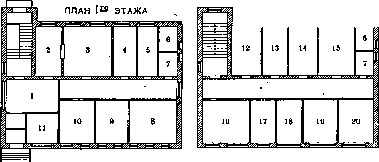

PLAN II AND FLOOR, "Figure 1. Regional laboratory of Type I: 1 - reception office; 2 - office for taking samples; 3 - clinical-diagnostic office; 4 - material room; 5 - utility room; 6 - toilet; 7 - washroom; 8 - library; 9 - director's office; 10 - office; 11 - duty room for staff; 12 - forensic medical office; 13 - hydrogen sulfide room; 14 - medium preparation; 15 - washroom; 16 - bacteriological; 17 - serological; 18 - weighing room; 19 and 20 - sanitary-hygienic; 21 - room for experimental animals."
furnaces should open into corridors. Rooms for conducting analyses, especially for microscopy, should preferably face north (this is not of particular importance for auxiliary rooms). To protect against direct sunlight, laboratory room windows should be equipped with white curtains. Artificial lighting is preferably electric, gas-mantle, kerosene-mantle, and alcohol-mantle. The requirements for artificial lighting in terms of brightness and glare are standard (see Lighting). For microscopy, local lighting in the form of floor or table lamps is undesirable; it is preferable to use a source installed almost in the plane of the table and enclosed in a box so that the observer's eye does not see the bulb itself.-Wastewater from L. and liquid waste may be discharged into the general sewer system or (in the absence of sewerage) into a properly constructed cesspool at L., but on the condition that infectious material is previously disinfected or destroyed (for this purpose, used infectious excretions-urine, feces, sputum, etc.-must first be boiled or processed in an autoclave, and then poured into sinks; filter paper, packaging material, dry waste, carcasses of small experimental animals must be burned in an ordinary or special furnace).-The composition of sanitary-bacteriological L. of all types should include the following rooms: 1) laboratory rooms for conducting analyses (separately for sanitary-hygienic, bacteriological, serological, general clinical-diagnostic; with a large volume of work, rooms should be allocated for taking material, a room for vaccinations); 4) library; 5) office; 6) room for experimental animals; 7) toilets. Approximate dimensions of laboratory rooms and their relative arrangement can be seen from the attached preliminary designs of the most common types of sanitary-bacteriological laboratories (Fig. 1 and 2).-For equipping a laboratory, special laboratory equipment is required. The composition and quantity of laboratory equipment depend on the nature and volume of work. The laboratory staff is divided into laboratory and administrative-economic groups. The laboratory group includes: 1) laboratory workers of the highest qualification (heads of L., senior and junior assistants and laboratory technicians), who have the right to conduct all la
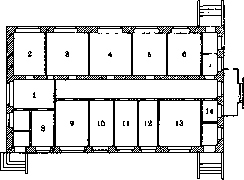
Figure 2. District laboratory of type II: 1- reception; 2- room for taking materials; 3- clinical-diagnostic office; 4- sanitary-hygienic; 5- library; 6- experimental animals; 7- anteroom; 8- office; 9- bacteriological; 10- serological; "11- material; 12- storage room; 13- bacteriological kitchen and washroom; 14- toilet.
laboratory research and those responsible for them. Such persons can only be individuals with higher education, qualified specialists—doctors, chemists, or biologists—who have special theoretical and practical training in laboratory work; 2) laboratory workers of medium qualification (technical laboratory assistants and preparers) who perform auxiliary functions in laboratory analyses (preparation of stains, reagents, solutions, etc., care of apparatus, performance of preparatory manipulations in various research, etc.). These are persons predominantly with secondary education who have sufficient practical experience in laboratory work and possess the necessary theoretical training; 3) junior laboratory workers (laboratory attendants, orderlies) who perform all technical functions in the service of the laboratory (washing of glassware, cleaning of premises, care of animals, etc.). They should be well-literate persons who have acquired sufficient experience and skill in performing their duties. The administrative-economic group includes, in addition to the head of the laboratory, also the head of the household, office personnel, and economic technical personnel. Small laboratories (with staff of less than 8 persons) may not have special economic personnel. The amount of laboratory personnel depends on the volume and nature of the laboratory's work. The People's Commissariat of Health of the RSFSR and the Central Committee of Medical Labor have established the following annual norms of workload per laboratory assistant (doctor, chemist, and biologist) for large laboratories: serological analyses—4,000, general clinical—3,000, bacteriological—1,500, sanitary—400. For medium and small laboratories, these norms are reduced by 15-20%. On the basis of these average norms, the required number of highly qualified workers can be established for each laboratory, and depending on this number, the necessary amount of medium and junior laboratory personnel is determined (1 technical laboratory assistant can serve from 2 to 6 highly qualified laboratory assistants, 1 attendant can serve from 3 to 6 laboratory assistants). The main scientific and practical training of highly qualified laboratory workers is received in the corresponding higher educational institutions, with further improvement in the course of work in the laboratory. In addition, for the purpose of improving laboratory workers, special courses are systematically organized. The training of scientific personnel workers in various fields of laboratory work is partly carried out through the system of postgraduate studies and internships in scientific research institutions. For the training of technical laboratory assistants, the system of short-term courses is practiced in some bacteriological institutes. Occupational hazards of laboratory labor and measures for their prevention. Laboratory labor is accompanied by certain professional hazards and dangers. These hazards, on one hand, stem from the very nature of laboratory labor (contact with infectious or poisonous materials, manipulation of animals and their carcasses, specific features of many technical procedures), and on the other hand, depend on the inexperience of the workers themselves and unfavorable working conditions (in terms of housing, maintenance, regime in the laboratory, degree of preparedness of auxiliary personnel, etc.). In well-equipped laboratories, with a completely rational organization of laboratory work and with high qualification and teamwork of laboratory personnel, the degree of laboratory hazards can be reduced to a minimum. The most important occupational hazards of laboratory labor include the following: 1) laboratory infections, 2) poisonings, 3) burns, 4) traumatic injuries, 5) fatigue, 6) cold-related diseases. 1. Laboratory infections. The portals of entry for infection in laboratory infections are usually the skin, the conjunctiva of the eyes, the mucous membranes of the mouth and nose, and the gastrointestinal tract. The most dangerous moments of work are taking material from patients, experimental animals, and from corpses, as well as the autopsy itself (splashing of infectious material, pricks and wounds with infected instruments, etc.); unpacking and processing of delivered material; inoculations, aspiration of material with pipettes; injection of infectious material into experimental animals; disinfection and destruction of infectious material; disinfection of infected utensils; experiments on animals and care of them. Precautionary measures in bacteriological work are as follows. 1) Work in a gown (medical gowns, fastened at the back). 2) Do not eat or smoke at the laboratory table. 3) Watch the condition of the skin on the face and hands, noticed wounds should be treated with iodine and covered with adhesive plaster. 4) Be careful when unpacking sent material: jars containing the latter should be immediately wiped with a disinfectant solution upon receipt and placed not directly on the table, but on flat trays. 5) Never touch door handles in laboratory rooms with disinfected hands. 6) Maintain meticulous order and cleanliness on work tables; at the end of the working day, the table surfaces should be wiped with a 5% solution of phenol. 7) Used slides and cover glasses, Petri dishes, pipettes, test tubes, etc., should immediately after use be thrown into vessels with a strong disinfectant solution (unrefined sulfuric acid). 8) Places on laboratory tables or on the floor, accidentally spilled or splashed with infectious material, should immediately be poured with a 1-3% solution of mercuric chloride, leaving it in place for no less than an hour. 9) Observe certain technical procedures in ordinary manipulations with infectious materials, such as: when aspirating this material with a pipette, use mainly safety pipettes (with double spherical expansion of the mouthpiece), put a piece of cotton wool into the mouthpiece, thoroughly clean and disinfect the locking index finger, aspirate the most dangerous material with the help of a rubber cap, etc.; when working with Petri dishes, do not touch the upper edges with fingers, beware of contact with condensed water from inoculated dishes; when infecting animals with infectious material, check the tightness of the needle fitting on the cannula, remove the air bubble into a sterile cotton swab; when flaming infected platinum needles and loops, hold the handle vertically over the flame, not horizontally, etc. 10) After any accidental contact with infectious material, disinfect hands with a 1-2‰ solution of mercuric chloride or a 3% solution of phenol; especially thoroughly disinfect hands at the end of work or during breaks. 11) In case of skin wounds with infected instruments, do not rush to stop the bleeding; apply an alcohol dressing; in case of pricks and scratches with infected instruments, cauterize the puncture site with a heated needle or smear it with fuming nitric acid or iodine; in case of suspicion of rabies virus entering a wound, anti-rabies vaccinations should be given. 12) If infectious substance gets into the conjunctiva of the eye, do not wipe the eye with cotton wool or gauze, but repeatedly inject a 1‰ solution of Hydrargyri oxycyanati into the eye, after which instill 1‰ Vaselini oxycyanati (do not blow your nose!). 13) If infectious material gets into the mouth, immediately spit it out into a vessel with mercuric chloride, rinse the mouth for several minutes with a 0.2% solution of HCl or a 1:4,000 solution of Kalii hypermang., and drink a glass of 0.2% hydrochloric acid solution (repeat the entire procedure 2-3 times within the next few hours); in addition, if material containing typhoid or paratyphoid pathogens gets into the mouth, a preventive vaccination should be given (if a ready vaccine is not available, it is advisable to prepare it from the strain that served as the original material for infection); if material containing cholera pathogens gets into the mouth, the victim should be in quarantine for 5 days, which can be lifted only after three negative results of stool examination for cholera. 14) Infected experimental animals should be kept in isolator cages, easily accessible for cleaning and disinfection; excretions of these animals and carcasses should be burned. 15) Take measures against flies in laboratory premises (insert screens in windows, do not keep infectious material in open vessels, cover with screens the opened carcasses of infected animals, etc.). 16) Work with particularly dangerous material (plague, glanders, anthrax) should be entrusted only to fully prepared personnel and special completely isolated rooms, absolutely inaccessible to domestic animals and rodents, should be allocated for this work; all ordinary precautionary measures during this work should be strengthened: over gowns, rubber aprons and armlets should be worn; in some cases, when droplet or dust infection is possible, work should be done in respirators; some of the most dangerous manipulations with infectious material should be performed in special glass boxes with openings for hands. Poisonings occur mainly in sanitary-chemical and medico-legal laboratories in work associated with the formation of harmful vapors and gases. More rarely, bacterial toxins (e.g., tetanus toxin) in bacteriological laboratories can be sources of poisoning. In laboratories having gas, cases of poisoning with illuminating gas are possible.
Most poisonous substances that one has to deal with in chemical laboratories are gaseous. Of greatest significance as sources of poisoning are hydrogen sulfide, chlorine, ammonia, HCl, sulfur dioxide, acetone, bromine, arsenic hydride, formalin, osmic acid, chloropicrin, phenols, phenylhydrazine, products of incomplete combustion of kerosene, gasoline, etc. The severity of poisoning varies from the mildest and most transient symptoms to severe, life-threatening phenomena. - Measures for preventing poisoning by gaseous products during laboratory work consist mainly in the rational equipment of laboratories (fume hoods, a special hydrogen sulfide room, ventilation systems, etc.) and in taking all necessary precautions when handling dangerous substances. - Measures against poisoning by illuminating gas: a) systematic observation of the condition of the gas pipeline network with the adoption of necessary measures at the slightest signs of gas leakage; b) frequent checking of the condition of burners and connecting rubber tubes; c) the use of burners with 'pilot flame'. Burns. Both thermal and chemical burns are observed. The former most often occur when boiling liquids, blowing and sealing glass, working with kerosene, gasoline, and alcohol lamps for heating when working with vapor generators, etc. Burns that are particularly dangerous in their consequences can occur from explosions of easily flammable substances (ether, gasoline, alcohol) and illuminating gas. - Precautionary measures: a) systematic observation of the condition of laboratory equipment; b) do not use gasoline for blowtorches and soldering lamps designed for kerosene and not having a safety device; c) do not handle easily flammable substances near an open flame, always keep them in hermetically sealed and strong containers; store supplies of these substances outside laboratory premises; d) take fire-prevention measures (have fire extinguishers or a fire hose with a hose, monitor the condition of the electrical wiring network, etc.). Chemical burns occur during laboratory work with caustic substances, for example, strong acids and alkalis. - Precautionary measures: a) wear a rubber apron and sleeves over the lab coat; b) when there is a possibility of splashing caustic liquids, wear protective goggles. - Traumatic injuries. Minor cuts from glass fragments and tools, injuries and bruises from apparatus breakdowns (especially dangerous are autoclaves, centrifuges, mechanical engines, etc.), injuries from explosions, bruises and bites from small and large laboratory animals are possible. - Protective measures: care when handling glassware and instruments; periodic inspection (not less than once every 1/2 year) of the technical condition of large laboratory apparatus; the use of properly arranged benches and instruments when operating on animals. - Fatigue. General fatigue is a fairly common phenomenon among laboratory workers engaged in strenuous and sufficiently monotonous work in performing analyses, often in unhygienic conditions. Particularly harmful are improperly arranged laboratory furniture (seats that are too high or too low, etc.), poor lighting, abnormal temperature (elevated or reduced), humidity, bad odors, noise (from working fans, motors, centrifuges, blowtorches, etc.). Forced body position during certain manipulations (especially when microscoping, weighing on analytical balances, prolonged observation of physiological instruments during experiments on animals, etc.) accelerates the onset of fatigue. - Preventive measures consist in establishing a normal workload for each worker and in maintaining proper hygienic conditions in the laboratory. Eye fatigue affects qualified personnel working with precision instruments, the use of which requires considerable strain on the organ of vision (microscopes, measuring pipettes, analytical balances, etc.). - Microscopists and serologists are particularly affected. The consequences of eye fatigue can be persistent pain in the eyes and head, progressive nearsightedness, spasm of accommodation, strabismus, etc. - Measures to prevent eye fatigue: proper arrangement of local and general lighting; establishing a normal workload for people working with precision instruments; at the first signs of eye fatigue, take a break from work; microscoping alternately with one eye and then the other, without closing the non-working eye. - Colds. These diseases mainly affect personnel working in washing and autoclave departments. Favorable conditions are high humidity, abnormal temperature (in autoclave departments reaching 42-45° and even up to 60°), wetting of clothing during dishwashing. Rheumatic diseases are most common. - Preventive measures consist in establishing proper thermal conditions in laboratory premises, in combating high humidity through appropriate equipment and ventilation, and in using appropriate protective clothing during dishwashing. Portable, or mobile, laboratories are portable sets of laboratory equipment and accessories necessary for performing elementary sanitary-hygienic, bacteriological, or clinical-diagnostic laboratory analyses, and in their composition, weight, volume, and packaging are convenient for transport as hand luggage or small baggage and allow for rapid deployment, use in any conditions, and quick repacking. Usually, the equipment of portable laboratories is placed in 1-2-3 small boxes (for example, 36 cm x 35 cm x 70 cm) weighing from 10 to 30 kg each, which have inside compartments or separate boxes for storing instruments, dishes, and reagents, thanks to which rapid and compact packing of laboratory equipment and its preservation during transport are achieved. Often, boxes containing the equipment of portable laboratories are made disassembled in such a way that, when emptied, they can be used as laboratory furniture (table and stool). Portable laboratories are most widely used in field units of troops during military campaigns (military campaign and military field laboratories). These laboratories are usually adapted for performing bacteriological research on the most important infections, for performing elementary diagnostic analyses and simple sanitary-chemical analyses (water, flour, milk, etc.). In peacetime, in the practice of sanitary authorities of the USSR, portable laboratories for elementary sanitary-chemical examination of water have become most widespread. A type of portable plague laboratory has been developed by the State Microbiological Institute in Saratov. Bacteriological portable laboratories have found less use in the practice of sanitary authorities. For their research, portable laboratories use the most simplified and rapid methods and ready-made reagents and nutrient media. Portable laboratories are supplied with the latter from the nearest stationary laboratories and therefore can be considered as their branches. (Laboratories in individual specialties - see Bacteriology, Histology, Psychology, Forensic Medicine, Pharmaceutical Chemistry, Physiology, Chemistry.)
Related articles
Cite this page
“Laboratories.” Soviet Medical Encyclopedia. English translation of Bolshaya Meditsinskaya Entsiklopediya, 1st ed. (Moscow, 1928–1936), ed. N. A. Semashko. https://sovietmedicalencyclopedia.pages.dev/article/laboratories/