Dynamometry
Historical document, translated for reference. It reflects medical knowledge of the 1920s–30s and is not medical advice.
Summary
Dynamometry is the method of measuring muscular strength, used in anthropology, neurology, and occupational health to assess physical development and fatigue. The article describes various devices, such as the Collin dynamometer, and distinguishes them from dynamographs, which automatically record force measurements over time.
Encyclopedia article (1928–1936)
DYNAMOMETRY (from the Greek dynamis—force and metron—measure), a method of measuring force. In medical and biological sciences, the muscular strength of the hand, arms, legs, and torso is usually measured. Since the force of contraction of individual muscle groups can, up to certain limits, be considered proportional to the degree of development of the entire muscular system of the body as a whole, the readings of a dynamometer (along with the results of measuring the circumference of the shoulder, forearm, thigh, and lower leg) characterize the degree of physical development. Dynamometry is used in anthropology, anthropometry, in neuropathology, for occupational selection, the study of military contingents, and the study of fatigue. The latter application of dynamometry is based on the fact that muscular strength changes depending on the difficulty and duration of professional work. If the method allows for results to be obtained in graphic form, it is called dynamography. A dynamometer—a device for measuring muscular strength—is available in a large number of models. The most common is the Collin dynamometer, which consists of an oval steel spring (Fig. 1).

Figure 1.
Its compression in the direction of the short diameter causes the dynamometer needle to rotate around a round dial, which has two arc-shaped scales. In addition to the needle connected to the dynamometer mechanism, a free needle is placed on the same axis, which is easily moved by the first needle. After the compression of the dynamometer ceases, the needle connected to the mechanism returns to the zero position, while the free needle remains at the division reached by both needles during compression. The reading is taken on the inner scale. This same dynamometer can also be used to measure pulling force. For this purpose, two handles equipped with

Figure 2.
hooks are attached to the ends of the long diameter of the dynamometer. The subject, having taken hold of the handles with their hands, stretches the dynamometer spring with force. The reading is taken on the outer scale. The disadvantages of the Collin dynamometer are its shape, which does not fully correspond to the clenched hand, and the small width of the spring, which presses into the hand during strong compression and thereby causes pain. Therefore, Sternberg and other authors have proposed dynamometers with parallel handles (Fig. 2), sometimes covered with leather to avoid contact with cold metal during measurements in the open air. There are specially designed dynamometers for measuring pulling force, e.g., the Andrew dynamometer. In some cases, a dynamometer that measures compression force (Figure 3) can be
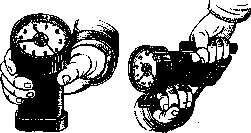
Figure 3.
Figure 4. converted with the help of simple attachments into a dynamometer for measuring pulling force (Figs. 4 and 5). Dynamometers have become widely used in devices that measure work—ergometers, in which the magnitude of mechanical work is calculated
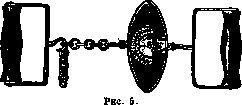
based on the magnitude of the effort. In these dynamometers, a spiral spring is usually used, as in a steelyard. A dynamograph is a device constructed similarly to a dynamometer but equipped with a mechanism for the automatic recording of readings. This is especially important in cases where the magnitude of the effort changes continuously during work.
A dynamograph is used when measuring (and simultaneously recording) the efforts involved in moving a wheelbarrow, cart, trolley, etc. The registration is performed on a moving strip of paper by a pen connected to one of the ends of the spring (Schultze dynamograph; Fig. 6), or by means of
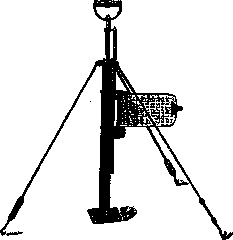
Figure 6.
an air transmission, as in the dynamograph of Imbert, Amar, and others. The dynamograph is a device transitional to the ergograph.
Related articles
Mentioned in
Cite this page
“Dynamometry.” Soviet Medical Encyclopedia. English translation of Bolshaya Meditsinskaya Entsiklopediya, 1st ed. (Moscow, 1928–1936), ed. N. A. Semashko. https://sovietmedicalencyclopedia.pages.dev/article/dynamometry/