Dejerine-Sottas Disease
Historical document, translated for reference. It reflects medical knowledge of the 1920s–30s and is not medical advice.
Summary
Dejerine-Sottas disease is a rare, hereditary hypertrophic interstitial neuritis of childhood characterized by nerve thickening, ataxia, and progressive neurological degeneration. The article outlines its complex pathology, symptoms resembling Friedreich's ataxia, and a chronic, progressive course.
Encyclopedia article (1928–1936)
DEJERINE-SOTTAS DISEASE (Dejerine, Sottas), progressive hypertrophic interstitial neuritis of childhood (névrite interstitielle hypertrophique et progressive de l'enfance), incorrectly called sometimes Hoffmann's disease. Heredity and childhood age are of primary importance in the etiology. The pathological anatomy is complex, the lesion affects many systems; there is hypertrophic interstitial neuritis [primarily hypertrophy of the Schwann sheath, which thickens concentrically around dying axis cylinders, with comparatively little damage to the interstitial connective tissue proper (Hoffmann)], extending also to the posterior and anterior roots of the spinal cord, atrophy of the anterior roots and cells of the anterior horns of the spinal cord, degeneration of the posterior columns of the spinal cord (sclerosis of the columns of Goll and Burdach), and degeneration in the area of Lissauer's zone. Pathogenesis: the disease is constitutional, occurs very rarely, has much in common with Charcot-Marie disease and Friedreich's disease, and is reducible to a congenital weakness of certain systems of the nervous apparatus. Symptomatology is very complex: onset in childhood or early youth, scoliosis (see figure), nystagmus, extinction of tendon reflexes, foot deformation, ataxia (resemblance to Friedreich's disease); but along with this, there are many other symptoms: thickening of nerve trunks (the most characteristic sign), both superficial and deep, sometimes determined only by palpation, sometimes clearly visible even upon simple inspection; the Argyll Robertson sign, lancinating pains of a tabetic type, and sensory disturbances. The gait presents simultaneously the characteristic features of steppage and ataxia. Ataxia resembles tabetic ataxia more than cerebellar ataxia. In the initial stages, ataxia is usually weakly expressed or absent altogether and only subsequently occupies a prominent place in the clinical picture of the disease. The course of the disease is very slow, progressive, sometimes with recurrent exacerbations ("forme récurrente de la polynévrite hypertrophique progressive", described by Rossolimo). One has to differentiate mainly from Charcot-Marie disease and Friedreich's disease. Prognosis, insofar as the question of the possibility of cure is raised, is unfavorable. Local therapy, as with all other hereditary-degenerative diseases of the nervous system, does not exist; one can only speak of rest and general strengthening of the organism.
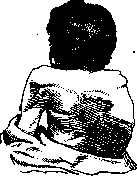
Kyphoscoliosis in interstitial
hypertrophic neuritis of Dejerine-Sottas.
Related articles
Mentioned in
Cite this page
“Dejerine-Sottas Disease.” Soviet Medical Encyclopedia. English translation of Bolshaya Meditsinskaya Entsiklopediya, 1st ed. (Moscow, 1928–1936), ed. N. A. Semashko. https://sovietmedicalencyclopedia.pages.dev/article/dejerine-sottas-disease/