Diastolic Murmur
Historical document, translated for reference. It reflects medical knowledge of the 1920s–30s and is not medical advice.
Summary
A diastolic murmur is an abnormal sound heard over the heart during ventricular diastole, classified as organic or functional. This 1930s Soviet medical article describes the various types of diastolic murmurs, their causes, characteristics, and clinical significance.
Encyclopedia article (1928–1936)
DIASTOLIC MURMUR, path. a sound phenomenon heard over the area of the heart during ventricular diastole. D. m. can be organic and functional. By origin, 4 types of organic D. m. are distinguished: 1) with narrowing of the left venous opening, 2) with narrowing of the right venous opening, 3) with insufficiency of the aortic valves, 4) with insufficiency of the pulmonary artery valves. With narrowing of the left venous opening, the murmur is most intense at the beginning of diastole, when the left ventricle is empty and the left atrium is filled with blood (greater difference in pressure, higher blood flow velocity), and at the end of diastole, when blood flow is also accelerated due to atrial contraction. Four variants are distinguished: a) protodiastolic murmur, audible only at the beginning of diastole, b) presystolic murmur, audible only at the end of diastole and having a crescendo character, c) a murmur occupying the entire diastole - first strong, quickly weakening, and then intensifying again at the end of diastole, and d) protodiastolic murmur followed by a pause and new intensification during atrial systole. The presystolic murmur is most common. It is typical for mitral stenosis. Recently, the presystolic murmur has tended to be explained by delayed closure of the mitral valve, which therefore occurs already after the beginning of ventricular systole. Its slower closure is a consequence of adhesions, thickening, and rigidity of the valve leaflets in stenosis. The blood rushing back at the beginning of systole through the still unclosed but increasingly narrowing opening causes a crescendo murmur, ending directly with the first tone. The absence of a presystolic murmur in mitral stenosis indicates "fibrillation" or "flutter" of the atria. The murmur in narrowing of the left venous opening is heard (usually) best at the apex of the heart. D. m. in aortic valve insufficiency arises due to reverse blood flow during diastole from the aorta into the left ventricle. It is strongest at the beginning of diastole, when the maximum difference in pressure between the aorta and the left ventricle occurs, and has a diminuendo character. Aortic valve insufficiency can also be relative, for example, with persistent dilation of the sclerosed aortic mouth with sometimes normal aortic valves. The murmur of aortic valve insufficiency is heard best over the middle of the sternum, in the III intercostal space to the left of the sternum, then in the II intercostal space to the right of the sternum, and over the neck vessels. Diastolic murmur in narrowing of the right venous opening is heard best over the lower end of the sternum; with insufficiency of the pulmonary artery valves - in the II intercostal space to the left of the sternum. 8 L arises due to blood entering from the left atrium into abnormally wide left ventricle through a normally wide atrioventricular ring.
P. Sukhinia. DIASCHIZ (from Greek diaschizo - I split), a concept introduced into neurology by Monakow and denoting a special type of shock. While other forms of shock
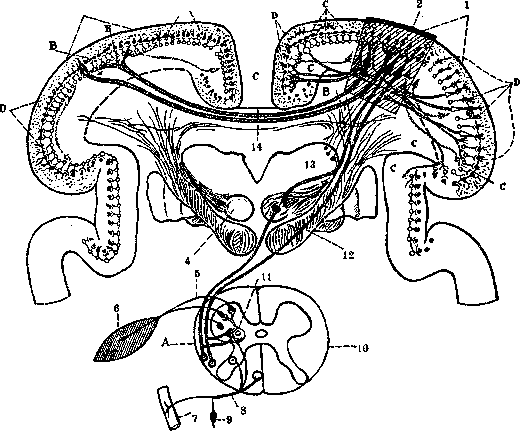
Diagram for the article Diaschiz. Connections between various parts of the cerebral cortex and underlying formations; A - path of spread of corticospinal diaschiz; B - path of spread of commissural diaschiz; C - path of spread of associative diaschiz; D - central paths for the spread of diaschiz; 1-right hemisphere; 2-focus; 3-left hemisphere; 4-nucl. ruber; 5-motor root; 6-muscle; 7-skin; 8-sensory root; 9-cell of spinal ganglion; 10-spinal cord; 11-interneuron; 12-pyramidal tract; 13-thalamus; 14-corpus callosum. Funct. D. m. are extremely rare, occurring in severe anemia, more often heard near the site of aortic auscultation, and, according to Sahli, in most cases represent a transmitted murmur of aneurysm to the heart area. Flint's presystolic murmur also belongs to diastolic murmurs - a soft murmur occurring in aortic valve insufficiency. It arises, according to some, because during diastole the anterior leaflet of the mitral valve is displaced toward the atrioventricular opening by blood rushing back from the aorta, thereby narrowing it. According to others, Flint's murmur (traumatic, psychic, apoplectic) is caused by more or less complete suppression of all bodily functions. D. is limited to separate anatomical, completely definite systems. In other words, in D., only those centers or accumulations of nerve cells that are anatomically connected with the damaged area of the central nervous system by systems of conducting pathways become incapable of function. And pathogenetically D. differs from other types of shock. While in them the cause of functional arrest is, according to Golts, overstimulation of cells, in diaschiz the cause of functional arrest Hi is purely passive or paralytic delay as a result of the sudden interruption of the usual physiological irritations flowing to the corresponding cells. Depending on the localization of D., Monakow speaks of cerebrospinal, associative, commissural D., etc., in their different types and degrees. An example of cerebrospinal D. can be the suppression of the function of cells of the anterior horns of the spinal cord in stroke in the area of the anterior central gyrus, connected with these cells by the conductors of the pyramidal tract. In such a stroke, the usual flow of irritations from the cells of the central gyrus to the cells of the anterior horns of the spinal cord ceases, which as a result fall into a state of "passive delay," which is D. An example of commissural D.: a section of the cortex of one hemisphere is affected by stroke, and the function of sections of the cortex of the other hemisphere connected with it by commissural fibers suffers. An example of associative D.: a section of the hemisphere is affected by stroke, and the function of other sections of the same hemisphere connected with the directly affected area by association fibers also suffers. What is the further fate of D.? Immediately after its occurrence, a reparative, restorative struggle begins from the side of the remaining healthy parts of the nervous system. The outcome of this struggle depends on many conditions and therefore can be very different. Here the location and size of the lesion, the nature of the pathological process that created this lesion, the condition and patency of blood vessels, the good or bad condition of the entire organism, the age of the patient, his constitutional features, etc. are important. The final result of this struggle Monakow calls "schism." As is understandable from what has been said, this result can be very different even in cases where autopsy reveals the presence of lesions that are completely similar in localization and size. In cases especially unfavorable for overcoming diaschiz (sharp general weakness of the body, deep old age, particularly severe nature of the local pathological process, etc.), this latter may not be smoothed out at all; in Monakow's expression it "freezes in immobility" ("erstarrte protrahierte Diaschisiswirkung"). The concept of D. has enormous significance for explaining many facts that interest the clinician and physiologist. For illustration, one can give the example put forward by Monakow himself, namely - the semiotics of pyramidal paralysis. As is known, the initial stage of hemiplegia, in addition to paralysis phenomena, also gives such symptoms as a fall in tone, disappearance of tendon and periosteal reflexes. Before the appearance of the theory of D., the occurrence of these symptoms was completely incomprehensible. From physiology it is known that tendon reflexes are a function only of the spinal reflex arc, that their disappearance can be observed only with its damage and therefore should by no means occur with a cerebral stroke distant from this arc. The theory of D. gives an explanation for this fact: in such cases, due to D., the cells of the spinal cord indeed become incapable of function, and along with cerebral symptoms, due to diaschiz, symptoms of spinal paralysis must also be present, which include atonia and areflexia. Monakow's theory also explains the course of hemiplegia and its possible variations. The flaccid stage of hemiplegia is replaced after a certain time by the spastic stage; this depends on the smoothing out of D., the smoothing out of the paralysis of spinal motor cells caused by diaschiz, manifesting as atonia and areflexia. The duration of the flaccid stage of hemiplegia is known to be very different. And this fact is excellently explained by Monakow's theory: this duration depends on the duration of D., and the duration of D. is extremely variable, since, as has already been seen, it depends on a whole series of conditions. Cases of permanent flaccid hemiplegia also become understandable: due to unfavorable local, especially general conditions, D. here is not overcome at all, there arises what Monakow designated as "frozen D." The theory of D. is also of such great significance for explaining other disorders of motility, disorders of sensitivity, especially disorders of complex functions - speech and movement functions (associative and commissural D.).
Related articles
Mentioned in
Cite this page
“Diastolic Murmur.” Soviet Medical Encyclopedia. English translation of Bolshaya Meditsinskaya Entsiklopediya, 1st ed. (Moscow, 1928–1936), ed. N. A. Semashko. https://sovietmedicalencyclopedia.pages.dev/article/diastolic-murmur/