Duboscq Colorimeter
Historical document, translated for reference. It reflects medical knowledge of the 1920s–30s and is not medical advice.
Summary
The Duboscq colorimeter is a widely used type of colorimeter consisting of two cylindrical vessels with glass bottoms and movable cylinders. It operates on the principle of Beer's law, allowing determination of substance concentration by comparing the color intensity of a test solution with a standard solution.
Encyclopedia article (1928–1936)
DUBOSCQ COLORIMETER (Duboscq), is one of the most common types of colorimeters (see figure). It consists of two cylindrical vessels expanding upward with flat glass bottoms, into which are immersed glass cylinders (solid or hollow, closed at the bottom with a glass plate). Light beams, reflected by a mirror or ground glass plate, pass upward through the liquid poured into the vessels, enter through rods into the prism system located in the upper part of the instrument, and are combined by the latter into a single field of view consisting of two halves. The thickness of the liquid layer lying in the path of the light ray can be arbitrarily changed by raising or lowering the vessels by means of a rack and pinion; a scale with a vernier allows measuring this thickness with an accuracy of 0.1 mm. *2i «47 DUBOIS-REYMOND
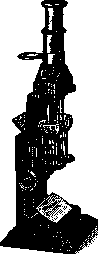
A standard solution is poured into one vessel, and the test liquid into the other; by moving the vessels, an equal coloration of both halves of the field of view is achieved. The content of the substance in the test solution is found on the basis of Beer's law, which states that with equal intensity of coloration, the products of the concentration of the substance by the thickness of the liquid layer are equal: c1d1=c2d2 (c = concentration, d = thickness of layer). Denoting the concentration of the desired substance in the test solution as cx, in the standard solution as c, and the corresponding thicknesses of the liquid layer (scale readings) as hx and h, we obtain cx=c·h/hx. The accuracy is greater the closer the concentration of the substance in the test and standard solutions. In ordinary models of D. k., 10-30 cm3 of liquid is required for research. At present, micromodels have been constructed that allow (with the same research accuracy) to get by with only 1 cm3. In new models, a convenient improvement is the use of a mirror and magnifying glass, which allows seeing the scale reading without changing the position of the eye looking into the eyepiece.
Related articles
Cite this page
“Duboscq Colorimeter.” Soviet Medical Encyclopedia. English translation of Bolshaya Meditsinskaya Entsiklopediya, 1st ed. (Moscow, 1928–1936), ed. N. A. Semashko. https://sovietmedicalencyclopedia.pages.dev/article/duboscq-colorimeter/