Dysmetria
Historical document, translated for reference. It reflects medical knowledge of the 1920s–30s and is not medical advice.
Summary
Dysmetria is the lack of measure in movement, both spatial and temporal, where movement exceeds the intended goal, stops too late, or is performed jerkily with excessive speed. It is a symptom of cerebellar damage and its connections, detectable through various clinical tests.
Encyclopedia article (1928–1936)
DYSMETRIA, lack of measure in movement both in spatial and temporal relations: movement goes beyond the set goal, stops too late, is performed jerkily, with excessive
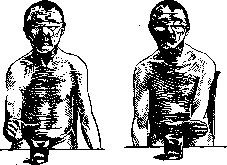
Excessive opening of the right and left hand when grasping a glass.
speed. D. is revealed by a series of experiments. - Grasping experiment: the patient is asked to take a glass - he opens his hand too widely and closes it later than he should (see figure). - Experiment with forearm rotation: the upper limbs are extended forward with palms up, on command the patient rotates them inward - on the affected side the rotation is excessive, more than on the healthy side. - Experiment with drawing: the patient is asked to draw a horizontal line to a set point - the line goes beyond this point; he is asked to draw a series of vertical strokes between two horizontal lines - the drawn' strokes go above and beyond these horizontal lines. The classic experiment - hitting the tip of the nose, the ear with the index finger. Dysmetria plays a large part in the formation of adiadokokinesia. On the lower limbs D. is especially manifested in gait - excessive flexion in the joints, throwing the affected lower limb to the side. A characteristic distinguishing feature of D. from spinal ataxia - complete independence from closing the eyes (A. Thomas). D. is a symptom of cerebellar damage and its connections. In a less pure form, it can be observed with cortical, thalamic, pontine and bulbar lesions. Instruments for registering dysmetria were proposed by Rossolimo.
Related articles
Mentioned in
Cite this page
“Dysmetria.” Soviet Medical Encyclopedia. English translation of Bolshaya Meditsinskaya Entsiklopediya, 1st ed. (Moscow, 1928–1936), ed. N. A. Semashko. https://sovietmedicalencyclopedia.pages.dev/article/dysmetria/