Ataxia
Historical document, translated for reference. It reflects medical knowledge of the 1920s–30s and is not medical advice.
Summary
Ataxia is a disorder of coordination of movements that can result from dysfunction in various parts of the nervous system, including peripheral sensory pathways, cerebellum, and other central structures. The article describes different types of ataxia, their causes, symptoms, diagnostic methods, and treatment approaches, with particular focus on Friedreich's ataxia.
Encyclopedia article (1928–1936)
Ataxia (from the Greek a- negative particle, and taxis-order), disorder of coordination of movements. Normal movements depend not only on the strength of contraction, but also on the correct order of contraction of individual muscles, harmony of these contractions, and on the proper sequence, regularity, and smoothness of work of agonists, antagonists, and synergists. If the strength of movements decreases, paresis, paralysis, akinesis results; if the harmony, sequence, and orderliness of movements are disrupted, we have ataxia; if the ease, elasticity, and smoothness of muscle contraction are impaired, we observe rigidity, tremor, etc. Coordination of movements depends not only on the proper functioning of central apparatuses, but also on the correctness and uninterruptedness of peripheral irritations affecting these apparatuses. The role of various organs in coordination of movements has been studied on the basis of clinical, experimental, and patho-anatomical facts. The significance of peripheral sensory innervation, especially kinesthetic sensations coming from the surfaces of joints, ligaments, tendons, and muscles, for the correctness of coordination, and consequently, for the origin of A., is extremely great. Another most important peripheral influence for coordination of movements comes from the semicircular canals through the vestibular nerve. The third group of peripheral influences on motor function comes from the eyes, from vision and kinesthetic sensations arising in the motor apparatus of the eyes. The organism's experience in combining these three kinds of perceptions and sensations, interwoven in their central influences, lies at the basis of one interesting and important fact: developed A. after some time may disappear due to the fact that any peripheral or central irritations that have fallen out as a result of the disease are replaced by others that have been preserved. Thanks to this, treatment of A. by exercise in movements is usually accompanied by greater or lesser success. The central divisions of the nervous system related to coordination are localized in the following places: 1) in the spinal cord-in the posterior columns of white matter and the lateral cerebellar pathway, 2) in the cerebellum, 3) in the brain stem, 4) in the subcortical formations and pathways, 5) in the frontal regions of the brain and probably in other less known parts of the central nervous system. On the basis of the predominant role of one or another part of the nervous system in the origin of A., the name or type of A. is designated. A. of peripheral, central, and mixed origin is distinguished. In disease of the peripheral sensory neuron, whose cell lies in the intervertebral ganglion, and the central end extends through the posterior root into the spinal cord, in cases of greater or lesser massive damage to nerve fibers, as occurs in tabes or polyneuritis (pseudo-tabes peripherica), A. of peripheral origin develops. Since in tabes dorsalis the pathological process affects the posterior roots and posterior columns of the spinal cord, tabetic A. is called not only radicular but also spinal. For peripheral, tabetic, or pseudotabetic A., disturbance of kinesthetic sensations (deep sensitivity, old name- "muscle sense") is characteristic. The patient with tabetic, persistent A. can learn to walk to a large extent by visual control. Cerebellar A. is observed in diseases of the cerebellum (sclerosis, degeneration, hemorrhage, tumor, abscess, etc.) and its connections with the spinal cord (Friedreich's disease) and other parts of the central nervous system (hereditary cerebellar A. of Pierre Marie). For cerebellar A., "drunken gait", adiadokokinesia, asynergy, past-pointing by Barany, nystagmus, etc., are characteristic. Other types of A., labyrinthine, frontal, pontine, etc., are associated with diseases of the corresponding parts of the nervous system, and according to the clinical picture, approach the cerebellar type. Acute A. represents a special kind of suffering (see Acute Ataxia). - Examination of A.: standing on two and on one leg, walking with open and closed eyes, stopping, turning on command; walking up stairs; heel-knee test; finger-nose test; synergies: standing and leaning backward, taking a glass filled with water without spilling; placing, without holding, one foot on a chair; rising from a lying position without using hands; speech, writing, elements of drawing, etc. For recording gait, the patient with painted soles is made to walk along a long strip of paper. Cinematography of patients. Examination of the vestibular apparatus by rotation, thermal and galvanic current are also used. Ataxia as a symptom is observed in the most diverse diseases (besides those listed above: syphilis, disseminated sclerosis, encephalitis; intoxications-alcohol, lead, nicotine, arsenic, copper, ergotism; pernicious anemia, etc.). Treatment of A.-by exercises (motor therapy, in particular according to Frenkel).
V. Khorshko. Friedreich's familial ataxia, first described by Friedreich in 1863, represents a familial disease, the main symptoms of which are progressive ataxia and pyramidal pareses, corresponding to the combined sclerosis of the posterior and lateral columns of the spinal cord underlying the disease. The disease begins gradually, usually in childhood. Main symptoms: loss of coordination of voluntary movements with phenomena of both motor ("tabetic") ataxia and cerebellar asynergia, and this disturbance of coordination, starting from the lower extremities (a peculiar "tabo-cerebellar gait"), gradually spreads, involving the upper extremities, trunk, and face, as well as the respiratory and speech musculature; further, involuntary movements of the nature of tremor, chorea, or choreo-athetosis are noted; nystagmus; areflexia; hypo- and anesthesia, predominantly on the lower extremities; scoliosis or kypho-scoliosis; characteristic deformation of the feet with a sharp deepening of the arch, extension of the main and flexion of the middle and nail phalanges (the so-called "Friedreich's foot", see Figure 1); relatively late paraparesis with Babinski's symptom and often with defensive reflexes join in. Sometimes paresthesias, shooting pains, weakness of the bladder join in. Often Friedreich's familial ataxia is combined with heart disease (congenital heart defects, chronic myocarditis). Individual cases show large deviations from the above-described clinical symptom complex both toward the formation of rudimentary forms and toward greater approximation to the Marie cerebellar form (late onset, preservation of tendon reflexes, etc.); sometimes various developmental anomalies join in (congenital joint laxity, asymmetry of the skull, congenital cataracts, brachydactyly, hypospadias, phimosis, underdevelopment of intelligence). Finally, the picture of Friedreich's familial ataxia can be complicated by some unusual signs, however, characteristic of other hereditary diseases of the nervous system, for example, muscular atrophies of myopathic type, hypertrophies of peripheral nerve trunks, chorioretinitis, etc. The course of Friedreich's familial ataxia is chronic-progressive. Acute infections often cause exacerbation of the disease or serve as a trigger for the first, sometimes subacute, appearance. Heredity in Friedreich's familial ataxia apparently corresponds to a simple recessive type. Usually several brothers and sisters-children of healthy parents-become ill. Sporadic cases are not uncommon. Often consanguinity of parents is noted. Healthy (heterozygous) carriers of the Friedreich trait often show the above-mentioned isolated or weakly expressed Friedreich symptoms.
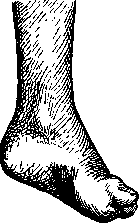
Figure 1. Friedreich's foot.
Patho-anatomically, small size of the spinal cord is often found, and as a constant rule, sclerosis of its posterior and lateral columns (see Figure 2), with the degeneration also involving the cerebellar pathways (of Flechsig and Govers) and the cells of Clark's columns. The membranes and vessels of the spinal cord remain normal. Inflammatory phenomena are absent. In individual cases, changes in the spinal cord are combined with hypoplasia of the cerebellum, as in hereditary cerebellar ataxia. Diagnosis is not difficult, but atypical cases may resemble Marie's cerebellar ataxia and Dejerine-Sottas hypertrophic neuritis. It has been repeatedly noted that congenital syphilis can give a clinical picture very similar to Friedreich's familial ataxia. The prognosis is poor. Treatment so
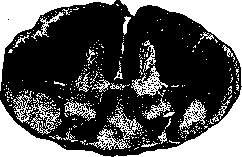
Figure 2. Degeneration of the posterior and lateral columns (light areas) in Friedreich's disease.
unknown. Prevention: Healthy members of Friedreich's families, especially if they are carriers of individual Friedreich's symptoms, may be permitted to marry only with persons known to come from another family. Hereditary cerebellar ataxia of Pierre Marie (heredoataxie cerebelleuse). Under this name, P. Marie (Pierre Marie), using previous observations (Nonne, Menzel, Fraser, etc.), in 1893 identified a special form of familial ataxia, differing from Friedreich's disease by a number of clinical, anatomical, and genetic features. Like Friedreich's disease, this is a progressive disorder of coordination, usually observed in many members of the same family; the nosological independence of this form cannot yet be considered as fully established. Clinically, hereditary cerebellar ataxia of Pierre Marie differs from Friedreich's ataxia by the following signs: hereditary cerebellar ataxia of Pierre Marie does not begin in childhood, as Friedreich's ataxia does, but at a later age (3rd or 4th decade of life); it is predominantly cerebellar in nature, sometimes accompanied by intention tremor; tendon reflexes of the lower extremities do not disappear, on the contrary, they are often strengthened; Babinski's symptom may be observed; deformities of the spine and the typical Friedreich's foot deformity are absent; pains and objective sensory disturbances are also absent; paralysis of eye muscles (especially ptosis and paralysis of abductors), disorders of pupillary light reaction, atrophy of the optic nerve are not uncommon; intelligence, usually preserved in Friedreich's ataxia, shows a progressive decline in hereditary cerebellar ataxia of Pierre Marie. The course of the disease is chronically progressive, however, with it, as with Friedreich's ataxia, exacerbations have been noted in connection with accidental causes (acute intoxications, childbirth, injuries). In a number of described families, the age at which the disease began gradually decreased in descending generations (the so-called "anteposition", which remains to this day a controversial question - perhaps a statistical error). Anatomically, the described pathological picture corresponds to hypoplasia of the cerebellum, and in some cases the cerebellum turns out to be histologically normal, in others - various degrees of cytological changes in the cerebellum, mainly in the neocerebellum (death of Purkinje cells); sometimes characteristic Friedreich's changes in the spinal cord were also added. Inflammatory and vascular changes are absent. Genetically, hereditary cerebellar ataxia of Pierre Marie should apparently be classified as a dominant disease, since direct transmission of the disease from parents to children is usually observed, whereas in Friedreich's ataxia, children of healthy parents usually get sick, which corresponds to the recessive nature of the hereditary trait. The syndrome described by P. Marie, upon further study, proved to be very variable, mainly in that it was often possible to observe numerous deviations from the described picture in the direction of greater similarity with familial Friedreich's ataxia: sometimes the disappearance of tendon reflexes in the further course, sometimes early onset, sometimes the presence of anesthesias, sometimes foot and spine deformities, etc. This led many authors at the time to deny the nosological boundary between the two forms and to describe them together as one disease (see Hereditary ataxic degeneration). At present, however, there is a return to recognizing the independence of separate subspecies. The different mode of hereditary transmission also speaks in favor of the fact that hereditary cerebellar ataxia of Pierre Marie is not identical to Friedreich's ataxia. It is even possible that hereditary cerebellar ataxia of Pierre Marie itself is not a single disease, but, in turn, consists of several large or small similar subspecies. When establishing a diagnosis, it is necessary to keep in mind a number of diseases that lead to the progressive development of the cerebellar symptom complex, such as: cerebellar tumors, the cerebellar form of multiple sclerosis, arteriosclerotic atrophy of the cerebellum, atrophia olivo-ponto-cerebellaris of Déjerine and Thomas, atrophia olivo-rubro-cerebellaris, dyssynergia cerebellaris myoclonica, etc. The clinical similarity of these latter, not yet fully clear nosologically, forms with hereditary cerebellar ataxia of Pierre Marie can be very great. In differential diagnosis, the hereditary nature of the disease should always be kept in mind. Sometimes a flattened occiput may indicate the presence of cerebellar hypoplasia. The prognosis is poor. Treatment is unknown. Prevention is usual for dominant hereditary diseases.
Related articles
Mentioned in
Cite this page
“Ataxia.” Soviet Medical Encyclopedia. English translation of Bolshaya Meditsinskaya Entsiklopediya, 1st ed. (Moscow, 1928–1936), ed. N. A. Semashko. https://sovietmedicalencyclopedia.pages.dev/article/ataxia/