Edematous Disease
Historical document, translated for reference. It reflects medical knowledge of the 1920s–30s and is not medical advice.
Summary
Edematous disease is a metabolic disorder resulting from malnutrition, characterized by massive edema and urinary disturbances. It primarily affects populations during war, famine, or severe economic hardship, with documented epidemics during World War I and in Soviet Russia during 1921-1922.
Encyclopedia article (1928–1936)
Edematous Disease (Oedemkrankheit of German authors), a peculiar metabolic disorder resulting from starvation, also known under the names of 'hunger disease,' hunger edema (Hungeroedem), war edema, epidemic dropsy (epidemic dropsy of English authors); sometimes it is erroneously called protein-free edema. The disease occurs on a mass scale, very rarely in individual cases, and arises when socio-economic prerequisites (war, famine) lead to inadequate and one-sided nutrition of certain population groups. However, E. d. does not occur with any starvation and should not be confused with local cachectic edemas appearing in body exhaustion as a result of complete starvation, e.g., in far-advanced stenoses of the esophagus and pylorus of the stomach, when besides solid food substances, fluids are not supplied to the body, or in cases where cachexia occurs due to endogenous causes (in cancer, tbc with sufficient food supply). Epidemiological data. It has long been known that major social upheavals, such as war, famine, lead to the appearance of mass edema; 'to swell from hunger' has always been the sad privilege of the masses during these upheavals of feudal and bourgeois society. Hunger edemas therefore in all times bore the pronounced character of a class disease of the proletariat and peasantry, and appearing epidemically (epidemic dropsy), they did not spread, unlike infections, to the exploiting classes whose nutrition, of course, always remained quite adequate. However, E. d. was first described only in 1742 by the English physician Pringle, who observed mass edemas in British troops during the war in Holland; Holzhausen notes a large number of edematous patients in 1812 in Napoleon's army, especially after its defeat in Russia; in 1879, Erisman describes edematous diseases on the Danube theater of military operations during the Russo-Turkish war. A more precise clinical and epidemiological study of E. d. belongs to the nearest time to us, to the era of the imperialist war. Strauss in 1915 described E. d. in German-occupied Poland, then followed numerous descriptions of E. d. in Germany among prisoners of war in concentration camps of the Russian and French fronts and among the poorest layers of the working class in large cities of Germany and Austria in the winter of 1917 in connection with their blockade by the Entente and the sharp decline in nutrition of the working masses. The number of diseases was very large: thus, in one Bohemia in 1917, 22,892 cases of E. d. were registered (Jaksch). Due to the censorship conditions of wartime, exact numerical and epidemiological data are not available, but it is known that E. d. at this time affected mainly factory workers of the largest industrial centers, while the disease did not spread to employees and petty-bourgeois layers. The epidemic of E. d. was less pronounced in districts with predominantly rural population, appearing there at the end of winter and spring, intensifying in early summer and disappearing by autumn during the harvest. The severity of the disease was influenced by conditions of nutrition and the nature of work: thus, in concentration camps, prisoners of war engaged in heavy physical labor became ill more often than orderlies, interpreters, cooks (Jürgens, Burger); the external temperature also had a noticeable effect on the frequency of E. d., and in cold months, E. d. cases significantly increased.
The epidemic of E. d. reached enormous dimensions in the famine years (in 1921-22) in the USSR, when as a result of the imperialist war, intervention, economic ruin and destruction brought by counter-revolutionary armies, the rural population was left without help during an unprecedented crop failure on the vast territories of the Volga region and Ukraine. In these years, in the young Republic, there could not yet be any question of statistical data and systematic observations. The epidemic of E. d. covered mainly the peasant masses. In cities, where supply could be better organized, workers did not get sick with E. d. The dependence of E. d. on nutrition is beyond any doubt; this is already evidenced by its appearance among isolated groups that are in worse nutritional conditions than the rest of the population, e.g., in concentration camps of prisoners of war, in prisons. Thus, in 1917, mortality from E. d. among prisoners in German prisons reached 47% (Meyer). The indications of authors regarding sex and age are very different; according to some data, men get sick more often than women, there is a discrepancy regarding the incidence of disease in children. However, during the epidemic of 1921-22, the number of children who got sick and died from edematous disease was exceptionally large, and the epidemic affected the entire population regardless of sex and age. Obviously, the difference of opinion among authors depends on different nutritional and working conditions of various population groups during famines.
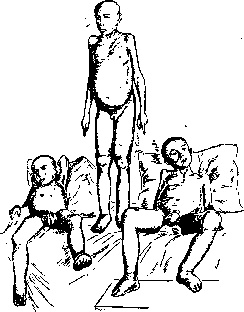
The clinical picture of E. d. Long before the appearance of edemas—the main symptom of the disease—patients complain of fatigue, especially in the legs, and general weakness, which they associate with poor nutrition; at this time patients already notice frequent urges to urinate with an increase in the amount of urine, which sometimes prevents them from sleeping; often at the same time diarrhea appears. Patients quickly lose weight and before the appearance of edemas they sometimes lose 10-12 kg. Along with emaciation and adynamia, an apathetic state develops, indifferent attitude to the surroundings, some inhibition of the psyche. The face is grayish-pale, dull, mask-like, without facial expression, temperature often subnormal. The skin is dry, covered with peeling epidermis. After this prodromal period, the main symptom of the disease appears—edemas. Edemas begin insidiously, most often on the legs, but cases have been described of rapid, within a day or two, strong spread of edemas all over the body, especially after physical exhaustion, e.g., after walking. Sometimes leg edemas decrease or disappear for a time, but quickly reappear all over the body. In their external appearance, patients with markedly puffy, swollen and pale faces, with huge edemas on the hands and legs, very resemble nephrotics. Relatively rarely (according to Knack in one-ninth of cases) there are edemas of cavities: ascites and hydrothorax, while in the pericardial cavity fluid usually does not accumulate. Especially often in children and adolescents, a huge edema of the scrotum is noted (see illustration). The amount of accumulating fluid is very large and reaches 22-25% of the patient's weight (Bürger, Luria). Edemas are completely painless, very loose, not cyanotic. With improved nutrition, edemas disappear very quickly and then it is possible to discover almost complete atrophy of the adipose tissue and markedly atrophied musculature, especially on the limbs. In their chemical composition, edemas in E. d. do not differ from edemas of other origin in relation to NaCl and other inorganic salts, residual nitrogen is also not greater than in other edemas, but the amount of NH3 is significantly increased (Maase and Zondek).
The second cardinal symptom of E. d. is disturbance of urination. Already early on, polyuria is noticed, increasing with the appearance of edemas. The amount of excreted urine during the period of increasing edemas reaches 3-4 liters per day; pollakiuria and nocturia are typical—up to 10-12 times at night (Luria). Specific gravity of urine—1.008-1.010. Urine contains neither protein nor sugar, sometimes acetone appears in it. After the disappearance of edemas, polyuria and especially pollakiuria continue for a long time. Functional tests after the disappearance of edemas do not give grounds to speak of kidney damage either in relation to dilution or concentration of urine. Similarly, there are no pathological deviations in the excretion of nitrogen and salt by the kidneys. The amount of B disease is increased in the urine
218 phosphoric and especially sulfuric compounds, potassium salts, creatinine; creatin also appears; the content of uric acid and ammonia is also increased. - On the side of the heart, there are usually no visible deviations. Bradycardia is noted in very many patients, the pulse drops to 40 and even to 26 per minute (Hulse); bradycardia is considered the third cardinal symptom of Ed. D. Even with slight movements, it easily transitions into tachycardia and arrhythmia. The electrocardiogram shows no pathological changes (Luria). Blood pressure is most often slightly lowered, but can also be normal; hypotension depends on the condition of peripheral vessels and quite quickly disappears with bed rest and improvement in the nutrition of patients. The Rumpel-Leede symptom is negative. Despite the absence of symptoms of organic heart and vascular disease, patients often die suddenly from paralysis of the heart. - Disorders of the gastrointestinal tract are sometimes so pronounced that the first researchers even considered Ed. D. to be secondary as a result of intestinal diseases, mainly dysentery. This view was not subsequently confirmed, since it was established that a significant portion of Ed. D. patients do not have diarrhea at all. Appetite is sharply increased even with diarrhea; there are no dyspeptic symptoms from the stomach. Gastric secretion is sharply reduced, there is subaciditas and anaciditas, the amount of enzymes is reduced to their complete absence. Diarrhea is very frequent, up to 15 times a day, the stools do not contain blood, pus, little mucus, often show symptoms of fermentative dyspepsia, sometimes mixed fermentative-putrefactive (Luria). On the side of the nervous system, there are no deviations characteristic of Ed. D. In the blood, the following phenomena are observed: the amount of Hb is slightly decreased; according to individual authors, it is often normal and even increased (Jakobstadt). The number of red blood cells is decreased, but this phenomenon is unstable, their resistance is normal; on the side of white blood cells, lymphocytosis (up to 60%) is most often noted. Thus, the morphological changes in the blood in Ed. D. are insignificant, but there are very significant deviations in the physicochemical properties of the blood: considerable hydremia with an increase in water content up to 10% and a decrease in dry residue to 15%; the amount of protein bodies is decreased to 6-5% and even to 3%; there is hypoglycemia up to 60 mg%; the amount of ketone compounds is increased; residual blood nitrogen is increased to 95-100 mg%; the amount of creatine, and sometimes also creatinine, is increased. The content of fat and lipoids in the blood deserves special attention; neutral fat most often disappears completely, the amount of fatty acids is sharply decreased, the amount of cholesterol fluctuates slightly within normal limits, the content of phospholipoid compounds is significantly decreased (to 2.5% according to Feiglro), and the amount of soluble phosphoric compounds is increased. The alkaline reserve of the blood is decreased. Arising as a result of nutritional deficiency, Ed. D. represents profound disturbances of the entire metabolism of the organism, which lives at the expense of the constituent parts of its organs and tissues. An expression of these pathological processes are the above-described changes in the physicochemical properties
Related articles
Mentioned in
Cite this page
“Edematous Disease.” Soviet Medical Encyclopedia. English translation of Bolshaya Meditsinskaya Entsiklopediya, 1st ed. (Moscow, 1928–1936), ed. N. A. Semashko. https://sovietmedicalencyclopedia.pages.dev/article/edematous-disease-2/