Electrolytic Dissociation
Historical document, translated for reference. It reflects medical knowledge of the 1920s–30s and is not medical advice.
Summary
This article discusses the fundamental concepts of electrolytic dissociation, explaining how electrolytes breakdown into charged ions in solution. It covers van 't Hoff's coefficient, the Arrhenius theory of electrolytic dissociation, and methods for determining the degree of dissociation via osmotic pressure and electrical conductivity.
Encyclopedia article (1928–1936)
ELECTROLYTIC DISSOCIATION, the breakdown of electrolytes in solution into electrically charged ions. Van 't Hoff coefficient. Van 't Hoff showed that the osmotic pressure of a solution is equal to the pressure that the dissolved substance would exert if it were in the state of a gas or vapor occupying the same volume and at the same temperature. This rule, however, is not valid for all substances. Many substances have an osmotic pressure exceeding that calculated theoretically. The ratio of the directly measured osmotic pressure to the theoretical one received the name of van 't Hoff's coefficient (i); it is always greater than unity: $i = \frac{P_{\text{measured}}}{P_{\text{theoretical}}} > 1$.
Since according to the kinetic theory the pressure (both gas and osmotic) at a given temperature depends exclusively on the number of dissolved particles, to explain deviations from van 't Hoff's theory one must assume the breakdown, dissociation, of a portion of the molecules into smaller particles, resulting in an increase in the total number of the latter. For the dissociation of gases, such an explanation was proven by isolating the products of breakdown. In the case of solutions, it encountered significant difficulties. If, for example, there is a solution of NaCl, the products of dissociation obviously cannot be Na and Cl atoms. Both of these elements, if they were in a free state, would be easily detected: metallic sodium violently decomposes water, releasing hydrogen from it and forming caustic soda, while gaseous chlorine...
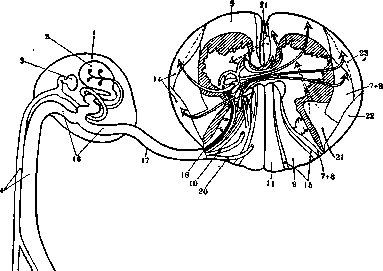
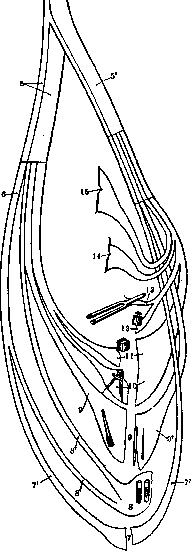
[Caption to figure for article Dissociation of Sensitivity]: Arrangement and course of sensory fibers in the spinal cord and peripheral nerve: 1—intervertebral ganglion; 2—intervertebral ganglion cell; 3—sympathetic cell; 4—peripheral sensory nerve; 5—cutaneous nerve or nerve conducting superficial sensitivity; 51—sensory nerve accompanying nerves to muscles and conducting deep sensitivity; 6—n. sympathicus; 7—pain sensitivity; 71—prick, pinch; 72—painful pressure on muscles and ligaments, etc.; 8—temperature sense; 81—minimum temperature 26° and maximum 38°; 82—fine differentiation of temperature between 22° and 40°; 9—sense of touch and localization; 91—light touch; 92—pressure; 10—discrimination of sensitivity; 11—stereognostic sense; 12—sense of heaviness; 13—bone sensitivity; 14—conscious deep sensitivity: sense of body position in space, sense of body position during active and passive movements; 15—unconscious deep sensitivity: muscle tone, coordination, balance; 16—peripheral sensory neuron; 17—posterior root; 18—short root fibers; 19—medium root fibers; 20—long root fibers; 21—direct and crossed pyramidal fibers; 22—Flechsig's tract; 23—Gowers' tract.
...should be easily liberated from solution. Nothing of the sort is observed. Likewise, one cannot assume the dissociation of NaCl—with the participation of water—into caustic soda (NaOH) and hydrochloric acid (HCl); on the contrary, both of these substances, as is well known, upon coming into contact instantly combine with each other, forming a neutral salt and liberating significant amounts of heat. Thus, the characteristic signs of gas dissociation (the ability to easily recognize and isolate dissociation products) are absent in solutions. Arrhenius theory. All substances whose solutions have an abnormally high osmotic pressure are electrolytes, i.e., substances that decompose when an electric current passes through them. According to Faraday, electric current is carried by their charged atoms (or radicals), which he called ions. Ions are attracted to oppositely charged poles and are deposited on them, yielding their charge to them: positively charged ions, or cations, are deposited at the cathode; negatively charged anions are deposited at the anode. Arrhenius (1887) linked the phenomena observed during electrolysis with the hypothesis of electrolytic dissociation, which had to be adopted to explain the anomalous osmotic pressure of electrolytes from the standpoint of van 't Hoff's theory. According to Faraday, when a galvanic current is passed through a solution, part of the electrolyte molecules is split into ions by the action of external electrical forces. Arrhenius, based on a large amount of data, showed that electrolytes in solution are constantly partially dissociated into ions, regardless of whether they are conducting an electric current at the given moment. Thus, a certain portion of electrolyte molecules undergoes dissociation in solution—"electrolytic dissociation"—into oppositely charged ions. In a solution of sodium chloride, along with NaCl molecules, there are Na+ and Cl- ions, or, as they are simplifiedly designated, Na• and Cl′; ions are designated by the same symbol as the corresponding chemical element or radical, adding to the upper right as many dots or primes as it carries positive or negative charges (the number of charges in turn equals the number of valences). The characteristic features of electrolytic dissociation noted above are explained by the presence of electrical charges. The products of dissociation are charged ions, not neutral atoms or molecules; therefore they differ from the latter in their properties. The separation of oppositely charged ions by means of diffusion or any other physical technique is impossible, as this is prevented by significant electrostatic forces that can be destroyed only by neutralizing the charges (during electrolysis).
Degree of dissociation. Ions alone conduct electric current; they also exhibit exceptional chemical and physiological activity. It is therefore extremely important to know what fraction of all dissolved molecules is in such an active state, dissociated into ions. The ratio of dissociated molecules to the total number of dissolved electrolyte molecules is called the degree of dissociation and is usually designated by the Greek letter $\alpha$ (alpha). The degree of dissociation thus shows what fraction of all molecules is in a dissociated state. Obviously, $\alpha$ can take values lying between 0 (absence of dissociation) and 1 (complete dissociation). Numerous measurements have shown that the degree of dissociation increases with decreasing concentration. In sufficiently dilute solutions, complete dissociation is observed; all molecules of the electrolyte split into ions. The following table presents the degree of dissociation of several electrolytes:
Concentration (molar) | Degree of dissociation: HCl | Degree of dissociation: KCl | Degree of dissociation: CH3COOH 0.1 | 0.76 | 0.79 | 0.004 0.01 | 0.86 | 0.93 | 0.013 0.001 | 0.94 | 0.97 | 0.041 0.0001 | 0.97 | 0.99 | 0.118
The degree of electrolytic dissociation can be determined by measuring the osmotic pressure of the solution, as there is a simple relationship between electrolytic dissociation and the coefficient $i$. Indeed, the increase in osmotic pressure, expressed by the coefficient $i$, is greater the more dissolved molecules split into ions. As a simple calculation shows, in the case of a binary electrolyte (i.e., an electrolyte splitting like NaCl into two ions), we have: $i = 1 + \alpha$. Substituting $i$ from the formula $i = \frac{P_{\text{measured}}}{P_{\text{theoretical}}}$, we find $\alpha$. Another, more convenient method of determining $\alpha$ is measuring the electrical conductivity of the solution. Since in solutions only ions carry electric current, electrical conductivity increases in proportion to the number of free ions, i.e., the degree of electrolytic dissociation. Let us denote molecular conductivity of the solution by $\mu$ (i.e., the conductivity of one gram-molecule of dissolved substance). At infinite dilution, dissociation becomes complete, ions of all molecules take part in conducting electric current, and molecular conductivity reaches its highest, limiting value ($\mu_{\infty}$). At higher concentrations, the degree of dissociation is directly determined by the ratio of molecular conductivity at a given concentration to this limiting value: $\alpha = \frac{\mu}{\mu_{\infty}}$.
(3). Dissociation Constant. If electrolytic dissociation is considered as a chemical reaction whose products are charged ions, then the dependence of the degree of dissociation on concentration can be derived from the general laws of chemical equilibrium. The dissociation of acetic acid, for example, is expressed by the equation: CH3COOH = CH3COO' + H+. According to the law of mass action, the concentration of undissociated acid molecules is proportional to the product of the concentrations of the dissociation products: K[CH3COOH] = [CH3COO'] · [H+]. Square brackets here denote the concentration of the substances enclosed in them, and K represents the constant characteristic of a given reaction, the so-called dissociation constant. If c is the total concentration of the dissolved acid, and α is its degree of dissociation, then the concentration of undissociated molecules is c(1 - α), and that of dissociated molecules (or CH3COO' and H+ ions) is cα. Substituting these expressions into the preceding equation gives: Kc(1 - α) = c2α2, or K = cα2 / (1 - α). The dependence between the concentration of an electrolyte and its degree of dissociation expressed by formula (4) was established by Ostwald; it received the name of the dilution law. Knowing K, one can use formula (4) to calculate α for any concentration. The following table gives the values of the dissociation constant for several acids and bases: Acids: Tartaric 1 · 10-3, Lactic 1.5 · 10-4, Acetic 1.8 · 10-5, Uric 1.5 · 10-6, Carbonic 3 · 10-7. Bases: Piperidine 1.6 · 10-3, Ammonia 1.8 · 10-5, Aniline 4.6 · 10-10, Urea 1.5 · 10-14. At equal concentration, the degree of dissociation is greater the larger the dissociation constant. However, since all electrolytes at high dilution tend toward the same limit—complete dissociation—differences in the degree of dissociation manifest especially sharply in concentrated solutions; as concentration decreases, they gradually smooth out. Thus, for example, in a normal solution of acetic acid, only 0.004 of the molecules are dissociated, and the H-ion concentration is nearly 200 times lower than in an equivalent solution of hydrochloric acid (α = 0.78). In a centinormal solution, the degree of dissociation is equal to 0.041, and acetic acid is only 23 times weaker than hydrochloric acid. If the concentration is reduced by another 100 times, then α increases to 0.31 and will be only 3 times lower than that of HCl. Dissociation of strong electrolytes. However, by no means do all electrolytes follow the dilution law. It is strictly observed only for most organic and for weak mineral acids and bases. The majority of mineral acids, bases, and salts (e.g., KCl, HCl, KOH, etc.)—all the so-called "strong electrolytes", which even in concentrated solutions have a high degree of dissociation—do not obey Ostwald's law. The value of K calculated by formula (4) is not constant for them, but increases rapidly with increasing concentration. Concentrated solutions of strong electrolytes are dissociated significantly more strongly than would be expected based on the laws of chemical equilibrium. The enigmatic behavior of strong electrolytes received an explanation in recent years thanks to the research of Bjerrum, Milner, Debye, and Hückel, among others. According to these studies, strong electrolytes even in concentrated solution are practically completely dissociated. However, at high concentration, electrostatic forces of attraction and repulsion acting between closely approaching ions begin to play an increasing role. These electrostatic interionic forces, which Arrhenius's theory did not take into account, reduce the mobility of ions and their electrical conductivity, weaken the osmotic pressure they exert and their other actions, i.e., produce all those changes that are usually attributed to a decrease in the degree of dissociation. The decrease in the value of α observed in strong solutions of strong electrolytes (see in the table the values of α for KCl and HCl) therefore depends not on a real decrease in the number of ions (degree of dissociation), but on a decrease in their activity. The action of strong electrolytes is thus determined not by the degree of dissociation and true ionic concentration, but by the "active concentration", or "activity" of the ions. Dissociation and physiological activity. Another characteristic feature of electrolytes is inextricably linked with the phenomenon of dissociation. In undissociated chemical compounds, the properties of the components disappear, replaced by completely new characteristics of the resulting compound. Iron sulfide (FeS) shows no signs of either iron or sulfur; chloroform (CHCl3) does not give the reactions characteristic of chlorine, and so on. Conversely, electrolytes possess the properties of their constituent ions. Common to all acids is the hydrogen ion, to which all acid properties are attributed: sour taste, ability to invert sucrose, turn litmus red, etc. Likewise, all properties of bases depend on the presence of the hydroxyl ion common to them. The chlorine ion, in whatever electrolyte it may be, precipitates silver from its salts; the copper ion imparts the blue color characteristic of it to aqueous solutions of all copper salts; the bromine ion produces the same physiological effect regardless of which cation it is bound to. Therefore, a strong electrolyte in solution has no individual chemical properties. Hydrochloric acid, for example, is fully characterized by the mentioned properties of the H+ and Cl' ions. For strong electrolytes and dilute solutions in which dissociation can be considered complete, this result is not surprising. Such solutions represent not a chemical compound, but a mixture of ions retaining all their features. But even in more concentrated solutions containing, alongside ions, ever-increasing amounts of neutral molecules, the appearance of any new properties is usually not observed. All properties of an electrolyte are properties of its cation or anion and are quantitatively determined by their concentration; only dissociated molecules are active in chemical and physiological processes. If this is true, if it is not molecules but their ions that act, then the intensity of an electrolyte's action must depend primarily on its degree of dissociation. This is indeed observed. Let us compare, for example, various acids. They all produce a qualitatively identical action depending on the hydrogen ion common to them. However, with complete qualitative similarity between the action of various acids, sharp quantitative differences are observed. The intensity of their action on chemical and biological processes decreases in the following sequence: HCl > tartaric > lactic > acetic > uric > carbonic acid. At equal (equivalent) concentration, each subsequent member of this series acts more weakly than the preceding one and must be applied at a correspondingly higher concentration to produce the same effect. The given series presents the same sequence in which the dissociation constant of the listed acids decreases (see table). The dissociation constant thus represents a quantitative measure of acid strength: the more dissociated an acid is, the stronger its action. A similar relationship can be established for salts. It was studied in particularly great detail on poisonous salts of heavy metals, in particular on mercury salts used for disinfection. As shown by experiments of Paul and Krönig on anthrax bacilli (Bacillus anthracis), among various mercury salts the most fully dissociated chloride salt (corrosive sublimate) is particularly poisonous, the bromide salt somewhat less so, whereas the very slightly dissociated cyanide salt proves to be the least active even at a higher concentration. Thus, toxicity increases in parallel with the degree of dissociation of the mercury salt and depends solely on the concentration of free Hg++ ions. The concentration of the latter can also be reduced by another method—by adding a salt (for example, NaCl) that forms a complex salt with corrosive sublimate and reduces its degree of dissociation. Indeed, as increasing amounts of NaCl are added to HgCl2, the toxicity of the solution rapidly decreases. Physiological activity is determined not by the total concentration of the electrolyte, but by its degree of dissociation, the concentration of its free ions.
Related articles
Mentioned in
Cite this page
“Electrolytic Dissociation.” Soviet Medical Encyclopedia. English translation of Bolshaya Meditsinskaya Entsiklopediya, 1st ed. (Moscow, 1928–1936), ed. N. A. Semashko. https://sovietmedicalencyclopedia.pages.dev/article/electrolytic-dissociation/