Gaffky and Haff Disease
Historical document, translated for reference. It reflects medical knowledge of the 1920s–30s and is not medical advice.
Summary
This article from the 1928–1936 Great Medical Encyclopedia profiles the prominent microbiologist Georg Gaffky and details Haff disease, an enigmatic condition characterized by severe muscle pain and myoglobinuria linked to the waters of the Frisches Haff.
Encyclopedia article (1928–1936)
GAFFKY, Georg (Georg Gaffky, 1850–1918), a prominent microbiologist and epidemiologist, one of the pupils of R. Koch, working with him from 1880 in the Imperial Health Office (Kaiserliches Gesundheitsamt) and in the Institute for Infectious Diseases, of which he became director after the death of R. Koch. Gaffky accompanied R. Koch on his first expedition to India to investigate cholera in 1883–1884. Gaffky's most major work is considered to be his classical study on the causative agent of typhoid fever, pure cultures of which Gaffky obtained and studied in detail for the first time; he also isolated the typhoid bacillus from the feces of patients. In 1897, Gaffky assumed leadership of the 2nd expedition of R. Koch to India to study plague, since Koch himself was occupied at that time in South Africa with research on rinderpest. During the imperialist war, Gaffky participated in the development and organization of anti-epidemic and sanitary measures, an activity he zealously pursued throughout his life alongside scientific research. The most important scientific works of Gaffky: "Zur Ätiologie des Abdominaltyphus" (Mitteil. aus d. Kais. Gesundheitsamt, B. II, 1884); jointly with Pfeiffer E., Sticker G., and Dieudonné A., "Bericht über die Thätigkeit der zur Erforschung der Pest im Jahre 1897 nach Indien entsandten Kommission" (Arb. aus d. Kais. Gesundheitsamt, B. XVI, 1899); "Massregeln zur Bekämpfung der Pest" (Deutsche Vierteljahresschrift f. öffentl. Gesundheitspflege, B. XXXIII, 1901); "Verbreitungsweise und Bekämpfung der Pest" (XIV Internat. Kongress f. Hyg. u. Demographie, B., 1907).

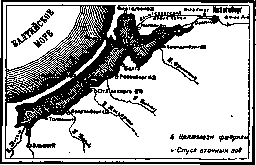
HAFF DISEASE (Haffkrankheit; Haff is an obsolete German word, nowadays encountered only as a proper name of three peculiar types of lagoons on the southern coast of the Baltic Sea), a characteristic disease that appeared in July 1924 on the shores of the Frisches Haff lagoon in Prussia (see figure) and was accompanied by extremely severe muscle pain and hemoglobinuria. Haff disease affected almost exclusively the inhabitants of villages lying directly on the lagoon, predominantly fishermen who engaged in fishing in the Frisches Haff, and as a rule, the fishermen fell ill during work on the lagoon, mostly during morning hours. Cases of the disease were also observed among persons working on land near the lagoon. Isolated cases of the disease were established among those living far from the lagoon, and in particular, two cases in the city of Königsberg. The etiology of Haff disease cannot be considered definitively clarified. Lewin and Lentz (L. Lewin, Lentz) suggested the hypothesis that poisoning by volatile arsenic compounds formed in the silt and water of the lagoon occurred here; as the source of poisoning, they pointed to two cellulose factories located near Königsberg, the wastewater of which enters the lagoon via a special canal; since 1923, these factories switched to Spanish pyrite with a high arsenic content (0.3%) instead of Norwegian pyrite, which they used before the war, for the production of sulfuric acid. Selter, Lockemann, and others deny the role of arsenic; in their opinion, Haff disease is connected with the consumption of eels, into the bodies of which poisonous products of silt decomposition penetrate. Despite differing individual views, all authors unanimously recognize that Haff disease should be regarded as mass poisoning resulting from changes in the hydrobiological conditions of the Frisches Haff.
In 1924, 560 people fell ill with Haff disease, with a maximum in August (288), and 6 died; in 1925, 164 fell ill, 5 died, and in addition, 37 doubtful cases were registered. In 1926, 16 fell ill; in 1927, 21; in 1928, 1 person. Pathological-anatomical examination of two cases yielded the picture of severe parenchymatous degeneration of both kidneys; in the spleen, no changes. Clinic. The disease usually began suddenly with muscle pain in the calves, sacrum, or upper part of the long muscles of the back. Within a few minutes, the pain spread throughout the body and became so severe that patients had to lie down. Any attempt at active or passive movement sharply increased the pain. At the beginning of the attack, retention of urine was observed, followed by the excretion of significant amounts of urine ranging from reddish-brown to dark brown in color, containing hemoglobin and methemoglobin; the urine reaction is acidic, with much protein (4–5%), casts from erythrocytes, individual erythrocytes and leukocytes; the benzidine test is always positive; upon standing, an abundant sediment formed containing casts of hemoglobin lumps. The tongue is coated and dry; in some cases, vomiting was observed. Pulse 85–105 beats per minute, soft. Blood pressure 110–135 according to Riva-Rocci. Temperature in individual cases rose to 37.7°. Consciousness is clear. Reflexes are normal. The nerve trunks and skin, in contrast to the muscles, are insensitive to pressure. No changes on the part of the liver and spleen. After 12–24 hours, the pain gradually began to subside, the urine became lighter, and after 2–3 days acquired a normal color; protein in the urine in small amounts was often detected for 3 weeks. Weakness persisted for several days, and sometimes weeks. Sometimes the disease recurred up to 6 or even 8 times, with repeated attacks appearing only when the fishermen went out onto the lagoon again. Prognosis is generally favorable. In cases that ended fatally, other serious organic diseases were simultaneously present.
Treatment is symptomatic. Prophylaxis boils down to the possible detoxification of wastewater: the cellulose factories switched from Spanish pyrite to Cypriot and Norwegian pyrites poorer in arsenic, as a result of which the arsenic content in wastewater dropped to 1.6 mg per 1 liter. In Königsberg, work has begun on improving wastewater purification.
Related articles
Cite this page
“Gaffky and Haff Disease.” Soviet Medical Encyclopedia. English translation of Bolshaya Meditsinskaya Entsiklopediya, 1st ed. (Moscow, 1928–1936), ed. N. A. Semashko. https://sovietmedicalencyclopedia.pages.dev/article/gaffky/