Haematometra
Historical document, translated for reference. It reflects medical knowledge of the 1920s–30s and is not medical advice.
Summary
Haematometra is the accumulation of menstrual blood in the uterine cavity due to atresia or narrowing of the lower part of the genital canal. This condition causes symptoms such as cramping pain, pressure on neighboring organs, and can lead to complications like hematosalpinx.
Encyclopedia article (1928–1936)
HAEMATOMETRA (from Greek haima-blood and metra-uterus), accumulation of menstrual blood in the uterine cavity due to atresia or narrowing in the lower part of the genital canal (see Giatrezia). Due to the impermeability of the cervical canal, menstrual blood accumulates above the site of atresia, clots, blood cells shrink, are lysed, and to the blood are added mucus, epithelial cells, and a small amount of leukocytes. All contents become a thick, viscous liquid with specific gravity 1.028 (Dohrn), without odor, and acquires a characteristic tar-like color. The amount of blood varies-from 1 tablespoon to 1-1.5 liters. Filippini found 3.684 g after 36 months of retention. Cases of complete absence of blood also occur. Thus, Pfannenstiel found no blood at all in a girl who had suffered from atresia for 6 years. The clinical symptoms depend on the amount of accumulated blood. Initially, the process is completely painless, but as blood accumulates, significant stretching and pressure on neighboring organs occur. For the development of H. in low-lying atresias (e.g., in the hymen)-see Haematocolpos. With atresia at the external or internal os, H. may develop primarily. Usually, the consequences of vaginal atresia are recognized at the age of puberty, with the onset of menstrual flow. Cramping pains appear, which are localized in the lower abdomen, sacrum, and radiate to the legs; sometimes there is painful tension in the perineal area. The pains occur periodically, similar to menstruation (molimina menstrualia). Each month, the amount of blood increases, causing overstretching of the uterus; the latter, as a muscular organ, begins to contract actively. The pains intensify, appearing also in the intermenstrual intervals and becoming even constant. To this are added symptoms from neighboring organs (rectum and bladder), frequent urination, constipation and inability to coitus. Often together with H. there is accumulation of blood in the Fallopian tubes-haematosalpinx (see). The latter can form as a result of direct transition of blood from the uterine cavity or completely independently due to accumulation of blood in the tube.
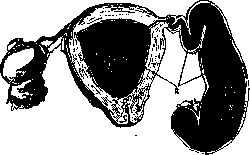
Haematometra and haematosalpinx after repeated curettage for abortion: ft-collection of blood (according to Tsomakion).
Diagnosis of H. is not difficult, considering the absence of menstruation, periodic pains and the presence of an enlarged uterus, almost spherical in shape, of firm-elastic consistency. With large accumulations of blood, the suffering of patients can be quite significant, especially if there is also haematosalpinx, which usually from the very beginning causes inflammatory adhesions. The diagnosis becomes more difficult with accumulation of blood in a rudimentary horn, especially with a double uterine apparatus, when one horn of the uterus may be patent and, consequently, menstruation will be present. In such cases, H. can be confused with an ovarian tumor. It is also not easy to diagnose H. in old women. Usually in such cases H. occurs in the preclimacteric age, when the cessation of menstruation is considered as the onset of climax, and the blood-stretched uterus is often taken for a developing neoplasm. One of the diagnostic methods can be puncture of H. through the cervical canal. In extremely rare cases, spontaneous healing occurs. The latter is possible only with thin membranous adhesions, which rupture under the pressure of blood accumulated above. Cases of rupture of H. into the rectum (4 cases, Sauer), into the bladder (Rosner) have been described. Neugebauer notes in 5 cases of spontaneous healing. Treatment can only be surgical; it consists in creating an artificial pathway for the blood to exit (operation of Amussat). With large adhesions, it is technically difficult to create a pathway between the bladder and intestine and then protect the newly formed canal from adhesions and narrowing. In such cases, the entire uterus has to be removed. With simultaneous accumulation of blood in the tubes, it is necessary to first remove the latter through laparotomy, and only then incise the atresia from the vaginal side. In doubtful cases, one has to resort even to exploratory laparotomy, since during surgical intervention a serious complication from haematosalpinx can always occur. In Neugebauer's 1,000 cases, 5 spontaneous ruptures of haematosalpinx with fatal outcome and 28 fatal peritonitis are described. The main requirement for treatment is the observance of the strictest asepsis during the operation and in the subsequent care of the patient.
Related articles
Mentioned in
Cite this page
“Haematometra.” Soviet Medical Encyclopedia. English translation of Bolshaya Meditsinskaya Entsiklopediya, 1st ed. (Moscow, 1928–1936), ed. N. A. Semashko. https://sovietmedicalencyclopedia.pages.dev/article/haematometra/