Hans Eppinger
Historical document, translated for reference. It reflects medical knowledge of the 1920s–30s and is not medical advice.
Summary
A biographical sketch of Hans Eppinger, a prominent Austrian therapist and clinician known for his work on the vegetative nervous system, hepatolienal diseases, and circulatory pathology.
Encyclopedia entry (1928–1936)
EPPINGER, Hans (born 1875), a prominent Austrian therapist. He graduated from the University of Vienna in 1899. He was an assistant to Noorden in the 1st Clinic in Vienna. In 1921, he was elected to the chair in Freiburg, and in 1927 he became director of the therapeutic clinic in Cologne. From 1933, he was the head of the 1st Therapeutic Clinic in Vienna. Eppinger is one of the most brilliant German clinicians of our time. His research work concerns the most diverse fields of clinical medicine and
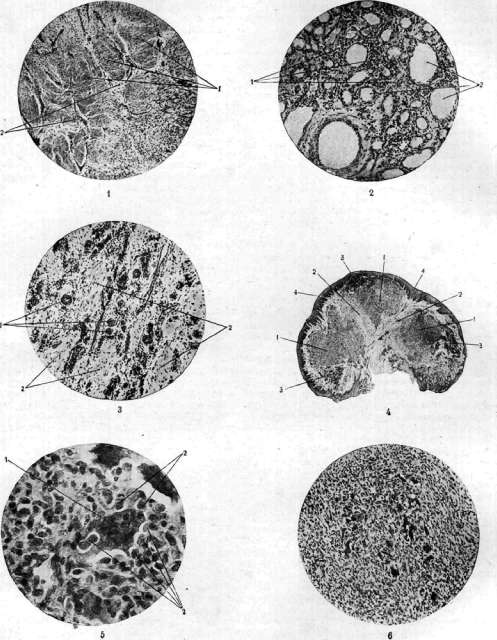
Figure 1. Epulis of the simple granuloma type in the stage of fibrous transformation: 1 - bundles of fibrous connective tissue; 2 - layers of loose connective tissue in which blood vessels are located. Figure 2. Epulis of the angio-granuloma type: 1 - gaping thin-walled vessels among delicate fibrous, cell-rich connective tissue. Figure 3. Epulis of the angio-granuloma type in the stage of fibrous transformation: 1 - vessels with thickened walls and narrowed lumens; 2 - bundles of fibrous, cell-rich connective tissue. Figure 4. Epulis of the giant-cell granuloma type: 1 - giant-cell areas separated from each other by layers of fibrous stroma (2); 3 - deposits of blood pigment in the fibrous connective tissue; 4 - epithelial cover. Fig. 5. Discomplexation of a giant cell: 1 - giant cell decaying into separate mononuclear elements (2) and having extremely irregular outlines as a result. Figure 6. Fibrous transformation of a giant-cell area in which discomplexation of giant cells takes place; false polymorphism of giant cells. (From the author's preparations.) pathology. World fame was acquired by Eppinger's work (jointly with Hess) in 1910 on the physiology of the vegetative nervous system, the antagonism of the sympathetic and parasympathetic systems, and the clinical forms of vagotonia and sympathicotonia. Despite the fact that the doctrine of Eppinger and Hess was subsequently revised and largely rejected, they nevertheless deserve immense credit for the initial clinical development of the issue. Eppinger also owns a number of studies on the pathology of the liver, bile formation, and pigment metabolism. They are summarized in a monograph on hepatolienal diseases (jointly with Walzel, also published in Russian, Moscow-Leningrad, 1928). Eppinger's views on experimental hemolysis, blockade of the reticuloendothelial system, and the formation of bile thrombi are currently generally accepted. Finally, Eppinger also paid much attention to the pathology of blood circulation (decompensation, edema). Eppinger's main works (excluding the monograph): "Die Vagotonie" (Berlin, 1910), "Pathologie und Therapie der menschlichen Oedeme" (Berlin, 1917), "Über das Asthma cardiale" (jointly with Papp and Schwarz, Berlin, 1924), "Das Versagen des Kreislaufs" (jointly with Kisch and Schwarz, Berlin, 1927). In addition, Eppinger published about 100 various articles in scientific journals.
Related articles
Cite this page
“Hans Eppinger.” Soviet Medical Encyclopedia. English translation of Bolshaya Meditsinskaya Entsiklopediya, 1st ed. (Moscow, 1928–1936), ed. N. A. Semashko. https://sovietmedicalencyclopedia.pages.dev/article/hans-eppinger/