Huygens' Principle
Historical document, translated for reference. It reflects medical knowledge of the 1920s–30s and is not medical advice.
Summary
Huygens' Principle is a fundamental method for calculating wave propagation in a medium by treating every point on a wavefront as a source of secondary spherical wavelets. This 1930s encyclopedia entry explains how the principle derives the laws of reflection, refraction, and diffraction.
Encyclopedia article (1928–1936)
HUYGENS' PRINCIPLE allows for the calculation of wave motion in a medium and is reduced to the following: let us imagine that a certain wave reaches position abed at time t, as shown in Figure 1. We need to know what the position of this wave will be at time t + Δt. To solve this question, according to Huygens, one must construct spheres around each point of the wave surface with a radius r = vΔt, where v is the speed of wave propagation and Δt is the time interval during which the wave motion propagates in the given medium. By describing a series of spheres with radius r around each point of the surface abed, as seen in the figure, and by drawing a tangent surface ABCD to all these spheres, we obtain the wave surface. By repeating the above construction, one can determine the position of the wave at any moment in time. Huygens' Principle is of enormous importance in the study of wave motion. Below are several examples clarifying the methods of applying Huygens' Principle. Let a plane wave AB (see Figure 2) fall on a flat reflecting surface SP and let
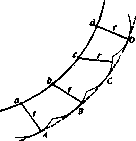
Figure 1.
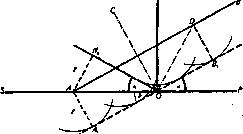
Figure 2.
at a certain moment, point A of the wave comes into contact with the surface of the mirror. Let us consider what will happen according to Huygens' Principle to wave AB in the following moments of time. To find the position of the wave after a time interval Δt, one must construct a sphere with radius r = vΔt around each point of wave AB, and the tangent plane to all these spheres (circles in the drawing) will represent the cross-section of the wave in the plane of the drawing. If the mirror were not there, the wave would occupy position A1OB1, but the mirror does not allow the waves to propagate into the space AOA1, and the waves will be reflected by the mirror such that they form a wave ON2, which will be symmetrical with respect to A1B1. The reflected waves will reach ON2 during the same time Δt during which they would have reached A1B1 in the absence of the obstacle SP. From the equality of triangles N2OA and A1OA, it is clear that the angles N2OA and A1OA are equal (angle α is equal to angle β); at the same time, β is equal to angle B1OP, as seen from the figure. Let us erect perpendiculars OC and OD to the direction of the waves CN2 and OB1. These perpendiculars give the directions along which the wave propagates and are called rays. Let us erect a perpendicular OR to the mirror at the point of incidence of the ray O. The angles formed by the wave front with the mirror, i.e., angles N2OA and B1OP, are equal to each other (they are equal to α); angles COB and ROD are equal to angles B1OP and N2OA as angles with perpendicular sides and are therefore equal: COR = ROD = α. Thus, parallel rays formed by plane waves yield the following laws upon reflection: 1) the incident ray and the reflected ray lie in the same plane as the perpendicular erected at the point of incidence of the ray; 2) the angle formed by the incident ray and the perpendicular to the mirror at the point of incidence (angle of incidence) is equal to the angle formed by the reflected ray and the same perpendicular (angle of reflection). The laws of wave refraction are derived from Huygens' Principle in exactly the same way. In this case, it is assumed that waves propagate at different speeds in different media. The bending of rays into the region of the geometric shadow (diffraction) is explained particularly simply and clearly from the point of view of Huygens' Principle. We will consider the simplest phenomenon associated with the passage of light through a narrow opening in screen AA (see Figure 3). A plane wave WW, having reached screen AA, forms a series of disturbance centers in the plane of the opening SS, from which spherical waves propagate in all directions. The rays of these waves, normal to the wave, bend away from the geometric shadow SS1-SS1, as seen in Figure 3, and this phenomenon is one of the most elementary phenomena of the application of Huygens' Principle (for details, see Diffraction).
Related articles
Cite this page
“Huygens' Principle.” Soviet Medical Encyclopedia. English translation of Bolshaya Meditsinskaya Entsiklopediya, 1st ed. (Moscow, 1928–1936), ed. N. A. Semashko. https://sovietmedicalencyclopedia.pages.dev/article/huygens-principle/