Hysteresis
Historical document, translated for reference. It reflects medical knowledge of the 1920s–30s and is not medical advice.
Summary
This 1930s encyclopedia article discusses the phenomenon of hysteresis, detailing magnetic hysteresis in iron rods and colloidal hysteresis, such as the swelling behavior of non-elastic gels like silica gel, and related processes of aging in colloidal systems.
Encyclopedia article (1928–1936)
HYSTERESIS (from Greek hysteros - later), a name given to a series of phenomena united by the general property that a certain quantity depends on the previous state of the system under study. - Magnetic H. If an iron rod is placed inside a coil through which an electric current flows, the magnetizing force of the coil will be
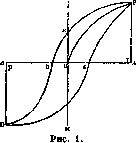
proportional to the current strength and can be determined in various ways. The relationship between the current strength and the degree of magnetization of the iron can be expressed by a curve (see Figure 1). This curve shows that initially magnetization proceeds almost proportionally to the increase in current strength, but then reaches a certain limiting value corresponding to the state of saturation of the iron, and a further increase in current no longer increases magnetization. If one then begins, from a certain point (indicated in the figure by the letter B), to decrease the current strength, we notice that the resulting curve will no longer coincide with the initial magnetization curve, but will run higher than it. Having brought the current strength to zero, we will still have a certain magnetization (so-called residual magnetism of the iron), expressed by the ordinate ok. In order to bring this piece of iron into a non-magnetic state, it is necessary to reverse the direction of the current, i.e., pass it in the reverse direction. In this case, a branch of the curve will be obtained which will intersect the abscissa axis at point n, and the segment on represents that reverse force which must be applied to demagnetize the iron piece. This force bears the name of coercive (retaining) force. If one then produces a further increase in the current in the reverse direction, the magnetization of the iron rod will again occur. It will be expressed by the curve nD, which will drop first rapidly, then more slowly, and finally a state of complete saturation will be obtained with the reverse direction of the current. If we take point D on this curve, which will have an abscissa or equal to the abscissa of point B (or), and, starting from this moment, again begin to gradually decrease the current strength acting in the reverse direction, then once again there will be no coincidence of the course of the curve either with the course of the curve that was just obtained, or with that course of the curve that would have been obtained during the magnetization of a piece of iron located in a neutral, non-magnetic state; instead, the branch DsB will be obtained, which will close the cycle. If the corresponding cycle is repeated many times, we will each time obtain different degrees of magnetization for the same current strength, depending on the direction of the cycle. This phenomenon is called magnetic H. and is caused by the fact that the degree of magnetization is influenced by the previous state of the magnetized piece of iron.
P. Lazarev. Colloidal H. H., or the prolonged after-effect of previously existing conditions, represents a phenomenon widely distributed among colloids. A good example of H. is the swelling of inelastic gels (see Gels), e.g., silica gel, thoroughly studied by van Bemmelen. If a freshly prepared
gel of silicic acid is placed in an atmosphere with a reduced water vapor pressure, it gradually comes into equilibrium with it, losing part of the water bound by it. Each water vapor pressure corresponds to a definite water content in the gel. With a successive decrease in vapor pressure, the water content in the gel successively decreases, tracing a definite curve (the lower branch of the curve, see Figure 2). If, however, at any point of this curve one begins to repeat the same changes in the reverse direction, transferring the gel to an atmosphere with steadily increasing vapor pressure, it takes up water again, but its content significantly yields to that which the gel had during the water loss process. Between points O1 and O2, the swelling isotherm forms two non-coinciding branches: at the same water vapor pressure (and constant temperature), the gel binds different amounts of water depending on its previous state. For example, at a relative air humidity of 50% (middle of the curve), the water content in the gel that was previously in a wetter atmosphere is more than twice as large as that of the one that was preliminarily subjected to the action of a drier environment. Thus, under completely identical external conditions, the swelling of the gel depends on its former state, on its past. Like a living organism, it has its own "life history" that leaves an imprint on its subsequent behavior. Such a prolonged after-effect of previously prevailing conditions bears the name of H. Characteristic of H. is the circumstance that the system lags behind external conditions not only in time, but also in phase: equilibrium in the forward and reverse processes does not coincide even after a long period of time. Closely related to hysteresis is another phenomenon that is frequently confused with it and designated by the same name. It consists in the fact that, due to imperfect elasticity, significant internal resistances, and the like, the system reaches equilibrium only very slowly, preserving the influence of initial conditions for a long time. Such a gradual, seemingly spontaneous, irreversible change in a colloidal system under constant external conditions resembles a life cycle caused by internal causes and is often given the analogical name "ripening" or "aging". An example of this is the so-called ripening of solutions of certain colloidal dyes, the particles of which acquire the degree of dispersion necessary for dyeing only after a more or less prolonged time following the preparation of the solution. The dispersion of many colloidal solutions slowly decreases upon standing, and the process of aging of colloids often ends in their complete precipitation. Similarly
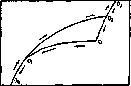
Figure 2. Water content in the gel.
gels can also gradually change their degree of swelling under constant external conditions. Even gelatin gel, which is distinguished by relatively perfect elasticity, somewhat deswells for three to four days after preparation, reducing its volume (i.e., the amount of bound water) and correspondingly its permeability to diffusing substances. To such phenomena of colloid aging belong also the age-related changes of the colloids of the living organism, which in recent years have been especially studied by Ruzicka and his coworkers, who incorrectly called them "protoplasmic hysteresis".
Related articles
Mentioned in
Cite this page
“Hysteresis.” Soviet Medical Encyclopedia. English translation of Bolshaya Meditsinskaya Entsiklopediya, 1st ed. (Moscow, 1928–1936), ed. N. A. Semashko. https://sovietmedicalencyclopedia.pages.dev/article/hysteresis/