Incompatibility
Historical document, translated for reference. It reflects medical knowledge of the 1920s–30s and is not medical advice.
Summary
Incompatibility refers to properties of medicinal substances that prevent their combined use in one formulation. This article classifies incompatibilities into physiological, chemical-physical, and chemical types, with examples of each.
Encyclopedia article (1928–1936)
INCOMPATIBILITY (Latin incompatibilitas), a term denoting various properties of medicinal substances that exclude their combined use in one medicinal combination (mixture, solution). Incompatibility is most often understood as established chemical interaction between these substances. Usually, incompatibilities are divided into the following classes: 1) Physiological (pharmacological) incompatibilities. The inclusion of physiological antagonists in one medicine is by many considered an error. Antagonists in this sense are recognized, for example, expectorants and substances that retard the secretion of mucus, salol and sulfate salts, arsenic compounds and iron oxide, purgatives and 'astringents,' etc. In fact, experience speaks in favor of full appropriateness in many cases of such combinations: codeine in an infusion of ipecac root exerts very good action, calming the distressing cough and at the same time facilitating the secretion of mucus. Sulfate salts are an antidote to phenols, including salol, but only after their processing by the body using the sulfate residue to convert phenols into sulfonic acids; this requires time, during which phenols manage to manifest their expected action along their path. Similarly, iron oxide does not give a completely insoluble compound in gastric juice with arsenic compounds, or gives it in many cases not immediately (examples: therapeutically effective preparations, such as iron cacodylate, arseno-iron salt, arsenated iron albuminate, arsenohemol, arsenoferin, etc.-). Even more so: combinations of physiological antagonists reveal in most cases therapeutically valuable action of each of the antagonists, often pushing to the background their mutually destructive poisonous action. 2) Chemical-physical incompatibilities. In individual cases, chemical interaction between prescribed ingredients makes it impossible to fulfill the prescription. Thus, combinations of camphor, menthol, thymol, chloral hydrate with each other or with salol, resorcinol, terpin hydrate and other aromatic or hydroaromatic compounds often give a liquid substance at room temperature (eutectic alloy), and they cannot be prescribed in powders. Similar in unexpectedness of consequences are hygroscopic combinations that attract moisture from the air and spread out; the same applies to dampening combinations of powders containing crystallization water and losing it as a result of interaction (for example, a mixture of alum with lead acetate). These incompatibilities are conditional, since with proper preparation (avoiding strong friction) and storage in a very dry atmosphere, such combinations remain in powdered form for quite a long time. It is undoubtedly an error to prescribe insoluble substances in solution form (if the physician does not intend to obtain a suspension or emulsion) or even soluble ones, but in quantities exceeding the solubility limit at room temperature. Thus, for example, according to the prescription 'Sol. Kalii hypermang. 10%,' the patient will receive about half of the permanganate in solution and half in precipitate; the inscription on the bottle 'shake well' with the most careful execution of this instruction will not save from considerable inaccuracy of dosage due to rapid settling of the precipitate. Explosive mixtures should also be included here, even in cases where explosion can be avoided when preparing the medicine, but it occurs or may occur with careless handling of the medicine by the patient at home. Practically, the issue usually concerns combinations of potassium chlorate with sugar, sulfur or easily oxidizable organic substances; among liquids—mixtures of strong or fuming nitric acid with alcohol, collodion, etc. These combinations should be avoided. 3) Chemical incompatibilities. The very fact of reaction between ingredients cannot be considered a sign of incompatibility, and even less sufficient are such external signs of reactions as change in color, taste or smell. Examples: mixtures containing alkalis in combination with raspberry or other berry syrups; solutions of iron salts in combination with tannins or salicylic acid salts; halogen salts (potassium or sodium bromide or iodide) with syrup; mixtures with orange flower water and aromatic ammonia spirit, etc. This also includes many quite common prescriptions: mixtures containing iron oxide salts in combination with antipyrine; combination of iodine with potassium or sodium iodide; combination of sublimate or arsenic iodide with a sufficient amount of potassium or sodium iodide; combination of iodine with fats, especially emulsions and cod liver oil; combination of sodium bicarbonate with ammonia (in the form of aromatic ammonia spirit) and many others. In all these cases, the chemical reaction amounts to exchange decomposition of the ingredients or to the formation of a new compound possessing the combined action of the ingredients, and (in the case of a mixture) no precipitate is formed. Regarding these combinations, 'incompatibility' as the ability of two medicinal substances to mutually react does not always bind the physician. There may be cases where the occurring reaction does not reduce the suitability of the medicinal substance, and sometimes even the chemical interaction of the combined medicinal substances is intended (Hayek). It can be noted in this connection that in one case of this kind (hardly sufficient grounds), the USSR pharmacopoeia gives the pharmacy a formal-legal basis to refuse to fulfill the prescription: this is the case when the prescription specifies licorice root syrup in mixture with any acidic liquid. But proper attention of the physician should be directed to not prescribing without special need and full conscious consideration of the consequences of such combinations, as a result of which the pharmacological character of action of the ingredients is fundamentally changed by chemical reaction. Thus, it is generally inadvisable to prescribe potassium permanganate together with organic substances (glycerin, extracts, alkaloids, etc.); silver nitrate— with reducing agents; acids— in combination with carbonate alkalis or alkaline salts (borax); iron oxide salts— in combination with sodium or potassium iodide; easily oxidizable organic bases in free state (apomorphine, morphine, eserine, pilocarpine, adrenaline, etc.)— with carbonate salts (soda) or ammonia (aromatic ammonia spirit); antipyrine— with calomel, etc. This does not mean that these combinations are 'prohibited.' One only needs to know that potassium permanganate in combination with a reducing agent will no longer act as an oxidant, but only as a potassium salt (alkali) and oxides (oxide or dioxide) of manganese; the combination of ferric chloride with potassium iodide gives the action of ferrous salt and free iodine, etc. The combination of an acid with a carbonate alkali gives the corresponding salt and CO2. The action of easily oxidizable organic bases may not manifest in an alkaline reaction. Amygdalin (see) in combination with sweet almond emulsion gives a much more strongly acting solution of hydrocyanic acid, etc. Especially when prescribing mixtures, combinations should be avoided that result in precipitates. If these precipitates are inactive, it is better to remove them (by filtration); if they are active, their uneven distribution creates inaccuracy of dosage; this has repeatedly led to poisoning due to accidental accumulation in one dose (usually in the last residue of the mixture) of a predominant amount of the strongly acting precipitate. Combinations deserve special mention in which the reaction does not occur immediately, but over time during storage, especially under the influence of air humidity. Examples: powders or tablets containing aspirin in mixture with caffeine-salicylate-sodium salt (but not with pure caffeine); in this case, gradual decomposition of aspirin and sodium salicylate occurs with the release of acetic and salicylic acids. Mixture
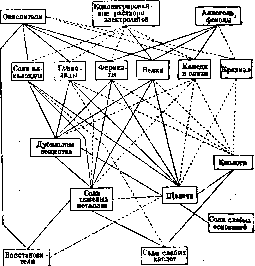
Boric acid with glycerin reacts acid and, in the presence of soda impurity, gradually releases CO2; similarly, a mixture with ammonium nitrate salt and soda. These combinations are appropriate if they are prescribed in quantities to be used within several hours or one day; but they should not be used if storage is intended. This group includes powder mixtures containing calomel (especially with gum arabic, soda, etc.). During storage, an oxidation-reduction process may occur, culminating in the transformation of calomel into a mixture of mercury with sublimate. In order to prevent unforeseen consequences of combinations in general, a good knowledge of the chemistry of the prescribed medicinal substances is necessary. To facilitate remembering the necessary information for this purpose, a simplified 'scheme of incompatibilities' was proposed (by Ober-gard). In this scheme (see the figure), solid lines connect groups of substances regarding which one can always assume that upon combination a chemical reaction must occur that essentially changes both substances »81 or at least one of them. If a reaction between substances does not always occur or it does not essentially change the nature of the ingredients, then the corresponding groups in the scheme are connected by a dotted line. In individual cases, the physician cannot in advance determine the degree of toxicity of the resulting combination; examples: alkaline solutions of salts of apomorphine, eserine, resorcinol, etc.; in these cases, it is safer to assume the greater toxicity of the product of combination. A special kind of such doubtful cases was created by multi-drug prescriptions (polypharmacy), brought to life by the evaluation of recipes by pharmacy associations 'piece by piece' - at average cost, regardless of the content of the prescription. As a result, recipes are encountered with such a multitude of ingredients that it is generally difficult to determine what reactions, in what sequence, and over what time period will occur. Upon receipt in the pharmacy of a prescription containing a combination of mutually reacting substances, the pharmacist is obliged to fill the prescription if, as a result of the interaction, a more potent combination is not obtained than the sum of the ingredients (even if the effect of one or more ingredients is eliminated, as in the case, for example, of pills with potassium permanganate salt and belladonna extract). But the pharmacy has the right to refuse to fill the prescription 'due to incompatibility' in the case of a) impossibility of fulfillment (liquid prescribed in the form of powders, explosive mixtures) and b) if as a result of filling the prescription a product more potent (more toxic) than the sum of the prescribed ingredients is obtained; in this case, the precipitation of potent ingredients in mixtures into insoluble precipitates should always be considered the formation of a more potent product due to the possibility of uneven distribution of the precipitate when taking the medicine and the entry of a significant portion of it in one dose. All other cases may be considered as more or less difficult cases of prescription writing, requiring an appropriate approach and solution, but they do not give the right to refuse to fill the prescription due to I. No templates and instructions can replace the main thing required to avoid I, namely - solid knowledge of the chemistry of medicinal materials. This knowledge is equally necessary for the practicing physician and the pharmacist.
Related articles
Mentioned in
Cite this page
“Incompatibility.” Soviet Medical Encyclopedia. English translation of Bolshaya Meditsinskaya Entsiklopediya, 1st ed. (Moscow, 1928–1936), ed. N. A. Semashko. https://sovietmedicalencyclopedia.pages.dev/article/incompatibility/