Karakurt
Historical document, translated for reference. It reflects medical knowledge of the 1920s–30s and is not medical advice.
Summary
This article from the 1928–1936 Great Medical Encyclopedia describes the karakurt spider (Latrodectus tredecimguttatus), its habitat in the southern USSR and Central Asia, its venom, and the clinical presentation of its bite in humans and animals. It details symptoms such as severe pain, weakness, and neurological manifestations, alongside traditional treatments and prevention methods.
Encyclopedia article (1928–1936)
KARAKURT, Latrodectus tredecimguttatus, a venomous spider inhabiting the southern parts of the USSR, starting from the Kharkov district. In Central Asia, it is found in the former Akmolinsk and Semipalatinsk regions. The female is 1 cm in length (see figure). The abdomen is nearly spherical, black with reddish or whitish spots. It lives in clayey or clay-sandy wormwood steppes, both on virgin land and in plowed fields. It builds a nest at the base of grass stems or on the ground, where it spins very characteristic cocoons for its eggs. It feeds on insects, scorpions, tarantulas, phalangids, etc. In some
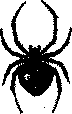
years, it multiplies in excessive numbers. The venom glands of the karakurt have the appearance of roller-like curved bodies lying in the cephalothorax. Their thin excretory duct opens near the tip of the movable claw of the upper jaws. The gland is covered with a muscular membrane which, upon contraction, squeezes the venom out of the gland during a bite with the jaws. There is no tumor at the site of the bite; two red points and sometimes insignificant erythema are visible. A burning pain spreads from the bitten spot throughout the body. The patient is restless, cannot stand on their feet due to weakness; the skin is cold and cyanotic; sweating, trembling of the body and extremities, headache, dizziness, convulsions of the fingers and toes. A stuporous state. Poisoning can lead to death in 1–2 days. Improvement comes gradually; recovery, depending on the severity of the poisoning, occurs in 2–3 weeks. Weakness lasts 1–2 months. Among domestic animals, the karakurt is dangerous to camels and horses, which die from karakurt bites in pastures. Treatment of the bite is performed by injecting 3–5 cm3 of an aqueous solution of Kalii hypermanganici 1:1,000 into the wound area in combination with lotions at the site of the bite with the same liquid; subcutaneous injection of 2 g of oleocamphor or 3 cm3 of a 3% Sol. Kal. hypermang. intravenously is also recommended. Houssay and Shcherbina prepared a specific antitoxic serum against karakurt venom, but these experiments did not go beyond laboratory research. Horses were successfully brought to a state of immunity to a 13-fold lethal dose of venom. The serum of immunized animals binds the antigen in vitro and can serve for the specific treatment of poisoning from a karakurt bite if injected into the poisoned animal no later than 10–20 hours after the bite. Exterminators of the karakurt are sheep and pigs, which devour it without any consequences. Sphex wasps paralyze the karakurt with stings of their venomous sting, while various ichneumon flies lay eggs in its cocoons and destroy the entire brood of spiderlings. To exterminate the karakurt, driving and grazing sheep through the mown steppe or pasture is used. If possible, the steppe is burned. Personal prophylaxis comes down to sleeping not on the bare ground, but on a tarpaulin or felt rug. A karakurt bite is possible when gathering hay with bare hands.
E. Pavlovsky
Related articles
Cite this page
“Karakurt.” Soviet Medical Encyclopedia. English translation of Bolshaya Meditsinskaya Entsiklopediya, 1st ed. (Moscow, 1928–1936), ed. N. A. Semashko. https://sovietmedicalencyclopedia.pages.dev/article/karakurt/