Injections
Historical document, translated for reference. It reflects medical knowledge of the 1920s–30s and is not medical advice.
Summary
This article from the 1928–1936 Soviet medical encyclopedia details the various methods of injecting substances into the body, including subcutaneous, intradermal, intramuscular, intravenous, and other routes. It explains the advantages and disadvantages of injections compared to oral administration, the techniques used, and the physiological effects of different injection methods.
Encyclopedia article (1928–1936)
INJECTIONS (injectio), the introduction of a small amount of fluid into the body parentrally, i.e., bypassing the normal path through the digestive tract. Injections can be subcutaneous, intradermal, intramuscular, intravenous, into the focus of disease, intracardiac, into the spinal canal. Injections allow for a more precise dosing of the substance introduced into the body. When introducing a substance per os, precise dosing suffers from various absorption conditions depending on the filling of the stomach and the nature of its contents. Some substances are not absorbed by the gastric mucosa at all, while others are altered under the influence of digestive juices. With parentral introduction, the influence of the liver and its barrier role also disappears. Finally, with injections, the possibility of ejecting the substance (the act of vomiting when given per os), the patient's unwillingness to swallow (suicides), and the inability to swallow (severe typhoid condition) are eliminated. Injections are convenient in cases where a rapid action of the substance is necessary. The disadvantage of injections lies in their greater complexity of application, the possibility of infection, the greater or lesser pain during injection, and the impossibility of obtaining many substances in the form suitable for injection. Injections are performed using a syringe; the most common and convenient are syringes of the 'Record' system. For the injection of some substances (e.g., Novasuroi), syringes without metal parts (e.g., Luer) are recommended. Injections are performed after cleaning the injection site by washing and disinfection (alcohol). The best results are obtained by lubricating the injection site with iodine tincture. The needle must be sufficiently sharp; for the injection of oily substances (camphor oil), it must be sufficiently thick. The injection (subcutaneous injection) must be performed with a brisk stroke. Camphor oil and gelatin must be preheated. Infection during injection can be introduced with the injected substance (non-sterility), with the operator's hands, or with the patient's skin; finally, microbes circulating in the blood of the patient (e.g., typhoid and paratyphoid bacilli) can settle at the site of trauma from the needle and cause suppuration. I. Subcutaneous injections (see Figure 1) are performed in parts of the body rich in subcutaneous tissue and relatively poor in blood vessels and nerves (the outer surface of the shoulders and thighs, the area of the chest above the pectoral muscles, the subscapular regions). Absorption of the substance occurs through lymphatic pathways and also through blood vessels (N. P. Kravkov). Subcutaneous injections give a slower entry of the substance into the blood than intramuscular injections, and intramuscular injections give a slower entry than intravenous injections. II. Intradermal (skin) injections are performed in the thickness of the skin (see Figure 2). They are used in local anesthesia and in immunization against certain infections (anthrax) to obtain a skin immune response (A. M. Bezredka). It is a disputed question whether local or general immunity is obtained in this case. In inflammatory skin diseases, autogenous hemotherapy into the skin is applied. The injection of various substances into the skin, including indifferent ones, exerts a distinct action on the organism, expressed, for example, in a decrease in the number of leukocytes.
Figure 2. Intradermal injection during local anesthesia. III. Intramuscular injections are performed mainly in the buttocks, in the upper lateral quadrant. In lying patients, in the muscles of the thigh (m. vastus lateralis). Intramuscular injection allows the introduction of a larger amount than subcutaneous injection. With such an injection of irritating substances, depots are formed from which the substance is absorbed gradually. With this calculation for gradual, slow absorption, the old salvarsan was introduced intramuscularly first. IV. Intravenous injection (see Figure 3, as well as in the article Infusion - Figure 4) is performed mainly in the veins of the elbow bend (v. cephalica, v. basilica and the vein connecting them - v. mediana); sometimes it is necessary to use the veins of the forearm (the same cephalica and basilica veins), the veins of the back of the hand and v. cephalica in the area of the anatomical snuffbox. On the legs - v. saphena magna and v. saphena parva (in the popliteal fossa, on its medial side). In infants, injections are made into the veins of the skull. Intravenous injection gives an immediate entry of the substance into the bloodstream. With the injection of salvarsan, clear traces of arsenic are already present in the urine after 5 minutes. A substance introduced quickly is also excreted quickly, but this varies with different substances. For example, one hour after the intravenous injection of sodium salvarsan, only 6.5% of the total injected arsenic is determined in the blood. Intravenous injection has the goal of a rapid effect from the injected substance. For example, intravenous administration of quinine is indicated in the comatous state of a malaria patient ('periculum vitae' - danger of imminent death of the patient - Ziemann). V. Injection into the focus of disease has a relatively limited application (iodoform emulsion in tuberculous fistulas). VI. Intracardiac injections, see Anesthesia. VII. Injection into the spinal canal, see Lumbar puncture.
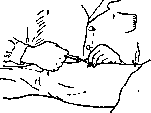

Figure 1. Subcutaneous injection.
Figure 3. Intravenous injection.
Related articles
Mentioned in
Cite this page
“Injections.” Soviet Medical Encyclopedia. English translation of Bolshaya Meditsinskaya Entsiklopediya, 1st ed. (Moscow, 1928–1936), ed. N. A. Semashko. https://sovietmedicalencyclopedia.pages.dev/article/injections/