Scorpions
Historical document, translated for reference. It reflects medical knowledge of the 1920s–30s and is not medical advice.
Summary
Scorpions are an order of arachnids characterized by a venomous stinger at the end of their tail. Found in tropical and warm regions including the southern USSR, their stings cause swelling, pain, muscle spasms, and other symptoms treated with specific antitoxin serum.
Encyclopedia article (1928–1936)
Scorpions, scorpiones—order of the class arachnids (Arachnoidea), phylum arthropods (Arthropoda). The body consists of the cephalothorax and abdomen, which is divided into a wide anterior abdomen and a narrow posterior abdomen, ending in a venomous ampulla with a sharp and strong stinger (fig. 1 and 2). There are two pairs of mouthparts: upper jaws (chelicerae) and lower jaws with pincer-like appendages (pedipalps). In the terminal ampulla are two venom glands; the scorpion bends the posterior abdomen forward and over the body and strikes with the stinger, thereby expelling the venomous secretion from the venom gland. Scorpions live in tropical and warm countries. In the USSR they are found in the southern part of Crimea, in Transcaucasia, on the Black Sea coast of the Caucasus, and in Central Asia. They belong to the species: Buthus eupeus, B. caucasicus, B. crassicauda, Orthochirus scrobiculosus, Liobuthus kessleri, Euscorpius italicus, E. mingrelicus, E. tauricus and fig. 1. Scorpions also. They live under stones, in ruins, in old clay fences, as well as under the bark of fallen trees and in other places. They often crawl into houses and get into beds, clothing, shoes. The sting of scorpions found in the USSR leads to the following phenomena: the stung place swells, and the swelling spreads to the entire limb; pain of varying intensity is felt; muscle spasms, trismus, sometimes vomiting, weakness. Specific treatment with antitoxic scorpion antiserum; local destruction of the venom is produced by injecting a solution of potassium permanganate 1:1,000 or bleaching powder 1:60.
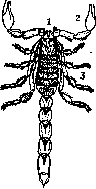
Fig. 1. Buthus: 1—jaws; 2 - claw of the lower jaw palp; 3 - legs.
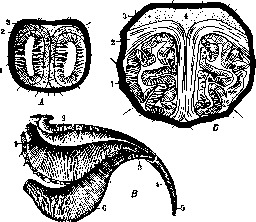
Fig. 2. A - cross section of the venomous vesicle of Euscorpius carpathicus; B - same Buthus eupeus: 1 - epithelium of the venom gland; 2 - its muscular sheath; 3 - chitin; 4 - body cavity. C - opened venomous vesicle of a scorpion, two venom glands (a and 1) are visible, of which one (b) has been emptied and displaced downward; 2 - chitic sheath; 3 - excretory duct of the venom gland; 4 - tip of the stinger; 5 - opening of the stinger.
throughout the limb; pain of varying intensity is felt; muscle spasms, trismus, sometimes vomiting, weakness. Specific treatment with antitoxic scorpion antiserum; local destruction of the venom is produced by injecting a solution of potassium permanganate 1:1,000 or bleaching powder 1:60.
L., 1931; Caius J. a. Mhaskar K., Notes on Indian Scorpions, Ind. med. res. memoir., 1932, № 24; Pawlowsky E., Giittiere und ihre Griftigkeit, Jena, 1927 (lit.).
Related articles
Mentioned in
Cite this page
“Scorpions.” Soviet Medical Encyclopedia. English translation of Bolshaya Meditsinskaya Entsiklopediya, 1st ed. (Moscow, 1928–1936), ed. N. A. Semashko. https://sovietmedicalencyclopedia.pages.dev/article/scorpions/