Lafar Plate
Historical document, translated for reference. It reflects medical knowledge of the 1920s–30s and is not medical advice.
Summary
The Lafar plate and Wolfhügel apparatus are historical laboratory devices used for counting microbial colonies in Petri dishes. These tools utilize marked glass plates to estimate the total number of colonies in a culture by extrapolating from counts in specific sections or squares.
Encyclopedia article (1928–1936)
Lafar plate (Lafar) and its modifications are devices for counting microbial colonies on Petri dishes and consist of a glass plate marked in one way or another. The most common are the plates of Lafar and Wolfhügel. The Lafar plate is a round glass plate (Fig. 1), in the middle of which a circle concentric with the edge of the plate is drawn (etched), dividing the entire plate into two circles: an inner, central one, and an outer one, enclosed between this circle and the edge of the plate.
The outer circle consists of three concentric circles, divided by radial lines into 18 equal fields, of which 3 are divided into smaller parts. To count the colonies, the Lafar plate is placed on the bottom of the dish so that its center coincides with the center of the dish. The counting of colonies is performed with the help of a magnifying glass, counting the colonies lying in one sector of the inner circle and in the 3 sections of the outer circle that are divided into smaller parts. The resulting number of colonies is multiplied by 6 to determine the number of colonies on the entire surface of the dish. The Wolfhügel apparatus (Fig. 2) consists of a wooden stand with a black bottom and a glass plate divided into equal squares. To count the colonies, the Petri dish is placed on the black stand of the apparatus bottom-up, and the counting plate is placed on it so that the diameter of the dish coincides with some transverse line of the plate.
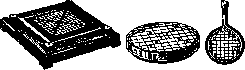
Figure 2.
Figure 3.
Figure 4.
Having counted how many squares fit along the diameter of the dish, one can calculate using the formula πR2 (π = 3.14) how many squares fit on the entire dish. Next, the number of colonies in 10-20 squares is counted, and the number of colonies per square is found. By multiplying the number of colonies in one square by the total number of squares in the dish, the number of colonies in the entire dish is found. In addition to the described apparatuses for counting colonies, Lindemann dishes (Fig. 3) and flat Schumburg flasks (Fig. 4) with marked graduations are also used. To determine the number of colonies per unit volume, a strictly measured amount of material (water, milk, microbial culture) should be transferred to a Petri dish and, after pouring in liquefied medium, thoroughly mixed, cooled, and left in an incubator for 48 hours or more. From each sample of the material under investigation, different amounts are inoculated: 1.0-0.5-0.25-0.1 cm3. If the material contains a large number of microbes, it is diluted 10-100-1,000 times before inoculation, and then the number of colonies counted on the entire dish is multiplied by the corresponding dilution. Even with careful counting, the method has an error of 30-40%.
Related articles
Cite this page
“Lafar Plate.” Soviet Medical Encyclopedia. English translation of Bolshaya Meditsinskaya Entsiklopediya, 1st ed. (Moscow, 1928–1936), ed. N. A. Semashko. https://sovietmedicalencyclopedia.pages.dev/article/lafar-plate/