Control of Bacterial Preparations
Historical document, translated for reference. It reflects medical knowledge of the 1920s–30s and is not medical advice.
Summary
An overview of the state control system for vaccines, therapeutic serums, and other bacterial preparations in the USSR during the 1920s and 1930s, detailing the historical establishment of the Tarasevich Institute and the laboratory methods used for testing sterility, purity, and microbial concentration.
Encyclopedia article (1928–1936)
CONTROL OF BACTERIAL PREPARATIONS (vaccines) as state control of vaccines and therapeutic serums was introduced in the RSFSR in 1919 and concentrated in Moscow at the Tarasevich Institute of Experimental Therapy and Control of Serums and Vaccines. All vaccines, therapeutic serums, and other bacterial preparations (smallpox detritus, anatoxins, testicular fluid, etc.) used on humans as therapeutic or prophylactic agents are preliminarily controlled at this institute. A preparation recognized as fit receives a control number and is only then permitted for circulation and use. The control institute also serves certain other republics of the USSR (Byelorussia, partly Ukraine, Azerbaijan, etc.). The idea of the necessity of a single state control of bacterial preparations (following the example of Germany) was expressed by Lev Tarasevich even before the imperialist war. During the war, the introduction of compulsory prophylactic vaccinations in the army brought the issue of control to the fore; three so-called control stations of the Zemsky Union were organized in Moscow, Kyiv, and Smolensk, which partially carried out this control. With the abolition of the Zemsky Union in 1918, these functions temporarily passed to the control station at the Microbiological Institute of the Society of Moscow Scientific Institutes. In 1919, on the initiative of Lev Tarasevich and under his administration, it was transformed into the Institute of Control of Serums and Vaccines of the People's Commissariat of Health. As the attached curves (Figures 1-3) show, the number of preparations passing through the institute is gradually growing. The drop in the number of preparations in 1923-1924 is explained by the fact that a decrease in intestinal diseases began in 1923; subsequently, the production functions of the institutes increased for all types of bacterial preparations. In the RSFSR, the German system of control of serums and vaccines was adopted in general terms. In France, almost all bacterial preparations without exception are produced at the Pasteur Institute; the control of these preparations is also concentrated there. In Germany, where bacterial preparations are manufactured mainly in private enterprises, state control has a particularly stringent character. All bottles of finished bacterial preparations are sealed by state controller officials and remain in this form until a control number is received from the State Institute of Experimental Therapy in Frankfurt am Main; only after this are they permitted into circulation.
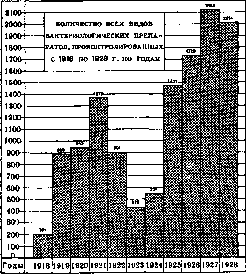
Figure 1. [...] Figure 2. Number of vaccine series controlled from 1918 to 1928 by years. [...] Figure 3. Number of serum series controlled from 1918 to 1928 by years. [...] concentrated and the control of these preparations. [...] The control of vaccines in the USSR consists of checking sterility by seeding the vaccine onto nutrient media, testing the purity of the taken strains (microscopic examination of smears), and determining the number of microbial bodies in 1 cm3 of the vaccine; sometimes the determination of its antigenic properties is also performed. Methods for determining the number of microbial bodies in an emulsion: 1) direct count of bacterial bodies, 2) count of live germs, 3) determination of the turbidity degree of the emulsion, 4) weighing the bacterial mass, and 5) determination of the sediment volume upon centrifugation. The direct count of bacterial bodies is most often performed by counting in a Thoma-Zeiss counting chamber or in some other chamber. Counting is performed with the highest dry system, sometimes after preliminary staining of microbes, with calculation according to the formula: x = (n · t · 250,000) / q, where x is the number of bacteria in 1 cm3, n is the number of counted bacteria, t is the multiplicity of dilutions, and q is the number of counted large squares. Counting can also be performed according to Wright's method: blood, a 1.5% sodium citrate solution, and the bacterial emulsion are successively drawn up to the mark into a pipette with a long drawn-out capillary (separating them with an air bubble). Everything is mixed in a glass slide well; a smear is made from a droplet of the mixture, fixed, stained with Manson's stain, and the number of erythrocytes and the number of bacteria are counted in several fields of view, and...
250 000 [...]
o . 5 000 000 000 calculation is made according to the formula x =------^-- where x = number of bacteria in 1 cm3, o = number of counted bacteria, and k = number of counted erythrocytes. There are a number of modifications of Wright's original method. Less common are the method of counting stained microbes on a coverslip (Klein's method, Maslakovets), counting a mixture of brewer's yeast and bacteria, and a number of others. All the above-mentioned methods determine microbes in a concentration from 100,000 to 1,000,000 in 1 cm3; the figures obtained are not entirely exact, with greater or lesser approximation. Determination of bacteria in an emulsion by the method of plating in an agar plate and counting live germs is used in the preparation of a vaccine, before killing the microbes. A series of dilutions is made from the main emulsion; 1 cm3 of each dilution is mixed with molten and cooled agar, the mixture is poured into a Petri dish, which is placed upside down for a day or two in an incubator at 37°. The number of grown colonies (corresponding to the number of living microbes) is determined using a magnifying glass, for which purpose there are various counting chambers with magnifiers. Determination of the number of bacteria by comparing the degree of turbidity of a bacterial emulsion with a 70% defined standard (the degree of turbidity is determined by translucency) is used most often due to the simplicity and speed of the method, although it possesses only approximate accuracy. The standard can be either a bacterial emulsion calculated by one of the methods set forth above, or other substances, e.g., suspensions of insoluble salts (barium sulfate), lecithin emulsion, etc. There are special devices, such as the Kleinman nephelometer, the Dold turbidocolorimeter (DoId), and others. Determination of the number of bacteria by weighing the bacterial mass is an inaccurate method, since the results vary depending on the moisture of the mass. It is also possible to determine the number of bacteria in an emulsion by the volume of sediment obtained by centrifugation; the latter is carried out in special centrifuges with a drawn-out capillary bearing graduation marks. To determine antigenic properties, the vaccine is administered repeatedly (2-4 times under the skin or into a vein) to several rabbits; after 10-20 days, blood is taken from the animals and the amount of agglutinins and complement-fixing substances is determined in it. Control of Sera. Therapeutic sera must meet the following requirements: the serum must be transparent and free from coarse sediments; it must be sterile, i.e., contain no living microorganisms; harmless to animals; as preservatives, only phenol in an amount of not more than 0.5%, chloroform (1%), or tricresol (0.4%) may be used; the protein content in the serum must not exceed 12%; the serum must comply with the established standard. The serum received for control is subjected to macroscopic inspection to determine its transparency and the presence of sediments. Then, seeding is done on ordinary broth, slant agar, and straight sugar agar to check for sterility. To test for harmlessness, the serum is injected subcutaneously into a guinea pig in a dose of 8-10 cm3 and a mouse (0.5 cm3). The absence of disease in these animals excludes the presence of anaerobic microbes (Bac. tetani, causative agents of gas gangrene) and their toxins in the serum, as well as an excess of phenol (excess phenol causes mouse poisoning, expressed by body tremors). If by the 6th day the animals remain completely healthy, the serum is fit for use (if of course it meets other requirements). In some cases (concentrated sera), the serum is tested for the amount of protein contained in it, which should not exceed 12%, since with a high protein content, serum phenomena are intensified. In addition to testing for sterility and harmlessness, sera are standardized, i.e., tested for their specific potency. According to the method of obtaining therapeutic sera and the nature of their action, 2 types of sera are distinguished: antitoxic and antibacterial (bactericidal). The tests for the potency of antitoxic and antibacterial sera differ significantly from each other. The basis for determining the potency of antitoxic serum (standardization) is the neutralization of toxin by antitoxin. The basis for determining the potency of antibacterial sera is the determination of the amount of bacterial antibodies (bacteriolysins, agglutinins, complement-fixing bodies, etc.). In general, it can be said that the methodology for determining the potency of antibacterial sera is significantly less accurate than the methodology for standardizing antitoxic sera. Antitoxic sera include antidiphtheria, antitetanus, antidysentery, partly antiscarlet fever, and antigangrene sera. The last two, however, are often mixed, i.e., simultaneously antitoxic and antibacterial. Standardization of antidiphtheria serum is carried out in Europe and America according to Ehrlich's method on guinea pigs. To carry out the control, a standard serum is required, a control toxin with a precisely established dose according to the standard serum, physiological NaCl solution for dilutions, a series of pipettes graduated in hundredths of a cm3, a number of vials, 1 and 5 cm3 syringes, guinea pigs weighing 250-300 g, and the serum whose potency, indicated on the label, is to be checked. The dose of toxin for the experiment (Prüfungsdosis) is established using the standard serum, which is diluted with physiological solution so that 1 cm3 of the dilution contains 1 unit of antitoxin (AE according to Ehrlich). First, it is necessary to determine the dose of toxin that is precisely neutralized by the immune unit (AE), i.e., from the subcutaneous administration of which together with the AE, a guinea pig weighing 250-300 g not only does not die (L0-Limes Null), but even at the site of subcutaneous injection, not the slightest infiltrate is detected and the weight of the pig does not drop. Next, the dose of toxin is established (Lt-Limes mors, death), i.e., the amount of toxin which, in combination with AE, contains just enough free toxin to kill a guinea pig weighing 250-300 g within 4-5 days. This dose must be used when titrating the test antidiphtheria serum. The latter is diluted so that in a certain amount of liquid (for uniformity of results, 4 cm3 is accepted) 1 antitoxic unit (AE) is contained. For example, if the serum contains 300 AE in 1 cm3, then it is diluted 300 x 4 = 1,200 times. Such a dilution contains one AE in 4 cm3. To avoid large volumes of liquid, double dilution is used: 99 cm3 of physiological solution and 1 cm3 of serum are poured into the 1st vial; 1 cm3 from this dilution is transferred to the 2nd vial with 12 cm3 (in our case) of physiological solution, and the desired dilution of the serum 1,200 times is obtained. If 4 cm3 are taken from the 2nd dilution, then they will contain 1 AE. To this amount of liquid, using an accurate pipette, the dose of toxin established by the standard serum is added, and after thorough mixing, the mixture is left for 15-30 minutes at room temperature t° and then injected under the skin of the abdomen of a guinea pig weighing 250-300 g. That serum is considered satisfactory, the mixture of which with the toxin does not kill the guinea pig; infiltrates and cachexia are not taken into account. In reality, however, in accordance with what was said earlier, that serum already contains the assumed number of units, from the mixture of which with the toxin a guinea pig weighing 250 g dies on the 4-5th day. Thus, upon survival, a certain excess of antitoxin is obtained (about 10%), which goes to cover the loss of antitoxins during storage and shipment. According to the regulations adopted in the USSR, 1 cm3 of diphtheria serum must contain at least 300 antitoxic units. Sera must be sent for control no earlier than 4 months from the moment of their preparation, when they become stable in their potency. The check of the potency of diphtheria sera can also be carried out according to Römer's method: 0.1 cm3 of a mixture of diphtheria serum, diluted depending on the indicated potency, and control toxin is injected intradermally into a guinea pig. The mixture, after standing for 15-20 minutes, is injected intracutaneously. The appearance within 4-5 days at the injection site of an infiltrate or necrosis suggests that the test serum is weaker than the indicated potency; otherwise, the puncture site is absolutely smooth. According to Römer's method, on a pig weighing 350-400 g, one can control 4 different batches of diphtheria serum, which is a great convenience with a limited number of animals. The newest method for determining the potency of antidiphtheria serum is the flocculation reaction according to Ramon. According to this method, 20 cm3 of control toxin are poured into a series of test tubes, the test serum is added in decreasing amounts (1.5-0.4), and shaken. After several hours of staying at room temperature t°, the formation of flakes can be noted. First of all, flakes precipitate in that test tube where the mixture of toxin and antitoxin is precisely neutralized.
It is by this test tube that the determination of the serum's potency is carried out. In addition, the titration of antidiphtheritic serum is carried out by the so-called ring-precipitation method (Gen, Tsyp, and Chertkov), which is also based on the principle of flocculation. Standardization of antitetanus serum. In the USSR, the determination of the potency of antitetanus serum is carried out according to the American method of Rosenau and Anderson (Rosenau, Anderson). The principle of this method is completely the same as that for the titration of antidiphtheritic serum. The antitoxin unit (AU) is defined as 10 times the minimum amount of serum that protects a 350 g guinea pig for 4 days from the test dose of standard tetanus toxin (a dry tetanus toxin distinguished by high stability). The test dose of toxin contains somewhat less than 100 minimum lethal doses. A mixture of 1/10 of an antitoxic unit with 100 lethal doses contains just enough free toxin to kill a guinea pig on the 4th day (Lt). The potency of the serum under test is measured by the toxin, using its Lt. The test serum is diluted so that 1 cm3 of it contains 1/10 AU; for example, if the serum contains 150 units of antitoxin, it must be diluted 1,500 times. 1 cm3 of this dilution is mixed with 1 cm3 of toxin diluted in such a way that it contains Lt, made up to 4 cm3 with physiological saline, and after standing for one hour at room t°, is injected into the skin of the abdomen of a guinea pig. Within 4 days, the guinea pig must remain alive.--Titration according to the German method is based on the principle of neutralization of 1/1000 AU by increasing doses of toxin. The test is carried out on mice. For control, 2 series of 8 mixtures are prepared. The test tubes of the first series contain 1 cm3 of diluted standard serum (1 cm3 = 0.01 antitoxic unit), and the second series contains dilutions of the test serum made according to the number of AUs per 1 cm3 of serum indicated on the label. Control toxin in increasing doses from 0.08 to 0.15 is added to each test tube of both series, made up to 4 cm3 with physiological saline, and 0.4 cm3 of this mixture is injected into the skin of the thigh of two series of mice (weighing 15 g each, 16 mice in total), such that each mouse receives 1/1000 AU and increasing doses of toxin. Observation is carried out for 5 days. If the controlled serum has the potency indicated on the label, all phenomena in the animals proceed in parallel in both series; otherwise, from the mismatch of results (rapid death of the mice) with the standard serum, it is calculated how much weaker the test serum turned out to be. Tetanus serum, just like diphtheria serum, is sent for control only 4 months after manufacture. The ratio between the American and German units is approximately as follows. If the value of the German unit is taken as 1, the American unit will correspond to 60-66 units. The potency of tetanus serum manufactured in the USSR fluctuates between 100 and 600 units in 1 cm3.--Standardization of antidysenteric serum. In 1926, the Hygiene Section of the League of Nations adopted the international method for standardizing serum. By resolution of this section, the Copenhagen Sanitary-Hygienic Institute regularly distributes to all central institutes a standard antitoxic serum containing 200 antitoxic units in 1 cm3. Dry dysenteric toxin, which represents dried microbial bodies, is titrated against the standard serum. The maximum amount of toxin, when combined with an antitoxic unit, neutralized to such an extent that the majority of 6 mice remain alive by the 8th day, is the dose of toxin used to test the serum. This dose, mixed with decreasing doses of the test serum, is left for 3/4 of an hour in a thermostat at 37° and then injected in a volume of 0.5 cm3 into the tail vein of a white mouse weighing 14-18 g. The minimum amount of serum that protects mice from death for 7 days contains one unit of antitoxin. Serums containing not less than 300 AU in 1 cm3 are released into circulation. Control of anti-scarlet fever serum. Modern anti-scarlet fever serums are usually antitoxic, although serums of a mixed type are sometimes prepared. There is as yet no generally accepted control method. The following methods are used: 1. The rash-blanching method of Schultze-Charlton. At the height of the eruption, the test therapeutic serum in various dilutions in a volume of 0.1 cm3 is injected into the thickness of the skin of a scarlet fever patient. The limiting dilution of the serum causing the phenomenon of rash "blanching" (skin pallor in the corresponding area) is the titer of the given serum.--2. The American method on goats, proposed by Wadsworth, Kirkbride, and Wheeler and developed by S. V. Korshun and V. A. Krestovnikova. The skin of a special breed of goats (in the USSR, the Saanen and Yaroslavl breeds proved most suitable) is a sensitive organ with respect to "scarlet fever" toxin (toxin obtained by growing under certain conditions hemolytic streptococcus isolated from scarlet fever patients). When such a sensitive goat's skin is injected with "scarlet fever" toxin in a definite dose (3 human skin doses), redness appearing an area of 1.5-2 cm in diameter forms at the injection site after a day. When antitoxic scarlet fever serum is mixed with the "scarlet fever" toxin, the latter is neutralized, and upon injection into the goat's skin, the reaction is absent. The minimum amount of serum neutralizing 100 goat skin doses of toxin is called an antitoxic unit. For serum titration, the "scarlet fever" toxin is diluted so that 100 goat skin doses are contained in 0.05 cm3; various dilutions of the test serum, also in a volume of 0.05 cm3, are mixed with 100 goat skin doses and, after a 3/4-hour stay in a thermostat in a volume of 0.1 cm3, are injected into the skin of the goat. The minimum amount of serum neutralizing 100 goat skin doses is the titer of the given serum, i.e., it indicates the number of antitoxic units in 1 cm3 of serum. Therapeutic serum must contain not less than 200 antitoxic units in 1 cm3. The method has not become widespread in view of the difficulty of finding goats sensitive to the "scarlet fever" toxin.--3. The American method of Dick. The testing of serum potency is carried out by skin reaction on a human sensitive to the "scarlet fever" toxin. The Washington Federal Laboratory has now prepared a standard serum containing 40 antitoxic units in 1 cm3. The antitoxic scarlet fever unit according to this method neutralizes 50 skin doses. Usually, American serum is prepared 10-15 times stronger.--4. The in vitro flocculation method has given good results in the hands of some authors (Ramon, Khalyapina), but is insufficiently developed. The English method (O'Brien, Okell, Parish) on rabbits is also insufficiently developed. The abundance of applied methods indicates that all of them are still far from perfection. According to the principle of antibacterial serums, anti-meningococcal, anti-streptococcal, anti-pneumococcal, anti-anthrax, and other serums are also prepared and titrated.--Anti-meningococcal serum is usually titrated by the agglutination method (in France), the complement fixation method, or the method based on bacteriotropism (in Germany, Neufeld).--Anti-streptococcal and anti-pneumococcal serums are titrated on mice by injecting them subcutaneously with a lethal dose of streptococcus or pneumococcus followed by or preceded by the injection of various doses of the corresponding serum.--Anti-anthrax serum. There are several methods for determining the potency of this serum (Ascoli on guinea pigs, Mendez, Sobernheim on rabbits). The most widespread and accepted method in the USSR is the Sobernheim method, which consists of the following: 5 rabbits are injected intravenously with the test serum in various volumes: one with 1 cm3, another with 2 cm3, a third with 3 cm3, a fourth with 4 cm3, and a fifth with 5 cm3, and 5-10 minutes later they are injected subcutaneously with 10 lethal doses of a live anthrax culture. Control animals receive only the anthrax culture. If within a week more than half of the experimental animals remain alive, the serum is considered active and is admitted into circulation.--Anti-gangrene serums are prepared against a whole series of microbes, namely: Bacillus perfringens, Vibrio septicus, Bacillus oedematicus, Bacillus sporogenes, Bacillus histolyticus (French terminology). They are prepared and titrated predominantly according to the type of antitoxic serums.
Related articles
Mentioned in
Cite this page
“Control of Bacterial Preparations.” Soviet Medical Encyclopedia. English translation of Bolshaya Meditsinskaya Entsiklopediya, 1st ed. (Moscow, 1928–1936), ed. N. A. Semashko. https://sovietmedicalencyclopedia.pages.dev/article/control-of-bacterial-preparations/